 Spanish
Here are the phrases you need on shift right now. Tape this to your station, screenshot it, or read it once before you clock in.
Your 12 ready-to-say phrases:
- Greeting: Buenos días / Buenas tardes / Buenas noches (BOO-eh-nos DEE-as / BWEH-nas TAR-des / BWEH-nas NO-ches) — Good morning / afternoon / evening
- Welcome: Bienvenido/a (bee-en-veh-NEE-doh) — Welcome
- Offer help: ¿En qué puedo ayudarle? (en KEH PWEH-doh ah-yoo-DAR-leh) — How may I help you?
- Reservation check: ¿Tiene una reservación? (TYEH-neh OO-nah reh-ser-vah-SYON) — Do you have a reservation?
- Room request: ¿Qué tipo de habitación prefiere? (KEH TEE-poh deh ah-bee-tah-SYON preh-FYEH-reh) — What type of room do you prefer?
- Taking an order: ¿Qué desea tomar? (KEH deh-SEH-ah toh-MAR) — What would you like to have?
- Allergy check: ¿Tiene alguna alergia? (TYEH-neh al-GOO-nah ah-LEHR-hyah) — Do you have any allergies?
- Apology: Lo siento mucho, lo soluciono enseguida. (loh SYEN-toh MOO-choh) — I’m very sorry, I’ll fix it right away.
- Check-out: ¿A qué hora desea hacer el check-out? — What time would you like to check out?
- Directions: Está a la derecha / izquierda. (es-TAH ah lah deh-REH-chah / ees-KYEHR-dah) — It’s to the right / left.
- Emergency: ¡Llame al médico! / ¡Necesito ayuda! (YAH-meh al MEH-dee-koh / neh-seh-SEE-toh ah-YOO-dah) — Call a doctor! / I need help!
- Thank you: Muchas gracias. Que disfrute su estancia. (MOO-chas GRA-syas) — Thank you. Enjoy your stay.
Usted vs. tú: Always use usted with guests you don’t know. It’s the formal “you” and signals respect. Switch to tú only if a guest explicitly invites it.
30-second on-shift drill: Pick three phrases from the list. Say each one aloud twice, then use it the next time a guest interaction fits. That’s it. Repetition in context beats memorizing a full list once.
Key Takeaways
Spanish for hospitality comes down to a short set of high-frequency phrases, practiced by role, used daily on shift, and reinforced through structured instruction when staff are ready to move beyond the basics.
| Point | Details |
|---|---|
| Start with 12 core phrases | Greetings, check-in, orders, apologies, and emergencies cover the majority of guest interactions. |
| Always use usted with guests | Formal address is the safe default across all Spanish-speaking regions until a guest invites otherwise. |
| Role-based vocabulary is fastest | Front desk, housekeeping, and F&B teams each need a different word set — train by function, not by level. |
| Drills beat memorization | 60–90 second role-play scripts improve retention faster than studying vocabulary lists alone. |
| Spanish Explorer for structured training | Private lessons and corporate programs at Spanish Explorer let teams move from phrases to full conversations in 4–8 weeks. |
Table of Contents
- Spanish for hospitality: essential greetings and introductions
- How to handle reservations, check-in, and check-out in Spanish
- Taking orders and serving guests in Spanish
- How to handle guest requests and complaints in Spanish
- How to give directions and explain amenities in Spanish
- Role-specific vocabulary every hospitality team member needs
- Pronunciation and politeness tips that actually make a difference
- Practice dialogues and micro-exercises for team huddles
- How to keep learning and build real conversational confidence
- What actually works on a real shift
- Spanish Explorer makes the path from phrasebook to fluency practical
- Sources
- FAQ
Spanish for hospitality: essential greetings and introductions
The single best opening line for any front-desk or F&B staff member is Buenos días / Buenas tardes / Buenas noches, bienvenido/a y ¿En qué puedo ayudarle?. It covers the greeting, the welcome, and the offer of help in one breath. Use bienvenido for a male guest and bienvenida for a female guest.
According to don Quijote’s hospitality guide, using usted consistently for guests you don’t know is the safest politeness strategy across virtually all Spanish-speaking regions. It avoids unintentional familiarity, which can read as disrespectful in many Latin American and Spanish cultures.
| Situation | Formal (usted) | Informal (tú) | When to use |
|---|---|---|---|
| First guest contact | ¿En qué puedo ayudarle? | ¿Cómo puedo ayudarte? | Always start formal |
| Welcome | Bienvenido/a, señor/señora | Hola, ¿cómo estás? | Formal for new guests |
| Asking name | ¿Me puede dar su nombre? | ¿Cómo te llamas? | Formal at front desk |
| Offering a seat | Por favor, tome asiento. | Siéntate, por favor. | Formal in restaurant |
| Saying goodbye | Hasta luego, que tenga un buen día. | ¡Hasta luego! | Formal at check-out |
Sample greeting dialogue:
Small talk that works well: ¿Cómo estuvo su viaje? (How was your trip?) and ¿Es su primera visita aquí? (Is this your first visit here?) are low-risk, friendly openers that guests appreciate.
How to handle reservations, check-in, and check-out in Spanish
Front-desk staff need a handful of reliable lines, not a full vocabulary course. SpanishDict’s hotel vocabulary guide organizes the core check-in and check-out phrases clearly, and the ones below are the most practical for daily use.
Key phrases for reservations and check-in:
- ¿A nombre de quién está la reservación? — What name is the reservation under?
- ¿Cuáles son las fechas de llegada y salida? — What are your arrival and departure dates?
- El check-in es a las tres de la tarde. — Check-in is at 3:00 PM.
- El check-out es a las doce del mediodía. — Check-out is at noon.
- ¿Cómo desea pagar? — How would you like to pay?
- ¿El desayuno está incluido? — Is breakfast included?
- Tenemos estacionamiento disponible. — We have parking available.
- El Wi-Fi es gratuito en todo el hotel. — Wi-Fi is free throughout the hotel.
Step-by-step check-in script:
- Buenos días, bienvenido/a. ¿Tiene una reservación? — Good morning, welcome. Do you have a reservation?
- ¿Me puede dar su nombre completo, por favor? — May I have your full name, please?
- Aquí tiene su llave. Su habitación es el número… — Here is your key. Your room number is…
- El desayuno se sirve de siete a diez de la mañana en el restaurante del primer piso. — Breakfast is served from 7 to 10 AM in the first-floor restaurant.
- Si necesita algo, llame a recepción. Que disfrute su estancia. — If you need anything, call reception. Enjoy your stay.
For check-out: ¿Desea revisar su cuenta antes de pagar? (Would you like to review your bill before paying?) prevents billing disputes before they start.
Taking orders and serving guests in Spanish
The two phrases every F&B and room-service staff member should know cold are ¿Qué desea tomar? (What would you like to have?) and ¿Tiene alguna alergia alimentaria? (Do you have any food allergies?). Those two lines alone cover the start of almost every table interaction.
Dish descriptor checklist — words staff use to explain menu items:
| Spanish | English | Example use |
|---|---|---|
| asado/a | grilled / roasted | El pollo está asado. |
| frito/a | fried | Las papas son fritas. |
| al vapor | steamed | El pescado es al vapor. |
| picante | spicy | Este plato es picante. |
| sin gluten | gluten-free | Tenemos opciones sin gluten. |
| vegetariano/a | vegetarian | Este plato es vegetariano. |
| la porción | the portion / serving | ¿Desea una porción grande? |
When a guest reports an allergy, the escalation phrase is: Voy a informar al chef inmediatamente. (I’m going to inform the chef immediately.) Never guess on allergens. Confirm with the kitchen and return with a clear answer.
For upselling without pressure: ¿Le gustaría agregar una copa de vino? (Would you like to add a glass of wine?) works because it’s a simple yes/no question, not a pitch.
How to handle guest requests and complaints in Spanish
The first thing to say when a guest reports a problem is: Lo siento mucho. Lo soluciono enseguida. (I’m very sorry. I’ll fix it right away.) Say it calmly, say it immediately, and mean it. That single sentence de-escalates most situations before they escalate further.
Scripts for common issues:
- Housekeeping complaint: Disculpe las molestias. Envío al personal de limpieza ahora mismo. — I apologize for the inconvenience. I’m sending housekeeping right now.
- Billing dispute: Permítame revisar su cuenta. Un momento, por favor. — Let me review your account. One moment, please.
- Late arrival / room not ready: Su habitación estará lista en aproximadamente veinte minutos. — Your room will be ready in approximately twenty minutes.
- Escalation to manager: Voy a llamar a mi supervisor para ayudarle mejor. — I’m going to call my supervisor to assist you better.
- Timeframe phrase: Lo soluciono en diez minutos. — I’ll resolve it in ten minutes.
Pro Tip: In Spanish-speaking cultures, tone carries as much weight as the words themselves. Lowering your voice slightly and slowing your pace signals calm and control. The phrase “con mucho gusto” (with great pleasure) added to any offer — “Con mucho gusto le ayudo” — shifts the interaction from transactional to genuinely warm, which guests notice immediately.
Avoid the phrase no es mi culpa (it’s not my fault) in any form. Even when it’s true, it reads as dismissive. Own the fix, not the blame.
How to give directions and explain amenities in Spanish
The fastest way to give directions is to combine a location word with a distance cue: Está a la derecha, a dos minutos a pie. (It’s to the right, two minutes on foot.) Guests process that faster than a full sentence.
For local recommendations: Le recomiendo el restaurante en la calle principal, está a cinco minutos en taxi. (I recommend the restaurant on the main street, it’s five minutes by taxi.)
Safety phrase for emergencies: ¿Necesita ayuda? Llamo a emergencias ahora. (Do you need help? I’ll call emergency services now.) Post this one at every station.
Role-specific vocabulary every hospitality team member needs
Don Quijote’s hospitality resource emphasizes role-based vocabulary as the most efficient way to train staff, and the tables below reflect that approach. Each role gets the words it actually uses, not a generic list.
Front desk essentials:
- la reservación — reservation
- el pasaporte — passport
- la tarjeta de crédito — credit card
- la habitación doble / sencilla — double / single room
- el depósito — deposit
- la llave — key
- la factura — invoice / bill
Housekeeping essentials:
- las sábanas — bed sheets
- las toallas — towels
- la almohada — pillow
- limpiar — to clean
- cambiar — to change / replace
- el carro de limpieza — housekeeping cart
- no molestar — do not disturb
Food and beverage essentials:
- el menú — menu
- la cuenta — the bill
- la propina — tip
- la mesa — table
- el pedido — the order
- servir — to serve
- recomendar — to recommend
Bell / valet essentials:
- el equipaje — luggage
- la maleta — suitcase
- el maletero — trunk (of a car)
- estacionar — to park
- el carrito — luggage cart
- subir / bajar — to take up / bring down
Cross-role verbs every team member needs:
- tener (to have) — ¿Tiene una reservación?
- necesitar (to need) — ¿Necesita algo más?
- traer (to bring) — Le traigo su pedido en un momento.
- cambiar (to change) — Puedo cambiar su habitación.
- ayudar (to help) — ¿En qué puedo ayudarle?
Pronunciation and politeness tips that actually make a difference
Three pronunciation rules fix the most common errors immediately:
Spanish vowels are pure and short. The letter a always sounds like “ah,” e like “eh,” i like “ee,” o like “oh,” u like “oo.” They never slide into diphthongs the way English vowels do. Gracias is “GRAH-syahs,” not “GRAY-see-us.”
The ñ is not an n. Señor (sir) is “seh-NYOR,” not “seh-NOR.” Getting this wrong changes the word entirely. Practice it by saying “canyon” and isolating the “ny” sound.
Stress usually falls on the second-to-last syllable. Habitación breaks as “ah-bee-tah-SYON” — the stress is on the last syllable because the written accent mark tells you so. When in doubt, look for the accent mark.
| Common mistake | Correct pronunciation | Quick fix |
|---|---|---|
| “Gra-see-us” | GRA-syahs | One syllable: “syas” |
| “Sen-yor” | seh-NYOR | Add the “y” sound |
| “Res-er-va-SHUN” | reh-ser-vah-SYON | End with “syon” |
| “Boo-en-oh” | BWEH-noh | “Bweh,” not “boo-en” |
Pre-shift drill (60 seconds): Say Buenos días, bienvenido, ¿en qué puedo ayudarle? five times at a normal speaking pace. Then say Lo siento mucho, lo soluciono enseguida five times. That covers your two most-used openings and your recovery phrase.
Pro Tip: Por favor and gracias are non-negotiable in every interaction. Adding por favor to any request softens it immediately, and con mucho gusto (with great pleasure) as a response to thanks sounds far warmer than a plain de nada. U.S. hospitality teams often skip these because English relies more on tone; in Spanish, the words themselves carry the politeness signal.*
Practice dialogues and micro-exercises for team huddles
Phrase lists paired with short role-play drills improve retention faster than grammar-focused lessons for hospitality staff. These two scripts are designed to run in 60–90 seconds each.
Script 1: Front desk check-in
Staff: Buenos días, bienvenido/a. ¿Tiene una reservación?
Guest: Sí, a nombre de Johnson.
Staff: Un momento… Aquí está. Habitación 304. ¿Cómo desea pagar?
Guest: Con tarjeta de crédito.
Staff: Perfecto. Aquí tiene su llave. El desayuno es de siete a diez. ¿Necesita algo más?
Guest: No, gracias.
Staff: Que disfrute su estancia.
Script 2: Restaurant order
Staff: Buenas tardes. ¿Está listo/a para ordenar?
Guest: Sí. ¿Qué recomienda?
Staff: Le recomiendo el pollo asado. ¿Tiene alguna alergia?
Guest: No, ninguna.
Staff: Perfecto. ¿Algo para tomar?
Guest: Un agua, por favor.
Staff: Enseguida.
Micro-exercise list for team practice:
- Shadowing drill: One person reads a line; the partner repeats it immediately with the same rhythm and pace. Switch after five lines.
- Rapid-response drill: A manager calls out a situation in English (“Guest needs directions to the pool”). Staff respond in Spanish within three seconds.
- Substitution drill: Take Script 1 and swap out the room number, payment method, and guest name. Run it three times with different variables.
- Flashcard sprint: Write ten key words on index cards (Spanish on one side, English on the other). Flip through the deck in 90 seconds before a shift.
- Phrase-of-the-day: Manager posts one phrase on the team board each morning. Every staff member uses it at least once during the shift.
3-minute team huddle plan for managers:
- Minute 1: Read the phrase of the day aloud together twice.
- Minute 2: Run a rapid-response drill with three scenarios.
- Minute 3: One volunteer does a 30-second role-play using the previous day’s phrase.
How to keep learning and build real conversational confidence
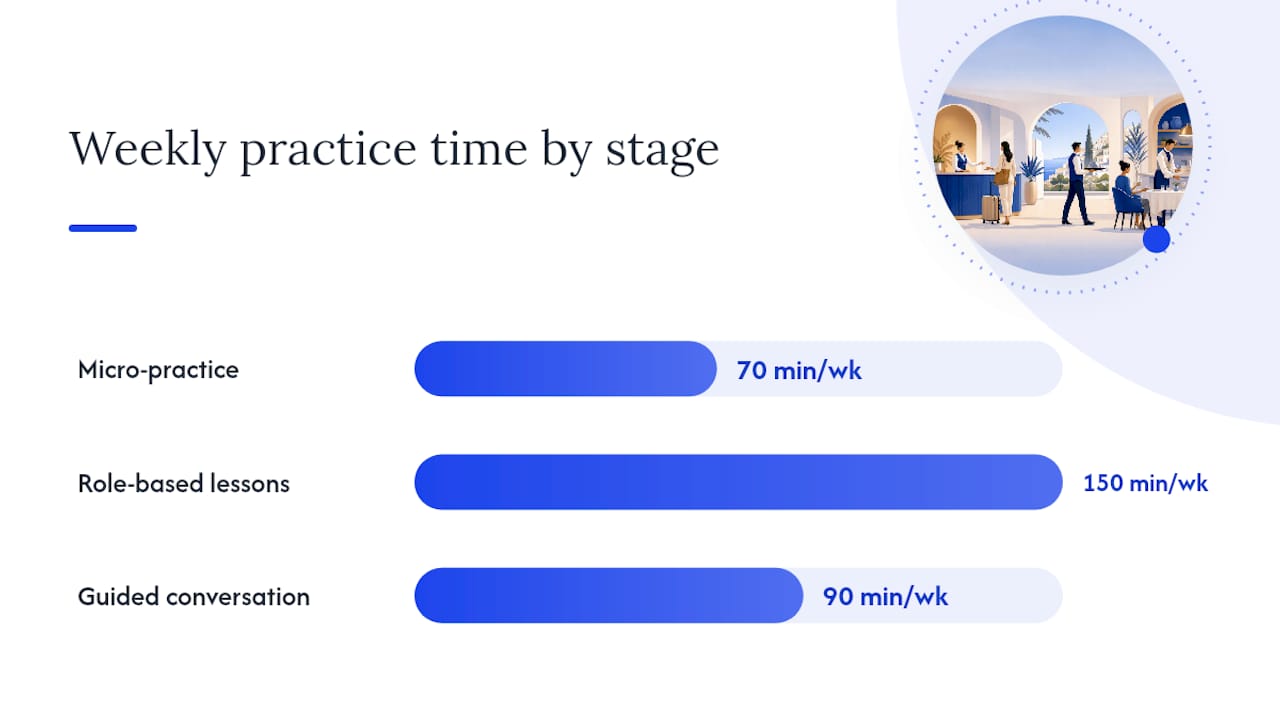
The most efficient progression for hospitality staff runs in three stages: micro-practice first, then targeted role-based lessons, then guided conversation sessions. Skipping straight to conversation before the role vocabulary is solid wastes time.
| Stage | Format | Weekly time | Expected outcome |
|---|---|---|---|
| 1. Micro-practice | Phrase drills, flashcards, shift exercises | 10 minutes/day | Handle basic greetings and check-in within 2 weeks |
| 2. Role-based lessons | Short units by job function | 2–3 hrs/week | Manage full check-in, orders, and complaints within 4 weeks |
| 3. Guided conversation | Private or group sessions with instructor | 1–2 hrs/week | Hold a full guest interaction with confidence within 8 weeks |
Cell-Ed’s Spanish Hotel Professionals Level 1 course structures training exactly this way: short mobile-friendly units covering greetings, job titles, schedules, and phone calls, each designed to fit a busy shift worker’s schedule. The ¡A Viajar! hospitality course model from the University of California takes a similar unit-based approach, framing language learning around real hospitality scenarios rather than grammar rules.
For staff who want to move faster, private lessons tailored to hospitality roles cut the timeline significantly. A focused one-on-one session with an instructor who knows your job context covers more ground in an hour than a week of self-study. For teams, corporate training programs let managers customize the vocabulary and scenarios to match their property’s actual guest interactions.
Pro Tip: Track progress by function, not fluency level. After two weeks, can your staff handle a check-in? After four, can they take a full order and manage an allergy? Concrete functional milestones are more motivating than abstract “beginner / intermediate” labels, and they tell you exactly where to focus next.
What actually works on a real shift
The hardest part of learning Spanish for hospitality isn’t the vocabulary. It’s the moment a guest responds faster than you expected, or uses a regional expression you’ve never heard, and your brain freezes.
The fix that works in practice is a simple one: prepare for the response, not just the question. Most staff practice asking ¿Tiene una reservación? but never practice what to say when the guest says No, pero quisiera una habitación para esta noche. (No, but I’d like a room for tonight.) Running substitution drills with a shift partner, where one person plays the guest and deliberately varies their answer, builds the mental flexibility that phrase memorization alone doesn’t.
One technique worth adopting immediately: keep a small card at your station with your five most-used phrases and their most common guest responses. When you hear a response you don’t recognize, a calm ¿Puede repetirlo más despacio, por favor? (Could you repeat that more slowly, please?) buys you time without embarrassment. Guests appreciate the effort far more than they mind the pause.
Spanish Explorer makes the path from phrasebook to fluency practical
Knowing the phrases is a start. Using them confidently under pressure, with a real guest, in real time, is a different skill. That’s where structured instruction makes the difference between a staff member who can read a cheat sheet and one who can actually hold a conversation.
Spanish Explorer offers adult group classes, private lessons, and corporate training programs designed for exactly this kind of professional application. Lessons are taught by certified native Spanish-speaking instructors who are fluent in English, so explanations are clear and the learning curve is shorter. The online Zoom format means your team can train without leaving the property. For managers who want to build a Spanish-ready team fast, the corporate training option lets you customize the curriculum around your property’s specific roles and guest interactions.
A staff member starting from zero can handle a full check-in confidently within four weeks of focused role-based lessons. Browse the available Spanish courses or reach out directly to discuss a format that fits your team’s schedule.
Sources
The phrase lists, dialogues, and training recommendations in this guide draw from the following references.
- Hotel vocabulary in Spanish | SpanishDict
- Spanish for hospitality | don Quijote
- ¡A Viajar!: Spanish 3 for Hospitality
FAQ
What are some Spanish words related to hospitality?
Core hospitality vocabulary in Spanish includes la recepción (front desk), la habitación (room), la reservación (reservation), el desayuno (breakfast), la cuenta (the bill), and el equipaje (luggage). SpanishDict’s hotel vocabulary guide organizes these by category for quick reference.
How do you say “hospitality industry” in Spanish?
The standard term is la industria hotelera (the hotel industry) or el sector de la hospitalidad (the hospitality sector). In everyday professional use, hotelería y turismo (hotel and tourism) is the most common pairing.
What is the most important phrase for hospitality staff to learn first?
¿En qué puedo ayudarle? (How may I help you?) is the single most useful phrase because it opens every guest interaction and signals formal, respectful service from the first word.
How long does it take to learn enough Spanish for a hotel job?
A staff member can handle basic check-ins and greetings within two weeks of daily phrase drills. Reaching the level needed for full guest conversations, including complaints and recommendations, typically takes 4–8 weeks of role-based lessons with a qualified instructor.
Should hospitality staff use usted or tú with Spanish-speaking guests?
Always start with usted. It’s the formal “you” and is universally understood as respectful across Latin America and Spain. Switch to tú only if the guest explicitly invites it, which is rare in a professional hospitality setting.
Recommended
Start Learning Spanish Today
Book a trial class and see how quickly you can progress with a professionally trained native-speaker teacher guiding the way.
Book a Trial Class