 Spanish
The Spanish word for “logistics” is “la logística,” and its adjective form is “logístico” or “logística” depending on gender agreement. You will hear it constantly in shipping and supply-chain conversations, almost always singular even when discussing multiple operations. The sections below cover the specific vocabulary, phrases, and grammar rules that turn that one word into working professional Spanish.
TL;DR:
- Cargo and shipment terms like “la carga” and “el envío” are used universally, but precise vocabulary varies by transport mode, affecting documentation.
- Proper pronunciation of “almacén” and “mercancía” is essential for comprehension, while gender agreement in nouns like “la mercancía” remains strict in writing.
- Common phrases for tracking, scheduling, and confirming shipments should be practiced with role-plays to ensure real-time fluency and accuracy.
- Abbreviations such as B/L, FTL, LTL, and CIF are frequently used and should be spelled out when uncertain to prevent communication errors.
- Active verbs like “despachar,” “recibir,” and “rastrea” are key for maintaining clear, functional logistics conversations in Spanish.
Table of Contents
- Spanish for Logistics: Core Vocabulary You’ll Use Daily
- Sea, Air, and Road: How Terms Change by Transport Mode
- Reading the Paperwork: Documentation Vocabulary in Spanish
- Phrases for Shipment Status, Scheduling, and Delivery
- Grammar Notes That Prevent Costly Misunderstandings
- Memorization Methods That Actually Stick
- Common Abbreviations and Acronyms in Spanish Logistics
- Verbs and Action Phrases for Daily Logistics Operations
- Working With Spanish-Speaking Logistics Partners
- What Twenty Years in Language Classrooms Teaches You About Industry Vocabulary
- Build on This Vocabulary With Structured Business Spanish Training
- Where This Vocabulary Comes From
- Sources
- FAQ
Spanish for Logistics: Core Vocabulary You’ll Use Daily
Every logistics conversation in Spanish leans on a small set of nouns and verbs. Learn these first, because they show up in emails, phone calls, and warehouse floors alike.
- el almacén (warehouse, plural: los almacenes) — “El almacén está cerrado los domingos.” (The warehouse is closed on Sundays.)
- la carga (cargo/load) — “La carga Lego dañada.” (The cargo arrived damaged.)
- el flete (freight) — “¿Cuánto cuesta el flete a Barcelona?” (How much does freight to Barcelona cost?)
- el envío (shipment) — “El envío salió esta mañana.” (The shipment left this morning.)
- el transportista (carrier) — “El transportista confirmó la ruta.” (The carrier confirmed the route.)
- la mercancía (goods/merchandise, often plural: las mercancías) — “Las mercancías pasaron la inspección.” (The goods passed inspection.)
- despachar (to dispatch) — “Vamos a despachar el pedido hoy.” (We’re dispatching the order today.)
- recibir (to receive) — “¿Cuándo van a recibir la carga?” (When will you receive the cargo?)
- el pedido (order) — “El pedido está listo para envío.”
- la ruta (route) — “Cambiamos la ruta por el clima.”
- el proveedor (supplier) — stressed on the second syllable: pro veedor.
- la cadena de suministro (supply chain) — the phrase you’ll hear in nearly every planning meeting.
Pronunciation trips people up on “almacén” (stress on the last syllable, alma CEN) and “mercancía” (mer can CI a). Get those two right and half your listening comprehension problems disappear. For a broader foundation beyond logistics terms, business Spanish vocabulary fills in the surrounding professional language you’ll need in meetings and emails.
Sea, Air, and Road: How Terms Change by Transport Mode
Logistics vocabulary splits hard by mode, and using the wrong set of terms with a shipping partner signals you don’t know the industry. Handling procedures and document names shift depending on whether cargo moves by sea, air, or road, so grouping vocabulary by mode saves confusion later.
Sea freight (marítimo):
- el contenedor (container)
- el conocimiento de embarque (bill of lading, often shortened to B/L even in Spanish)
- el buque (vessel/ship)
- el puerto de origen / puerto de destino (port of origin / destination)
Air freight (aéreo):
- la guía aérea (air waybill)
- el avión de carga (cargo plane)
- la tarifa aérea (air rate)
Road freight (terrestre):
- el camión (truck)
- carga completa / FTL (full truckload)
- carga consolidada / LTL (less than truckload)
- el conductor (driver)
Sea, air, and road each generate different paperwork, and asking this one question upfront saves a round of confused emails later.*
Reading the Paperwork: Documentation Vocabulary in Spanish
Documents carry the terms that matter most when something goes wrong, so learning to ask for the right one by name saves real time. Industry glossaries like Novocargo’s terminology guide group these terms consistently, which makes them worth bookmarking for reference.
- el conocimiento de embarque (bill of lading, B/L) — the legal contract between shipper and carrier. Ask: “¿Puede enviable el conocimiento de embarque?”
- la factura (invoice) — “Necesito la factura comercial para aduanas.” (I need the commercial invoice for customs.)
- la lista de empaque (packing list) — details what’s inside each box or pallet.
- aduanas (customs) — “El envío está retention en aduanas.” (The shipment is held at customs.)
- el número de seguimiento (tracking number) — “¿Cuál es el número de seguimiento?”
Customs terminology varies somewhat by country, since each government sets its own procedural language. DSV’s glossary is a solid reference when you hit a term specific to one market rather than the general vocabulary above.
Phrases for Shipment Status, Scheduling, and Delivery
Vocabulary lists only get you halfway. You also need ready phrases for the calls and emails that actually move freight. Here are ten you can adapt directly:
- “¿Cuánto cuesta el envío?” (How much does shipping cost?) — a very useful phrase in this language for this job, according to SpanishStep’s phrase guide.
- “¿Cuáles son los gastos de envío?” (What are the shipping charges?) — a more formal alternative for written quotes.
- “¿Cuándo llega el envío?” (When does the shipment arrive?)
- “¿Puede confirmar la fecha de entrega?” (Can you confirm the delivery date?)
- “Necesito programar la recogida para mañana.” (I need to schedule pickup for tomorrow.)
- “El envío está retrasado.” (The shipment is delayed.)
- “¿Podemos reprogramar la entrega?” (Can we reschedule the delivery?)
- “Confirmo recepción de la mercancía.” (Confirming receipt of the goods.)
- Formal email opener: “Estimado/a [nombre], le escribo para confirmar el estado de su pedido.” (Dear [name], I’m writing to confirm the status of your order.)
- Informal phone line: “Hola, llamo para preguntar por el envío número [X].” (Hi, calling to ask about shipment number [X].)
Grammar Notes That Prevent Costly Misunderstandings
Gender mistakes are forgivable in casual Spanish, but in written logistics documentation they read as careless. “La mercancía” is feminine even though it ends in what looks like a neutral sound, and its plural, “las mercancías,” takes the feminine plural article throughout. “El documento” and its plural “los documentos” are masculine and regular.
Watch two verbs that sound similar but mean very different things: embarcar (to load/ship) versus embarazar (to make pregnant). Confusing these in a business email is an easy way to derail a serious conversation. Stress patterns matter too: logística is stressed on the antepenultimate syllable (lo GÍS ti ca), and the ñ in words like “año” or “compañía” (company) requires a distinct nasal sound English speakers often flatten into a plain “n.”
Memorization Methods That Actually Stick
Word lists fade fast without a system behind them. Spaced repetition tools like Anki force you to recall terms right before you’d naturally forget them, which builds far more durable memory than rereading a list. Themed flashcard sets, including public Quizlet decks built around logistics Spanish, give you a ready-made starting deck if you don’t want to build one from scratch.
Cloze-deletion practice, where you delete the key term from a sentence you already know (“El ___ salió esta mañana”), works better than isolated vocabulary because it locks in the phrase, not just the word. Role-play exercises push retention further still: SpanishStep’s research on phrase acquisition found that short, work-like tasks such as translating a packing list or rehearsing a customs clearance call surface real collocations that flashcards alone miss.
- Try a mock call confirming a pickup time.
- Translate a sample packing list end to end.
- Label a warehouse diagram entirely in Spanish.
| Method | Best for | Time investment |
|---|---|---|
| Spaced repetition (Anki) | Long-term vocabulary retention | 10 min daily |
| Cloze-deletion sentences | Phrase and collocation memory | 15 min, multiple times weekly |
| Role-play calls | Real-time speaking confidence | 20 min weekly |
For a structured approach to building vocabulary beyond flashcards, these vocabulary list strategies go into more depth on sequencing and review timing.
Common Abbreviations and Acronyms in Spanish Logistics
Abbreviations move faster than full terms in daily logistics communication, and Spanish borrows many directly from English while inventing a few of its own. 3PL and 4PL (third and fourth-party logistics providers) appear untranslated in most Spanish-language contracts. B/L stands for conocimiento de embarque, used exactly as in English. FTL and LTL (full and less-than truckload) also carry over directly.
Spanish-specific abbreviations you’ll encounter include CIF (Costo, Seguro y Flete, or Cost, Insurance, and Freight), one of the Incoterms used in international shipping contracts. FOB (Free on Board) stays in English letters but is pronounced letter by letter in Spanish, “efe o be.” EDI (Intercambio Electronic de Datos) refers to electronic data interchange between logistics systems. You’ll also see OTM (orden de transporte marítimo) on some sea freight paperwork, though this varies by carrier.
Don’t assume every acronym translates cleanly. Some providers keep the English abbreviation because the underlying term (like “cross-docking”) has no single accepted Spanish equivalent, so it gets described rather than named. When in doubt, ask your Spanish-speaking contact to spell out the acronym once. It takes ten seconds and prevents weeks of miscommunication over a term you assumed meant something else.
Verbs and Action Phrases for Daily Logistics Operations
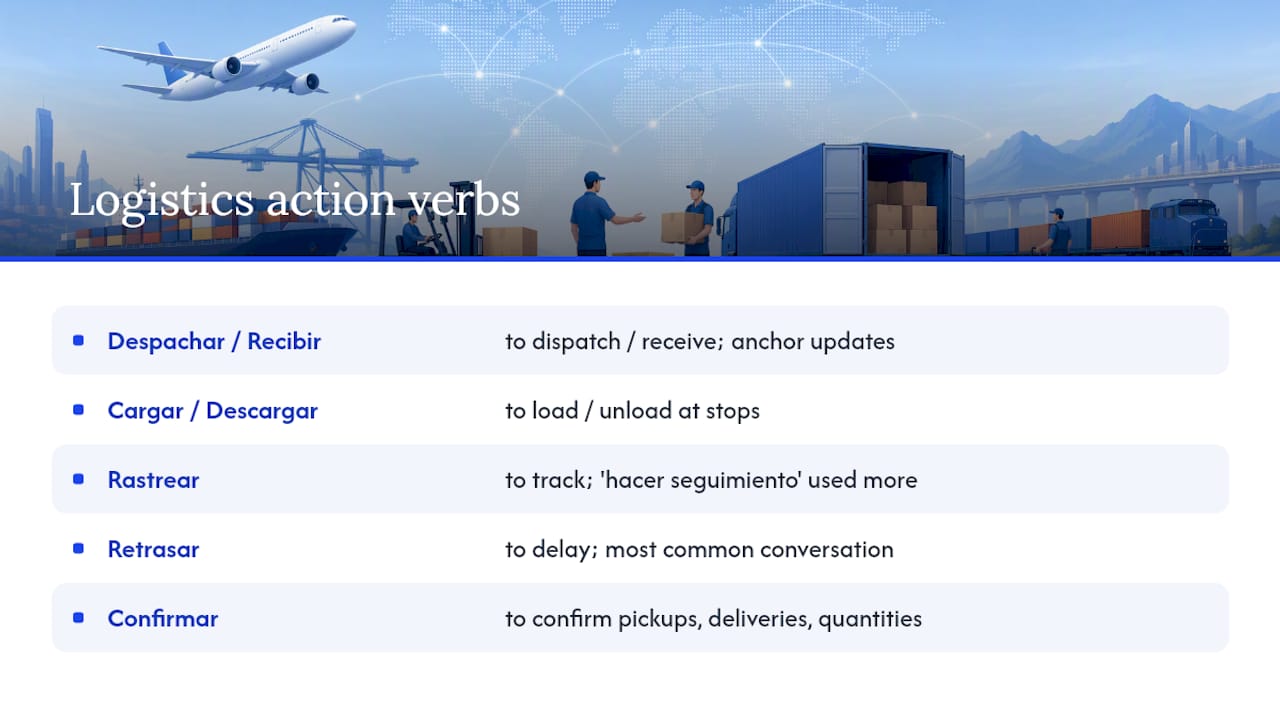
Nouns describe the cargo. Verbs describe what actually happens to it, and logistics conversations run on a fairly compact set of them. Despachar (to dispatch) and recibir (to receive) anchor most status updates, but a handful of others come up constantly.
Cargar (to load) and descargar (to unload) describe the physical handling at each stop. “Vamos a cargar el camión a las echo.” (We’re loading the truck at eight.) Rastrear (to track) shows up whenever someone wants shipment status: “¿Puede rastrear el pedido?” Retrasar (to delay) and its noun form el retraso describe the single most common conversation in the entire industry. Confirmar (to confirm) covers pickups, deliveries, and quantities alike, and you’ll type it more than almost any other verb in this list.
Almacenar (to store) refers to warehousing goods before onward shipment, while etiquetar (to label) covers the packaging step before dispatch. Inspeccionar (to inspect) applies to customs and quality checks. Facturar (to invoice) is the verb form of “la factura,” used when billing a client for completed shipping.
One collocation worth memorizing as a unit: “hacer seguimiento” (to follow up / track progress), which native speakers use more often than the single verb “rastrear” in day-to-day conversation. Pairing verbs with their most natural collocations, rather than learning them in isolation, is what separates textbook Spanish from Spanish that sounds like you actually work in the field.
Working With Spanish-Speaking Logistics Partners
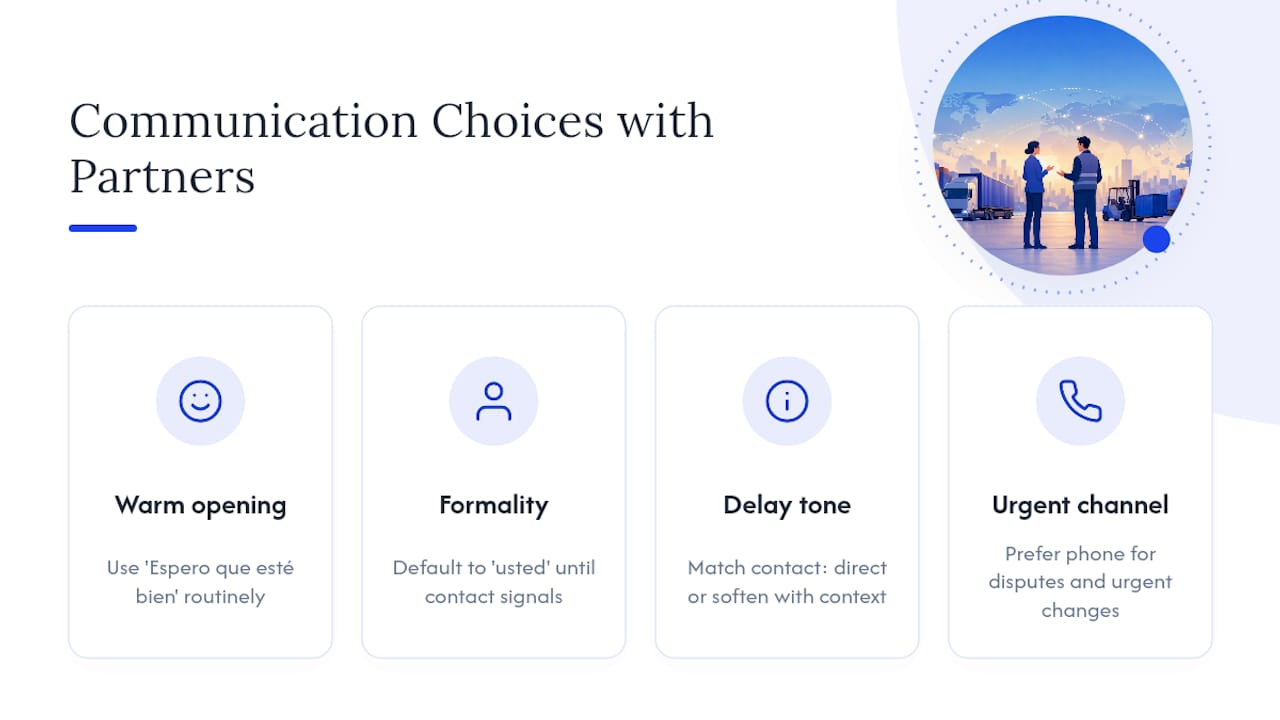
Vocabulary gets you understood; understanding inventory management for industries can help put these terms into broader operational context. Communication style gets you trusted, and the two aren’t the same skill. Spanish-speaking business partners across Latin America and Spain generally expect a warmer opening than the clipped, get-to-the-point style common in English-language logistics emails. A quick “Espero que esté bien” (I hope you’re doing well) before diving into shipment details isn’t filler. It’s expected professional courtesy.
Formality also varies more than English speakers expect. Mexico and much of Central America tend toward more formal “usted” address with new business contacts, while parts of Spain and Argentina shift to “tú” faster, even in professional settings. When you’re unsure, default to “usted” until your contact signals otherwise. Getting this wrong doesn’t damage the relationship badly, but getting it right accelerates trust noticeably.
Directness around delays and problems also differs by region and by individual relationship. Some partners prefer a direct “el envío está retrasado” stated plainly; others expect the bad news softened with context before the fact itself lands. There’s no universal rule here beyond paying attention to how your specific contact communicates and matching that register. Phone calls, not just emails, still carry real weight in many Spanish-speaking logistics relationships, particularly for resolving disputes or confirming urgent changes.
What Twenty Years in Language Classrooms Teaches You About Industry Vocabulary
Most logistics vocabulary lists fail for one reason: they teach words without the sentence structures that make those words usable under pressure. A student who memorizes “el conocimiento de embarque” but never practices asking for one on a live call still freezes when a real customs delay hits. Classroom instruction that pairs vocabulary with role-play, phone scripts, and written templates closes that gap faster than any flashcard deck alone.
The strongest signal that a course actually works isn’t the size of its vocabulary list. It’s whether students can produce a coherent sentence about a shipment delay without translating in their head first. That distinction between recognition and production is where most self-study plans quietly stall.
— Paul
Build on This Vocabulary With Structured Business Spanish Training
Reading a vocabulary list is one thing. Speaking fluently on a customs call with a supplier in Bogotá is another, and that gap is exactly what structured, instructor-led practice closes faster than any app or flashcard deck. Spanish Explorer offers business Spanish and corporate training built around workplace scenarios, with instructors fluent in both Spanish and English who can drill shipping vocabulary, phone scripts, and email templates specific to logistics operations.

If your team handles freight, customs paperwork, or supplier calls in Spanish, corporate training can be scoped directly around logistics scenarios rather than generic conversation topics. Individuals can start with private online classes focused on industry vocabulary, scheduled around work hours over Zoom. Classes run from the training center at 10 Anson Road, Level 22, International Plaza, Singapore, directly above Tanjong Pagar MRT, with online options for anyone who can’t make it in person. Book a trial class to test how a lesson built around your actual job responsibilities feels before committing to a full course.
Where This Vocabulary Comes From
The core translations and gender notes here draw on the Cambridge Dictionary’s Spanish entry for “logistics”, while industry-specific terms are cross-referenced against Novocargo’s logistics glossary and DSV’s glossary. Shipping phrase examples follow patterns documented by SpanishStep.
Sources
- LOGISTICS in Spanish – Cambridge Dictionary
- Terminología de logística y distribución | Novocargo
- Glosario | DSV
- How to say “How much is shipping?” in Spanish | SpanishStep
FAQ
How can I explain logistics in Spanish?
Say “la logística” for the general concept, and use “logístico/a” as the adjective, as in “el proceso logístico” (the logistics process). Add a qualifier like “logística comercial” or “logística de distribución” when you need to specify the type of logistics you mean.
What is the Spanish word for “freight”?
“El flete” is the standard Spanish word for freight, referring to both the cargo itself and the cost of shipping it. You’ll also hear “la carga” used for the physical goods being shipped.
What is the Latin word for “logistics”?
The Spanish word “logística” descends from the same root as the English “logistics,” ultimately tracing to the Greek “logistikos,” meaning skilled in calculation, rather than directly from Latin.
What is another name for logistics?
Within Spanish-language business contexts, “la cadena de suministro” (supply chain) is the closest related term, though it refers more specifically to the network of suppliers, warehouses, and transport rather than logistics management as a whole.
Recommended
Start Learning Spanish Today
Book a trial class and see how quickly you can progress with a professionally trained native-speaker teacher guiding the way.
Book a Trial Class