 Spanish
The fastest route to sales-ready Spanish is a focused program combining live role-play, sales-method adaptation in Spanish, and measurable exit assessments tied to real deal stages. You do not need fluency. You need enough targeted vocabulary and cultural fluency to open, qualify, pitch, handle objections, and close in Spanish with confidence.
Who benefits most:
- SDRs and AEs prospecting into U.S. Latino markets or Latin American accounts
- Account managers managing Spanish-speaking clients and renewal conversations
- Sales leaders building teams that can compete for the fastest-growing U.S. consumer segment
Fastest expected outcome: Role-readiness for core sales conversations in 8–12 weeks with structured training.
Next step: Request a trial class or team needs analysis from Spanish Explorer’s online course options to see the format in action before committing.
Key Takeaways
Sales-ready Spanish requires methodology adaptation, live role-play, and measurable exit assessments — not vocabulary lists alone.
| Point | Details |
|---|---|
| Format determines speed | Private 1:1 coaching delivers role-readiness in 4–8 weeks; group classes work for cohorts over 8–12 weeks. |
| Methodology adaptation is non-negotiable | SPIN, Sandler, or Solution Selling must be adapted to Spanish cultural norms, not just translated. |
| Measure business metrics, not test scores | Track pipeline, close rates, and escalation reduction — not CEFR level alone — to prove ROI to leadership. |
| Daily drills beat weekly study | A 20-minute daily drill protocol produces faster sales-conversation gains than passive study. |
| Spanish Explorer as next step | Spanish Explorer offers live Zoom, private, and corporate options with CEFR benchmarks and role-play feedback. |
Table of Contents
- Why Spanish fluency gives sales professionals a real edge in the U.S.
- Which course format works best for your sales role?
- What a strong “Spanish for sales” course must include
- A sample 8–12 week sales Spanish curriculum
- How long does it take, and what does it cost?
- Daily drills and ready-to-use practice resources
- How to choose a Spanish-for-sales provider
- Spanish Explorer is built for sales teams and individual sellers
- The real ROI of sales-focused Spanish training
- Sources
- FAQ
Why Spanish fluency gives sales professionals a real edge in the U.S.
Spanish has moved from a résumé line to a revenue lever. As BBC Worklife reports, Latino population growth and rising spending power have pushed employers to actively value bilingual employees for market access and inclusive culture. For sellers, that shift is direct: the prospect pool is larger, the trust barrier is lower, and the competitive field is thinner when you can conduct a discovery call in Spanish.
Knowledge at Wharton’s analysis found that jobs requiring Spanish grew roughly 30% in several sectors, and companies that embed language training in leadership development track market outcomes rather than just test scores. That framing matters for sales managers making a budget case.
Three concrete employer use cases driving demand:
- Customer acquisition: Reaching Spanish-speaking prospects who default to vendors they can communicate with comfortably
- Retention and upsell: Conducting QBRs and renewal conversations in the client’s language, which signals long-term commitment
- Reduced escalation costs: Cutting reliance on interpreters for demos, contract reviews, and onboarding calls
Strong communication skills are a core driver of sales performance. Adding Spanish to that skill set opens a segment most competitors cannot touch.
Which course format works best for your sales role?
Format matters as much as content. A corporate SDR team running 80 cold calls a day needs something different from an enterprise AE managing three-month deal cycles with Spanish-speaking procurement teams.

| Format | Best for | Skills covered | Customization | Duration | Pricing shape | Assessment |
|---|---|---|---|---|---|---|
| Live online group | SDRs, junior AEs | Opening, qualifying, objection scripts | Low to moderate | 8–12 weeks | Per-session or package | CEFR-aligned exit task |
| Private 1:1 | AEs, account managers needing fast results | Full deal cycle, negotiation, contracts | High | 4–8 weeks | Per hour | Recorded role-play review |
| Short workshop | Sales teams, kickoffs | Pitch, objection handling, cultural nuance | Moderate | 1–2 days | Per-team flat fee | Pre/post scenario test |
| Corporate program | Enterprise sellers, sales leaders | Full methodology adaptation, industry vocab | Very high | 12+ weeks | Bulk/hour or retainer | KPI reporting, manager confidence |
Quick format guidance:
- Pick private coaching when an AE has a live deal in play and needs rapid, deal-specific vocabulary now.
- Pick live group classes when you have a cohort of SDRs at a similar level and want consistent baseline training.
- Pick a workshop for a sales kickoff or product launch into a new Spanish-speaking market.
- Pick a corporate program when you need methodology adaptation, industry-specific vocabulary, and reporting for leadership. A structured business language program typically includes all three.
What a strong “Spanish for sales” course must include
The course must adapt your sales methodology to Spanish, not just teach vocabulary. That distinction separates training that moves deals from training that moves test scores.
Non-negotiable checklist:
- Role-play with real scripts: Cold opens, discovery questions, objection responses, and closing sequences practiced in Spanish, not just translated
- Sales-method adaptation: SPIN, Challenger, or Solution Selling adapted to Spanish cultural norms, as Sandler’s practitioner guidance makes clear — the methodology must signal empathy and cultural alignment, not just linguistic accuracy
- Native or bilingual instructors with sales-facing experience: Someone who has worked in or trained sales teams, not only taught grammar
- Industry vocabulary customization: SaaS, financial services, healthcare, and manufacturing each carry different Spanish terminology
- Exit assessment: CEFR-aligned skill goals or a task-based demo call, not a multiple-choice grammar test
- Recorded role-play feedback: Lets reps review their own phrasing, tone, and pacing after each session
Pro Tip: Ask any prospective instructor to run a five-minute cold-open role-play in your industry during the trial lesson. If they cannot adapt the scenario on the spot, they are a language teacher, not a sales trainer.
A sample 8–12 week sales Spanish curriculum
A well-structured program runs two to three hours per week and maps each module to a specific deal stage. Here is what that looks like in practice:
| Week | Goal | Sample activities | Exit criteria |
|---|---|---|---|
| 1–2 | Opening and rapport | Cold-open scripts, small talk, LinkedIn outreach in Spanish | Deliver a 60-second cold open without prompts |
| 3–4 | Qualifying | BANT/MEDDIC questions in Spanish, active listening drills | Complete a five-question discovery sequence live |
| 5–6 | Pitching | Value proposition delivery, feature-benefit framing | Record a two-minute pitch; instructor review |
| 8 | Objection handling | Objection ladder drills, reframe scripts | Handle three objections in a live role-play |
| 10 | Negotiation and contracts | Pricing language, concession framing, contract terms | Negotiate a mock deal to close |
| 11–12 | Close and follow-up | Closing sequences, follow-up email templates, referral asks | Full simulated deal cycle, recorded and reviewed |
Ready-to-use script frames:
- Opening: “Hola [nombre], le llamo de [empresa]. Trabajo con equipos de ventas que buscan [resultado]. ¿Tiene dos minutos?”
- Qualifying: “¿Cuál es el mayor desafío que enfrenta su equipo con [área]?”
- Objection response: “Entiendo su preocupación. Muchos de nuestros clientes pensaban lo mismo antes de ver [resultado específico].”
These frames are starting points. A good instructor will drill variations until the phrasing feels natural, not rehearsed.
How long does it take, and what does it cost?
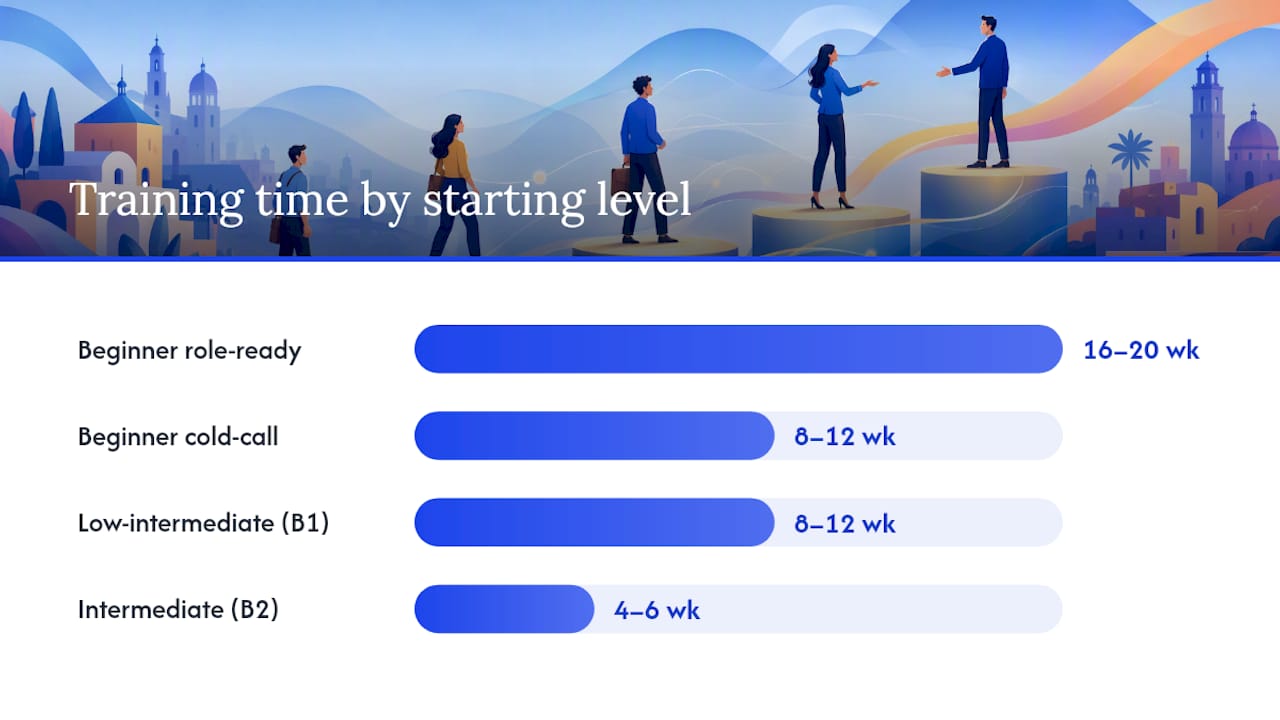
Timeline by starting level:
- Beginner (A1/A2): 16–20 weeks to basic role-readiness; 8–12 weeks to handle a structured cold call
- Low-intermediate (B1): 8–12 weeks to full deal-cycle readiness
- Intermediate (B2): 4–6 weeks of targeted sales vocabulary and methodology training
Typical U.S.-market pricing:
- Private coaching: $60–$120 per hour depending on instructor seniority and customization
- Group classes: $30–$60 per session in a cohort format
- Corporate programs: custom pricing based on team size, customization depth, and reporting requirements
What changes the price most: instructor seniority, industry-specific vocabulary development, and whether the vendor builds a pre/post assessment framework. That last item is worth paying for. Pearson’s GSE ROI guidance recommends tracking task-completion rates, meeting participation, and reduced reliance on external translators rather than test scores alone. Those are the metrics that land with a CFO.
To present ROI to leadership, use a simple before/after template: baseline the number of Spanish-language deals in the pipeline, the average deal size, and the close rate, then measure the same figures 90 days post-training. A practical ROI framework built around four metrics (meeting participation, time to produce client materials, escalation rate, and manager confidence) gives you a defensible number without complex modeling.
Daily drills and ready-to-use practice resources
Short, focused drills move the needle faster than passive study for sales tasks. A 20-minute daily protocol beats a two-hour weekly grammar session every time.
Daily 20-minute drill protocol:
- Cold-open role-play (5 min): Record yourself delivering your opening in Spanish; replay and fix one thing
- Qualification checklist (5 min): Run through your five core discovery questions in Spanish aloud
- Objection ladder (5 min): Pick one objection and practice three different reframe responses
- Follow-up email (5 min): Write one follow-up email in Spanish using a template, then vary one sentence
Supporting resources:
- Script templates for each deal stage (request from your instructor or build from the frames above)
- Language exchange programs with native speakers for low-stakes conversation practice between lessons
- Multilingual call support tools for teams handling inbound Spanish-speaking leads, such as multilingual agent solutions, which complement human training for live customer interactions
- Recorded role-play library: save every practice session and review one per week for phrasing patterns
How to choose a Spanish-for-sales provider
Ask for task-based evidence, not certificates alone. A vendor who leads with a course brochure and a language level chart is not the same as one who can show you a recorded role-play from a past cohort.
Questions to ask in an RFP or trial call:
- Can you show a sample lesson plan for an SDR or AE at my industry?
- What sales methodologies have your instructors worked with or trained in?
- How do you assess progress — language test, task-based demo, or recorded role-play?
- How do you customize vocabulary for my industry?
- What KPIs do you track and report to managers or HR?
- Can you share a client outcome or case study showing sales impact?
Evaluation checklist (yes/no):
- Instructor has sales-facing or business training experience
- Curriculum includes role-play with real deal-stage scripts
- Exit assessment is task-based, not grammar-only
- Vendor offers pre/post metrics framework
- Industry vocabulary is customizable
- Trial class or sample lesson is available before purchase
Red flags:
- No role-play in the syllabus
- Assessment is a multiple-choice language test only
- “Business Spanish” claims with no sales-specific content
- Generic instructor profiles with no business or professional background
Trust signals to request: Recorded role-play samples from past learners, instructor CVs showing professional or sales-adjacent experience, and a pre/post metrics template. Spanish Explorer’s instructor profiles show bilingual teaching credentials and professional backgrounds worth reviewing as a benchmark.
Pro Tip: Request a 20-minute trial lesson in your specific sales scenario before signing any package. If the instructor cannot adapt to your industry context on the spot, the customization they promise in the brochure will not materialize in the classroom.
Spanish Explorer is built for sales teams and individual sellers
Spanish Explorer offers live Zoom group classes, private 1:1 lessons, and corporate training programs designed for adult professional learners. For sales teams, that means role-play-driven sessions, CEFR-aligned benchmarks, and the flexibility to customize vocabulary to your industry and deal cycle.
Every class is taught by experienced, bilingual instructors fluent in both Spanish and English, with professional backgrounds suited to business and corporate learners. Corporate clients get structured reporting so managers can track progress against real business metrics, not just language scores.
The fastest next step: browse the available Spanish courses and request a trial class or team needs analysis. You will know within one session whether the format fits your team’s pace and objectives.
The real ROI of sales-focused Spanish training
Sales-focused Spanish training pays back faster than most L&D investments because the feedback loop is immediate. A rep who closes a deal in Spanish on week nine of training does not need a post-program survey to know it worked.
The mistake most teams make is treating Spanish training as a language project rather than a sales performance project. The measurement framework, the instructor selection criteria, and the curriculum design all change when you frame it correctly. Track pipeline metrics before and after. Measure close rates on Spanish-language opportunities. Count the deals that did not require an interpreter. Those numbers tell the story to leadership far better than a CEFR level badge.
Sources
- How Spanish fluency became a competitive business advantage
- The Spanish advantage: Why learning Spanish is becoming a strategic business skill – Knowledge at Wharton
- Succeed using Sandler in Spanish (podcast)
FAQ
How long does it take to become sales-ready in Spanish?
Most sellers at a low-intermediate level reach full deal-cycle readiness in 8–12 weeks of structured training. Beginners typically need 16–20 weeks to handle a complete sales conversation comfortably.
What is the difference between business Spanish and Spanish for sales?
Business Spanish covers general professional vocabulary. Spanish for sales goes further, adapting specific methodologies like SPIN or Sandler to Spanish cultural norms and drilling deal-stage scripts through live role-play.
Can a sales team learn Spanish together in a group format?
Yes. Live online group classes work well for SDR cohorts or AE teams at a similar proficiency level, typically running 8–12 weeks with two to three sessions per week.
What should I ask a vendor before buying a Spanish sales training program?
Ask for a sample lesson plan in your industry, evidence of instructor sales experience, and a task-based assessment method. Red flags include no role-play in the syllabus and generic “business Spanish” claims with no sales-specific content.
Does Spanish Explorer offer training for corporate sales teams?
Spanish Explorer offers group, private, and corporate Spanish programs delivered live via Zoom, with CEFR-aligned benchmarks and customization options suited to professional and sales-focused learners.
Recommended
Start Learning Spanish Today
Book a trial class and see how quickly you can progress with a professionally trained native-speaker teacher guiding the way.
Book a Trial Class