 Spanish
TL;DR:
- Learning Spanish in Singapore requires understanding proficiency frameworks and certification options that align with career and academic goals.
- Choosing courses with explicit CEFR level mapping and exam preparation ensures genuine progress toward recognized qualifications like DELE or SIELE.
Choosing to learn Spanish in Singapore sounds straightforward until you actually start researching your options. Suddenly you are staring at acronyms like CEFR, DELE, and SIELE, weighing group classes against private tutoring, and wondering whether the course you are eyeing will actually get you to a qualification that employers or universities recognize. Many motivated learners sign up for a general Spanish class, study diligently for months, and then realize their certificate carries no formal weight outside the classroom. This guide cuts through that confusion and gives you a clear, practical framework for choosing the right Spanish learning path in Singapore.
Table of Contents
- Why learn Spanish in Singapore?
- Understanding Spanish learning frameworks and exams
- Choosing the right Spanish course in Singapore
- From beginner to certification: Progression pathways
- Common mistakes and pro tips for Spanish success in Singapore
- The overlooked truth: Certification is not the finish line
- Start your Spanish journey with specialists in Singapore
- Frequently asked questions
Key Takeaways
| Point | Details |
|---|---|
| Certification is key | Spanish proficiency certifications (like DELE/SIELE) open more academic and career doors than informal study alone. |
| Match course to goals | Select courses that clearly prepare you for the specific exams or recognized levels you need, not just general improvement. |
| Pathways are structured | Progression from beginner to certified speaker in Singapore is mapped by CEFR levels and formal exam milestones. |
| Pitfalls to avoid | Don’t confuse internal course progress with verified proficiency—ensure both syllabus and mock exams align with your end goal. |
| Beyond certificates | True fluency requires real-world use and continued learning, not just passing an exam. |
Why learn Spanish in Singapore?
Spanish is the second most spoken language in the world by native speakers, with over 500 million people using it as their first language across 21 countries. For Singapore residents, that reach translates into real, tangible opportunity. Whether you are a professional eyeing roles in Latin American markets, a student applying to Spanish or European universities, or simply someone who wants to travel more meaningfully through Spain and South America, Spanish skills give you a measurable edge.
The benefits of learning Spanish extend well beyond the obvious. Research consistently shows that bilingual individuals demonstrate stronger cognitive flexibility, better memory retention, and improved problem-solving skills. Learning Spanish as an adult in Singapore is not just a cultural hobby. It is an investment in how your brain functions over the long term.
From a professional standpoint, Singapore’s position as a global business hub means that companies regularly seek employees who can bridge communication gaps with Spanish-speaking partners in Mexico, Colombia, Spain, and Argentina. Industries like logistics, finance, pharmaceuticals, and technology all have significant Spanish-speaking client bases. Adding Spanish to your resume signals cross-cultural competence, which is increasingly valued in Singapore’s multicultural workforce.
- Personal enrichment: Enjoy Spanish cinema, literature, and music in their original form
- Travel: Navigate Spain, Mexico, Colombia, Peru, and 18 other countries with confidence
- Cognitive benefits: Sharpen memory, attention, and mental agility through language learning
- Academic advantage: Qualify for Spanish-medium programs or international exchange opportunities
- Career growth: Stand out in sectors with Latin American or European business ties
“Learning a language is not just about acquiring words. It is about gaining access to an entirely different way of seeing the world, and in Singapore’s interconnected economy, that perspective has real market value.”
Understanding Spanish learning frameworks and exams
This is where most learners in Singapore get tripped up, and it is worth slowing down here. There are two distinct things at play: a framework that measures proficiency and certification exams that formally prove it.
The Common European Framework of Reference for Languages, known as the CEFR, is the internationally recognized system that organizes language ability into six levels: A1 and A2 (beginner), B1 and B2 (intermediate), and C1 and C2 (advanced). Almost every reputable Spanish course in Singapore uses CEFR levels to describe where students are and where they are headed. When a school says you will reach B1 after completing their course, they are using CEFR as the measuring stick.
But here is the critical distinction: completing a CEFR-aligned course does not automatically give you a recognized credential. For that, you need a formal certification exam. The two most widely recognized options are DELE (Diplomas de Español como Lengua Extranjera) and SIELE (Servicio Internacional de Evaluación de la Lengua Española). DELE is organized by Instituto Cervantes and certifies proficiency based on CEFR standards, making it the gold standard for academic and professional recognition globally.
SIELE, on the other hand, is a more flexible, modular exam that allows candidates to test individual skills separately. It is particularly useful for professionals who need to demonstrate specific competencies, like business writing or oral communication, without sitting a full exam.
| Feature | DELE | SIELE |
|---|---|---|
| Organized by | Instituto Cervantes | Instituto Cervantes + universities |
| Format | Fixed, full exam per level | Modular, skills-based |
| Recognition | Academic and professional | Primarily professional |
| Validity | Lifetime | 5 years |
| Best for | University applications, immigration | Workplace credentials |
Understanding this distinction matters enormously when you are selecting a course. A general Spanish class will help you grow along the CEFR scale, but only an exam-focused program will prepare you for the specific question formats, timing, and assessment criteria of DELE or SIELE. You can explore the full DELE vs SIELE comparison to decide which exam suits your goals, and review what to expect across Spanish course levels and exams before committing.
Pro Tip: Before enrolling in any Spanish course, ask the school directly: “Does your syllabus include practice with DELE or SIELE exam formats?” If the answer is vague, that course is likely built for general enrichment, not certification readiness.
Choosing the right Spanish course in Singapore
Singapore offers a range of Spanish learning options, from community classes at cultural centers to structured programs at dedicated language schools. The challenge is not finding a class. It is finding the right class for your specific outcome.
Here is a step-by-step approach to evaluating any Spanish course before you sign up:
- Define your goal first. Are you learning for personal enrichment, academic admission, or a professional credential? Your goal determines whether you need a general course or an exam-prep focused program.
- Check CEFR alignment. Confirm that the course explicitly maps its content to CEFR levels and can tell you which level you will reach upon completion.
- Ask about exam preparation. Ensure your course explicitly prepares you for the exam format you need, not only for general CEFR growth. This means timed practice tests, feedback on written tasks, and oral exam simulations.
- Evaluate teacher credentials. Look for instructors who are certified, ideally with experience preparing students for DELE or SIELE specifically. Native fluency alone is not enough. Teaching methodology matters.
- Consider class format. Group classes are cost-effective and provide peer interaction. Private classes accelerate progress and allow customized pacing. Corporate programs are tailored to business communication needs.
- Look at track record. Ask for pass rates or student outcomes. A school that has successfully prepared learners for DELE exams will be proud to share that data.
You can compare all available Spanish classes in Singapore and get a clearer picture of choosing Spanish class types based on your schedule and learning style.
It is also worth noting that Spain remains one of the top destinations for English teachers, which means Spanish proficiency can open doors not just in business but in international education careers as well.
Pro Tip: Ask if mock exams are included in the course fee. Schools that include full practice exams under timed conditions are serious about exam outcomes, not just classroom progress.
From beginner to certification: Progression pathways
Understanding how long the journey takes helps you plan realistically. Most adult learners in Singapore start at A1 with zero prior knowledge of Spanish. Here is a realistic breakdown of what to expect at each stage.
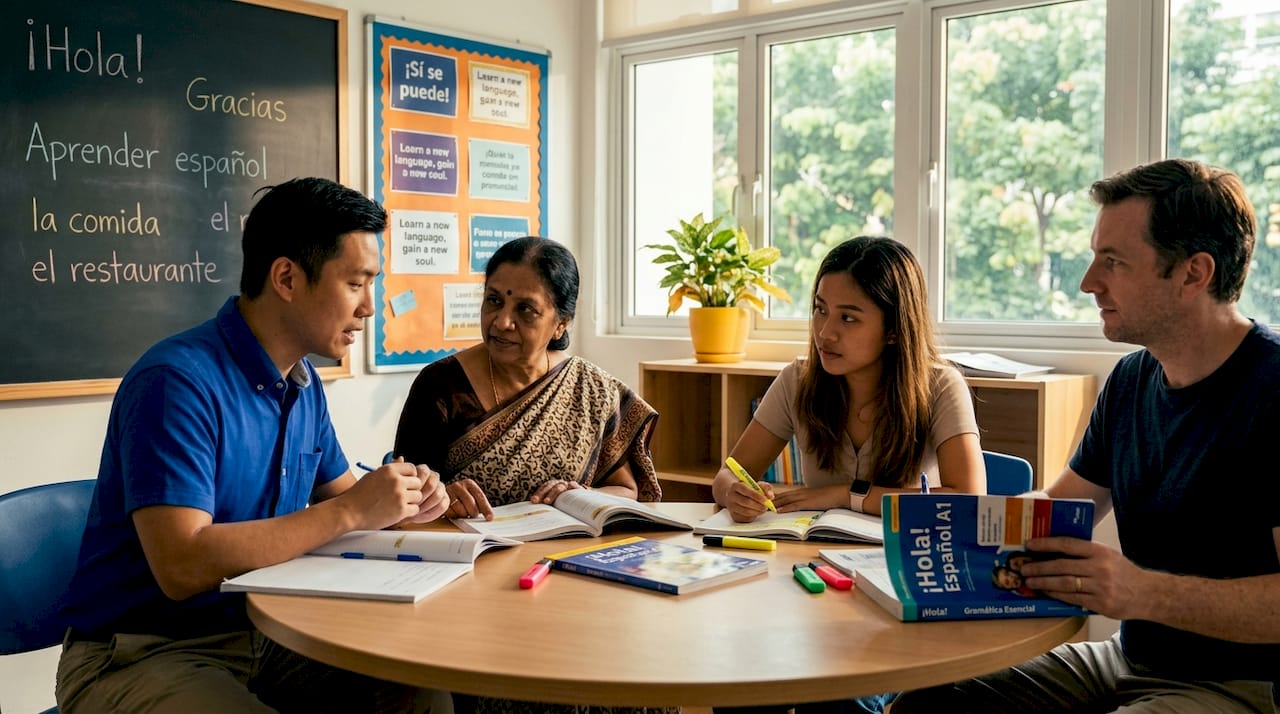
| CEFR level | Approximate study hours | Recommended exam | Typical timeline (structured study) |
|---|---|---|---|
| A1 | 60 to 80 hours | None (foundation) | 3 to 4 months |
| A2 | 80 to 100 hours | DELE A2 | 3 to 4 months |
| B1 | 150 to 180 hours | DELE B1 | 6 to 9 months |
| B2 | 180 to 200 hours | DELE B2 | 6 to 9 months |
| C1 | 200 to 250 hours | DELE C1 | 9 to 12 months |
| C2 | 250+ hours | DELE C2 | 12+ months |
These timelines assume consistent, structured study of around 4 to 6 hours per week. Learners who supplement classroom time with daily practice, Spanish media, or conversation partners will progress faster.
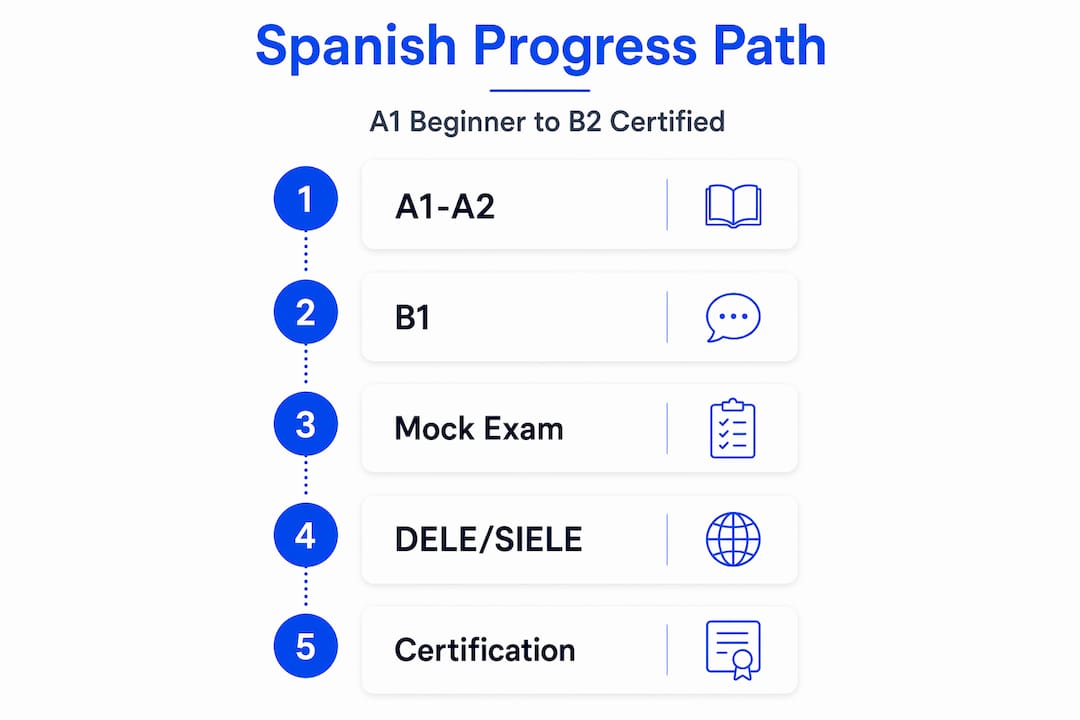
DELE is organized by Instituto Cervantes and certifies proficiency based on CEFR standards, so each exam level directly corresponds to a CEFR milestone. This means your course progress and your exam readiness should be moving in parallel, not separately.
Key milestones to keep in mind:
- A2: Solid foundation for basic travel and social conversation. Good entry point for your first formal credential.
- B1: The most popular certification level for professionals. Recognized by many universities for language requirements.
- B2: Required for many academic programs in Spain and Latin America. Demonstrates genuine working proficiency.
- C1 and C2: Advanced levels suited for academic research, professional translation, or teaching roles.
Use the DELE level guide to identify which exam fits your current stage, and explore curated Spanish learning resources to accelerate your progress between classes.
Common mistakes and pro tips for Spanish success in Singapore
Even committed learners make avoidable errors. Knowing what they are ahead of time saves you months of wasted effort.
- Confusing course completion with exam readiness. Finishing a B1 course does not mean you are ready to sit the DELE B1 exam. Exam readiness requires specific preparation for the test format, timing, and marking criteria.
- Skipping practice exams. Many learners study the language but never simulate actual exam conditions. This is one of the most common reasons for underperforming on test day.
- Choosing a course based on price alone. A cheaper class that does not align with your target certification will cost you more in the long run when you have to repeat preparation.
- Neglecting speaking and listening. Many Singapore learners are strong in grammar and reading but underprepare for oral components, which carry significant weight in DELE exams.
- Plateauing at B1. B1 is a comfortable level where many learners stall. Pushing through to B2 requires deliberate effort and often a change in study strategy.
“The most successful Spanish learners in Singapore are not necessarily the most talented. They are the ones who treat exam preparation as a separate, dedicated discipline alongside their general language learning.”
Some materials distinguish between language “frameworks” (CEFR) and “certification” exams (DELE/SIELE), and this distinction is not just academic. It directly affects which course you should enroll in and how you should structure your study time.
For learners who want to learn Spanish fast in Singapore, the key is intensity and consistency, not shortcuts. Pairing a structured course with daily exposure to Spanish content accelerates acquisition significantly. Spain also ranks among the top TEFL destinations globally, which means Spanish fluency can open unexpected international career doors beyond what most Singapore learners initially consider.
Pro Tip: Prioritize classes with exam-focused outcomes. Ask your school to show you a sample lesson plan that includes exam-style exercises. If every lesson is purely conversational without any structured exam practice, adjust your expectations accordingly.
The overlooked truth: Certification is not the finish line
Here is something we have observed consistently at Spanish Explorer. Learners who treat DELE or SIELE as their final destination often plateau shortly after passing. They stop using Spanish regularly, lose fluency quickly, and find that the certificate alone does not deliver the outcomes they expected.
Certification opens doors. It proves to an employer or university that you reached a specific standard at a specific point in time. But language is a living skill. It fades without use. The learners who get the most value from their Spanish studies are the ones who treat the exam as a milestone, not a finish line.
After certification, the real work begins. Seek out Spanish-speaking colleagues or communities in Singapore. Watch Spanish films without subtitles. Read Spanish news. Join conversation groups. Travel to Spanish-speaking countries when you can. These are the habits that convert a DELE certificate into genuine, lasting fluency.
We also encourage learners to reflect on why they started. The real benefits of learning Spanish are not captured on a certificate. They show up in the confidence you feel ordering food in Buenos Aires, the connection you build with a Spanish-speaking client, or the novel you finally read in its original language. Those outcomes require continued practice long after the exam is done.
The most effective Spanish learners we work with are the ones who build Spanish into their daily life, not just their study schedule.
Start your Spanish journey with specialists in Singapore
Navigating Spanish courses and certifications in Singapore is far easier when you have experienced guides alongside you from day one.
At Spanish Explorer, we offer a full portfolio of Spanish courses in Singapore designed for every stage of the learning journey, from complete beginners to advanced learners preparing for DELE C1 and C2. Our certified instructors bring both native-level fluency and structured exam preparation expertise, so your classroom time directly builds toward your certification goals. Whether you prefer group classes, private sessions, or a corporate program tailored to your team’s needs, we have a format that fits your schedule and your ambitions. Explore our DELE exam preparation resources and take the first step toward a credential that genuinely counts.
Frequently asked questions
What is the CEFR, and why does it matter for Spanish courses in Singapore?
The CEFR is an internationally recognized language proficiency framework that many Spanish courses in Singapore use to track and benchmark students’ progress. It provides a shared language between learners, teachers, and employers so that a B1 level means the same thing regardless of which school issued it.
Should I take DELE or SIELE for Spanish certification in Singapore?
Both exams are organized by Instituto Cervantes and certify CEFR-based proficiency; your choice should depend on your intended use, academic goals, or professional needs, and whether your course is specifically aligned to one exam format over the other.
Can I learn Spanish in Singapore without planning to take a certification exam?
Yes, many courses cater to learners focused on conversational or cultural skills, and some materials distinguish clearly between general CEFR-based learning and formal certification pathways. That said, earning a credential like DELE adds formal proof of your ability for career or academic purposes.
How long does it typically take to reach a certifiable level of Spanish in Singapore?
Many learners in Singapore progress from beginner to an A2 or B1 level within one to two years of structured study and dedicated exam preparation, though consistent daily practice outside the classroom can significantly shorten that timeline.
Recommended
- Spanish classes in Singapore: options, exams, and success
- Unlock the benefits of learning español in Singapore
- Best Spanish learning resources in Singapore for every learner
Start Learning Spanish Today
Book a trial class and see how quickly you can progress with a professionally trained native-speaker teacher guiding the way.
Book a Trial Class