 Spanish
A well-designed Spanish language onboarding process gets a new learner job-ready for role-specific tasks in weeks by combining pre-day-one assessment, CEFR-aligned placement, bilingual orientation, microlearning sessions, mentor support, and measurable 30/60/90-day milestones.
Quick actions you can take right now:
- Complete a short language preference survey before your first session
- Take a CEFR placement test to confirm your starting level
- Set up your Zoom or LMS account and switch the interface to Spanish
- Block three 15–20 minute practice windows into your daily calendar
Table of Contents
- Who benefits from a structured Spanish onboarding program?
- What does the Spanish language onboarding process look like, stage by stage?
- What should learners prepare before their first session?
- What must HR and training managers provide to launch the program?
- How long does onboarding take, and what does it cost?
- How do you measure progress and success?
- Which tools and resources should you include?
- A sample 30–60–90 day plan for busy professionals
- How Spanish Explorer structures its onboarding method
- Key Takeaways
- What most onboarding guides get wrong about language training
- Spanish Explorer’s corporate and adult Spanish courses
- FAQ
Who benefits from a structured Spanish onboarding program?
Three groups get the most out of a structured approach: busy working professionals, corporate cohorts, and HR or training managers rolling out company-wide language programs.
Busy professionals need fast, role-specific results. “Job-ready” for them means handling client calls, reading contracts, or navigating a Spanish-speaking workplace at a B1 level within 8–12 weeks. Corporate cohorts need consistent placement across a team so every learner starts at the right level and tracks to the same business communication milestones. HR and training leads need completion rates, placement score improvements, and time-to-productivity data they can report upward.
- Professionals: conversational competence for client-facing tasks
- Corporate cohorts: uniform CEFR placement, role vocabulary, team-wide progress tracking
- HR/training leads: retention lift, productivity metrics, compliance documentation in Spanish
What does the Spanish language onboarding process look like, stage by stage?
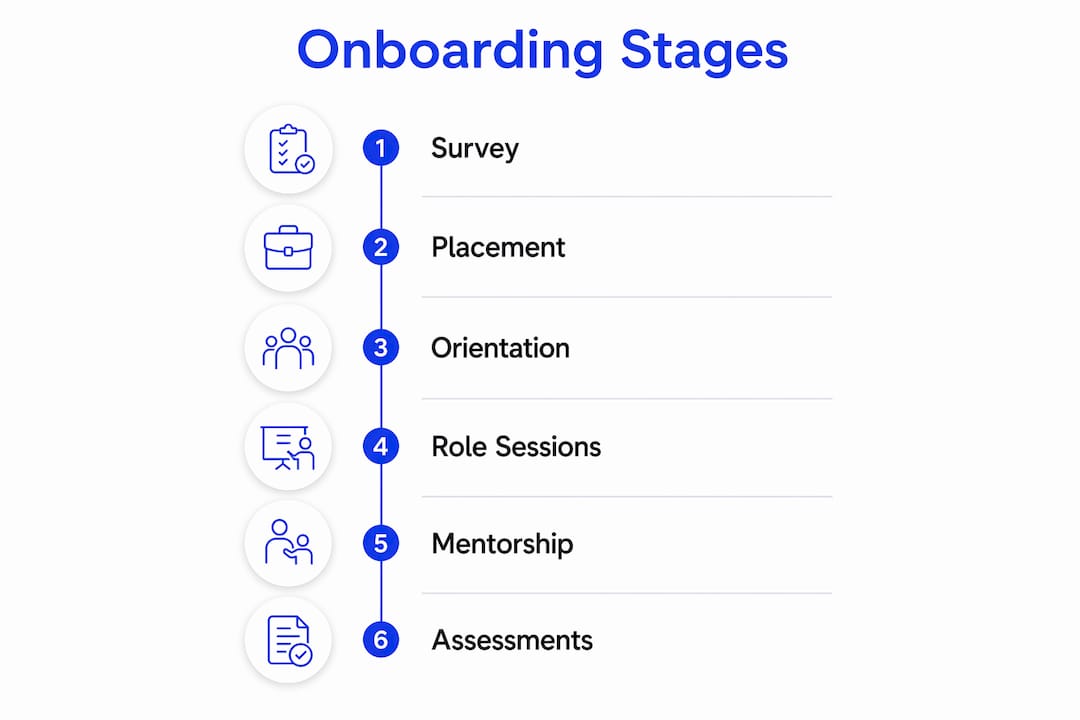
Stage 1: Pre-day-one intake
Send a short language preference and proficiency survey via SMS or a web form before the first session. SMS-based surveys achieve high read rates and allow automatic language flagging for all future communications. Capture learning goals, prior exposure, and role context at this step.
Stage 2: CEFR placement test
Map every learner to a CEFR level (A1 through C2) using a structured placement test. CEFR-aligned placement provides an objective baseline and makes milestone design straightforward. Assign learners to role-appropriate tracks immediately after results are in.
Stage 3: Bilingual orientation
Deliver a bilingual orientation covering logistics, safety, and role expectations. Bilingual orientation goes beyond literal translation to ensure genuine comprehension of safety procedures and policy. Use live or recorded assets and provide translated core documents.
Stage 4: Role-specific first sessions
Run short, focused sessions built around the learner’s actual job tasks. Use microlearning modules, visual aids, and hands-on demos rather than long slide decks. Short spaced modules help information stick without overwhelming someone working in a second language.

Stage 5: Mentor or buddy assignment
Pair each learner with a bilingual mentor for two-way check-ins via SMS or a messaging platform. Mentors create a low-risk space for clarifying role norms and asking questions that rarely surface in formal sessions.
Stage 6: Milestone assessments at 30/60/90 days
Schedule pulse surveys and placement re-tests at each checkpoint. Targeted surveys at milestone days reveal different pain points over time and let you iterate the program before problems compound.
Pro Tip: Automate language preference capture and session reminders via SMS before day one. Mobile-first delivery keeps response rates high and removes the need for manual follow-up.
Stage checklist:
- [ ] Language preference survey sent and completed
- [ ] CEFR placement test taken and results recorded
- [ ] Bilingual orientation scheduled and materials translated
- [ ] Role-specific first session delivered with microlearning assets
- [ ] Mentor assigned and first check-in booked
- [ ] 30/60/90-day assessment dates locked in the calendar
What should learners prepare before their first session?
Arriving prepared cuts wasted time and lets you use the onboarding window fully.
- Complete the language preference survey and any pre-work sent by your instructor
- Take the placement test before day one so your instructor knows your starting level
- Set up Zoom, your headset, and your LMS login; switch the platform interface to Spanish where possible
- Bring a role-specific vocabulary list, a notebook or note app, and access to any pre-work video or one-page job map
- Schedule three 15–20 minute microlearning blocks per workday for the first 30 days
Pro Tip: When an SMS prompt arrives from your instructor or program coordinator, respond immediately. Text messages carry a roughly 98% read rate versus around 20% for email, so the SMS channel is where your program lives.
What must HR and training managers provide to launch the program?
Pre-day-one responsibilities
- Collect language preferences via SMS or web form and flag them in your LMS
- Prepare translated core documents: offer letters, safety notes, compliance checklists
- Use ready-to-use Spanish templates for offer letters and safety prompts to reduce early-stage errors
Orientation and delivery
- Schedule bilingual orientation with live or recorded assets
- Assign qualified instructors and define role-specific learning tracks (safety, technical, soft skills)
- Set up mentor pairings before day one
Operations and measurement
- Configure SMS and email reminders in your LMS
- Track completion rates and document signatures in the learner’s preferred language
- Define milestone KPIs and assign owners before the program launches
| Action | Owner | Timing |
|---|---|---|
| Language preference survey | HR | Pre-day-one |
| CEFR placement test | Trainer | Pre-day-one |
| Translated core documents | HR + Trainer | Pre-day-one |
| Bilingual orientation | HR + Manager | Day 1 |
| Mentor pairing | Manager | Day 1 |
| 30/60/90 milestone assessments | Trainer + HR | Ongoing |
How long does onboarding take, and what does it cost?
Timeline at a glance:
- Pre-day-one: intake survey, placement test, document prep (1–3 days)
- Day 1: bilingual orientation and first session
- Week 1: daily microlearning, mentor introduction, Day 7 quick check
- Days 30/60/90: formal milestone assessments and program iteration
Common program lengths:
- Short bootcamp: 2–4 weeks for a focused vocabulary sprint
- Standard onboarding pathway: 4–12 weeks for functional business communication
- Ongoing maintenance: monthly or quarterly refreshers after the core pathway
Pricing varies by delivery model. Per-learner hourly rates apply to private lessons and typically reflect instructor seniority and session length. Corporate cohort packages bundle group sessions, materials, and LMS access into a fixed fee. Subscription-based LMS access suits large teams needing self-paced modules between live sessions. Key cost drivers are program length, role-specific customization, translation of materials, and the ratio of live instructor time to self-paced content.
How do you measure progress and success?
Primary metrics:
- Placement test delta: compare pre- and post-program CEFR scores
- Task-based assessments: can the learner perform their actual job tasks in Spanish?
- Microlearning completion rate tracked in the LMS
- Mentor check-in logs
Secondary metrics:
- Learner retention at 90 days
- Time-to-productivity: days until the learner performs role tasks without support
- Learner satisfaction scores from pulse surveys
Milestone checkpoints:
- Day 7: comfort with basic greetings, role vocabulary, and platform navigation
- Day 30: role-specific vocabulary and simple task execution
- Day 60: independent task performance and first formal assessment
- Day 90: business communication readiness and career-path next steps
A blended approach combining e-learning platforms with bilingual mentors sustains practice beyond initial orientation and produces stronger long-term outcomes than tech-only solutions.
Which tools and resources should you include?
Communication channels: SMS for high-visibility reminders, email for detailed documents, Slack or Microsoft Teams for ongoing coordination between sessions.
Delivery formats: live Zoom sessions with a certified instructor, short recorded videos with Spanish subtitles, pictograms for safety content, and microlearning modules of 5–10 minutes each.
Assessment tools: CEFR-mapped placement tests, SMS micro-quizzes after each module, and role-based simulated tasks reviewed by the instructor.
Support roles: bilingual mentors for day-to-day questions, multilingual supervisors for workplace integration, and certified instructors for structured business Spanish delivery.
For professional Spanish training and online workflow resources, Spanish Explorer’s course pages offer ready-made tracks aligned to these formats.
A sample 30–60–90 day plan for busy professionals
| Phase | Actions | Owner | Measurement |
|---|---|---|---|
| Days 1–30 | Placement test, daily 15–20 min microlearning, bilingual orientation, mentor pairing, Day 7 check-in | Learner + Trainer | Day 7 comfort check; placement confirmed |
| Days 30–60 | Role-specific training, weekly live Zoom session, practical simulations, Day 60 formal assessment | Learner + Trainer | CEFR delta; task quiz score |
| Days 60–90 | Independent task execution in Spanish, performance review conversation, career-path planning | Learner + Manager | Role-task sign-off; satisfaction survey |
Practice frequency: 15–20 minutes of self-paced microlearning daily, plus one live instructor session per week throughout the 90-day window.
How Spanish Explorer structures its onboarding method
Spanish Explorer’s approach follows a clear intake-to-milestone sequence that removes guesswork for both learners and program managers.
Spanish Explorer’s method: Every learner begins with a CEFR-aligned placement test, moves into a personalized learning plan built around their role and goals, and progresses through blended delivery combining live Zoom or in-person sessions with self-paced modules. Bilingual instructors fluent in both Spanish and English guide each stage, and milestone assessments at 30, 60, and 90 days confirm real progress before the next phase begins.
The intake process captures language preference before day one, the placement test sets an objective baseline, and mentor pairing creates a low-risk environment for questions that formal sessions rarely surface. Personalized onboarding tailored to a learner’s role and prior experience speeds integration faster than any one-size-fits-all translation approach.
Pro Tip: For corporate cohorts, have bilingual HR staff review all translated materials using formal, region-neutral Spanish before distribution. Regional slang in core documents creates confusion that undermines the entire orientation.
Key Takeaways
A structured Spanish language onboarding process requires CEFR placement, bilingual orientation, role-specific microlearning, mentor support, and 30/60/90-day assessments to move a learner from zero to job-ready.
| Point | Details |
|---|---|
| Start with placement | A CEFR placement test before day one sets an objective baseline and drives every subsequent track decision. |
| Use SMS for intake | SMS-based surveys achieve roughly 98% read rates, making them the most reliable channel for pre-day-one capture. |
| Blend tech with humans | Combining microlearning modules with bilingual mentors sustains practice and produces stronger outcomes than either alone. |
| Measure at milestones | Pulse surveys and placement re-tests at days 30, 60, and 90 reveal pain points early enough to fix them. |
| Spanish Explorer’s program | CEFR-aligned courses with bilingual instructors, flexible Zoom or in-person delivery, and corporate cohort options. |
What most onboarding guides get wrong about language training
The biggest mistake I see repeatedly is treating translation as the whole job. Swapping English words for Spanish ones in a document does not mean a learner understands the content. Comprehension requires context, cultural framing, and the chance to ask questions in a low-pressure setting. That is exactly what a bilingual mentor provides and what a translated PDF never will.
Skipping placement is the second error, and it compounds fast. A learner placed too high disengages within two weeks. One placed too low wastes time on vocabulary they already own. Neither outcome shows up in your completion rate until it is too late to recover the cohort.
The third mistake is front-loading everything into day one. Nobody absorbs a full orientation, a safety briefing, and three new software platforms on the same morning. Spaced microlearning across the first 30 days is not a nice-to-have pacing choice. It is the mechanism that makes information stick for someone operating in a second language.
For cultural integration, use formal, region-neutral Spanish in all core materials and have a bilingual team member review translations before they go out. Regional expressions that feel natural to one Spanish speaker can confuse or alienate another. Neutral, clear Spanish travels across every Spanish-speaking context your learners will encounter.
Spanish Explorer’s corporate and adult Spanish courses
Spanish Explorer offers CEFR-aligned adult Spanish courses designed specifically for professionals and corporate teams. Whether your team needs business Spanish for client-facing roles or you are an individual learner building conversational fluency fast, the program fits around a working schedule.
Courses run live via Zoom or in-person in Singapore, taught by certified bilingual instructors fluent in both Spanish and English. Corporate cohort packages include role-specific learning tracks, group sessions, and milestone assessments built into the schedule. Private lessons are also available for learners who need an accelerated, one-on-one pathway. Browse the online Zoom course options or contact Spanish Explorer directly to discuss a corporate training package for your team.
FAQ
What is the first step in a Spanish language onboarding process?
The first step is a pre-day-one language preference survey and CEFR placement test. These two actions set an objective baseline and ensure every learner starts on the right track.
How long does Spanish language onboarding typically take?
Most structured programs run 4–12 weeks for functional business communication, with short bootcamps available in 2–4 weeks for focused vocabulary goals.
Why is CEFR alignment important for Spanish onboarding?
CEFR levels provide a recognized, objective framework for placement and milestone design, making it straightforward to measure progress and report outcomes to stakeholders.
What is the best way to keep learners engaged during onboarding?
Short microlearning modules of 5–10 minutes, combined with SMS check-ins and a bilingual mentor, consistently outperform long sessions delivered once a week.
Can Spanish onboarding work fully online?
Yes. Live Zoom sessions with a certified instructor, self-paced LMS modules, and SMS-based check-ins replicate the full blended model without requiring in-person attendance.
Recommended
Start Learning Spanish Today
Book a trial class and see how quickly you can progress with a professionally trained native-speaker teacher guiding the way.
Book a Trial Class