 Spanish
Stop adding more passive input and start pairing calibrated input with daily forced output, tracked against one weekly metric. Run a quick audit today, start a fifteen-minute review, thirty-minute input, fifteen-minute output block tomorrow, and track a single number like comprehension percentage or average turn length every week. Stick with it and most intermediate learners see a real, noticeable shift within four to eight weeks.
TL;DR:
- Real plateaus in Spanish learning are characterized by sustained stagnation in comprehension, speaking, vocabulary, or grammar over several weeks despite consistent effort.
- Diagnosing a plateau involves quick assessments of listening, speaking, reading, and writing to identify specific skill gaps or fossilized errors.
- Progress requires shifting focus to input slightly above current ability levels and practicing daily, low-stakes output to reinforce active language use.
- Structured feedback from tutors or conversation partners accelerates breakthroughs by providing timely correction and calibration of input.
- Relying solely on passive exposure or recognition-based tools beyond a certain level hampers growth; active production and measurement are essential.
Table of Contents
- Is a Spanish Learning Plateau Real, or Just a Bad Week?
- Check All Four Skills: A Focused Audit to Find Your Bottleneck
- High-Impact Strategies That Actually Break Plateaus
- A 30 to 60 Day Plan to Break Your Spanish Plateau
- How to Measure Progress and Avoid Common Pitfalls
- Why Structured Feedback Speeds Up the Breakthrough
- An Editorial Take on Breaking the B1 Plateau
- How Com Helps You Move From B1 to B2
- Sources
- FAQ
Is a Spanish Learning Plateau Real, or Just a Bad Week?
A genuine plateau means your measurable ability, comprehension, vocabulary recall, speaking turn length, has flatlined for several weeks despite consistent study. A bad week or a rough conversation is not a plateau. It is noise. The distinction matters because the fixes are completely different.
Most people who say they are “stuck” have never actually measured anything. They feel stuck because studying no longer feels like progress the way it did at A2, when every week brought new grammar and obvious wins. At B1, growth gets quieter. You are refining, not discovering, and refinement does not feel as good even when it is working.
That said, real plateaus are common, and they usually trace back to one of a handful of addressable causes rather than some mysterious wall:
- Comprehension gap: you understand slower or simpler Spanish fine, but native-speed audio or dense text still stalls you.
- Output deficit: you recognize far more Spanish than you can produce, so conversations feel like translation under pressure.
- Lookup friction: you spend so much time checking dictionaries or apps that you never build fluency, only vocabulary lists.
- Fossilization: specific errors (gender agreement, subjunctive triggers, preterite versus imperfect) have hardened into habits nobody is correcting.
- Tool mismatch: your app or coursework is still built for beginners and no longer challenges you.
You can diagnose most of this in under twenty minutes. First, grab a two to three minute native-speed Spanish clip, a news segment or podcast excerpt works well, and score your comprehension honestly as a rough percentage of what you followed. Second, record yourself for two minutes answering an open question in Spanish, no notes, no pausing to translate in your head. Listen back and count how many times you stalled, switched to English, or restarted a sentence. Those two numbers tell you more about your B1 level competencies than weeks of vague self-assessment ever will.
Check All Four Skills: A Focused Audit to Find Your Bottleneck
You cannot fix a plateau you have not located. Most intermediate learners assume the problem is “everything,” but it is almost always one or two skills dragging the other three down. Run this four-part audit in a single sitting, about 30 to 40 minutes total, and let the results dictate what you study next.
- Test listening. Choose a two to three minute native clip, ideally something you have not heard before, at natural speed. Transcribe as much as you can, then check against a script or subtitle if available. Calculate a rough comprehension percentage. Anything under 70 percent on B1-appropriate material signals a real gap.
- Test speaking. Set a timer for two minutes and answer a question like “What did you do this weekend, and what would you change?” out loud, recorded. Measure your average turn length (how many seconds you speak before stalling or switching to English) and your recovery rate (how often you rephrase instead of freezing).
- Test reading. Pick a short article in your area of interest and count unknown words per hundred. More than 10 to 15 unfamiliar words per hundred means the text is too far above your current level to build fluency efficiently.
- Test writing. Write five sentences describing your day using at least one compound tense. Check sentence variety and whether you are still leaning on the same three structures.
Match the results to your next move. If your listening and reading scores beat your speaking and writing, you have a classic receptive-productive gap, and output practice becomes your priority. If all four scores are flat and low, you likely have a broader input calibration problem. If writing lags far behind speaking, your fossilized errors are probably grammar-based rather than pronunciation-based. The CEFR level descriptions offer a useful benchmark for what B1 and B2 performance actually looks like across all four skills, so you are not just guessing at “good enough.”
High-Impact Strategies That Actually Break Plateaus
Most plateau advice recycles the same tired suggestion: watch more Spanish TV, do more flashcards. That advice assumes your problem is exposure. For most intermediate learners, it is not. The research on plateaus points to a method mismatch: recognition-based tools like flashcards and gamified apps stop driving gains once you can already recognize most common vocabulary, and switching to production-focused practice is what actually moves the needle.
Calibrated input (i+1)
Krashen’s i+1 idea, input just slightly above your current level, still holds up as a practical filter. At B1, that means content where you understand roughly 80 to 90 percent without help. Below that range, you are decoding, not absorbing. Above it, you are not being pushed. Narrow reading and narrow listening, sticking to one topic (say, Latin American politics, or a favorite telenovela’s world) for two to three weeks, lets vocabulary and structures recur naturally instead of scattering across unrelated topics you will forget by Friday.
Forced output techniques
Passive review will not fix an output deficit. You need daily, low-stakes speaking under mild pressure:
- Record a 60 to 90 second monologue daily on a random topic, no scripting, no pausing to look things up.
- Practice 30-second-turn conversations with a partner or tutor, pushing past the instinct to answer in five words and stop.
- Try shadowing-plus: repeat a native speaker’s audio in real time, then immediately paraphrase what they said in your own words.
- Build recovery skills deliberately: when you blank on a word, practice describing around it instead of switching to English.
Vocabulary depth over vocabulary breadth
Adding 50 new random words a week feels productive but rarely improves fluency. Depth beats breadth at this stage. Focus on collocations (the words that naturally pair with ones you already know), prefabricated chunks (“me parece que,” “lo que pasa es que”), and pair spaced repetition with deliberate reuse in your own sentences. Pairing SRS with regular speaking practice turns passive recognition into active, usable vocabulary far faster than flashcards alone.
Fixing tool mismatch
If your lookup workflow eats ten minutes for every ten minutes of study, that friction is quietly killing your momentum. Use a reading tool that lets you tap a word and save it automatically instead of switching apps mid-sentence. Reserve dictionary lookups for words that block comprehension of the whole sentence, not every unfamiliar word.
Pro Tip: Keep a running “recovery phrase” list, five or six go-to expressions for when you blank mid-sentence (“¿cómo se dice…?”, “es como…, pero no exactamente”). Rehearsing these until they’re automatic does more for real-time fluency than another hundred flashcards.
A 30 to 60 Day Plan to Break Your Spanish Plateau
Strategy without a schedule stays theoretical. Here is a runnable routine built around a low-friction daily block.
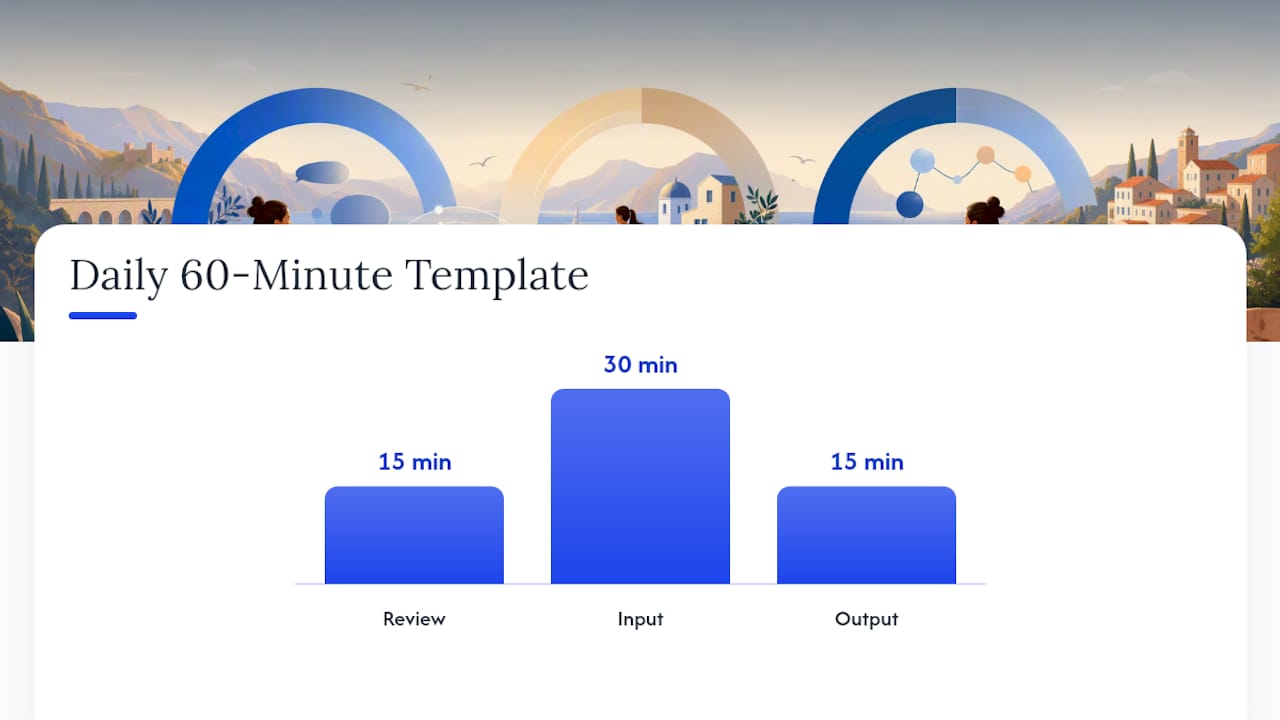
The daily template (about 60 minutes):
- 15 minutes review: go through your error journal and yesterday’s new vocabulary using active recall, not passive re-reading.
- 30 minutes calibrated input: narrow reading or listening in your chosen domain, aiming for 80 to 90 percent comprehension.
- 15 minutes forced output: a recorded monologue, a shadowing-plus exercise, or a short exchange with a partner.
Short on time? Cut the block to 10/15/10 rather than skipping days. Consistency beats duration here.
Week-by-week milestones:
- Week 1 to 2: pick your domain, run the four-skill audit, and start daily recordings even if they feel rough.
- Week 3 to 4: increase speaking turns from 15 to 30 seconds; log your first comprehension percentage baseline.
- Week 5 to 6: add a weekly conversation partner or tutor session focused purely on feedback, not new material.
- Week 7 to 8: retest all four skills and compare against your original audit.
Useful templates:
- Conversation partner brief: ask your partner to interrupt only for major errors, push you toward 30-second answers, and end each session with three corrected phrases you reuse the next day.
- Recording checklist: date, topic, duration, number of English switches, one phrase you want to reuse tomorrow.
- Error journal prompts: what did I want to say, what did I actually say, what is the correct form, when will I use it again this week.
This structure mirrors the 30-day domain-focused plan that intermediate learners use to force measurable gains through narrow input and daily production, and you can adapt the daily rhythm further using a structured practice routine if you want more example sessions to pull from.
How to Measure Progress and Avoid Common Pitfalls
Track four numbers weekly: comprehension percentage on a consistent type of clip, average speaking turn length, recovery rate (how often you paraphrase instead of freezing), and domain vocabulary depth (new words from your focus topic you can use unprompted). Log them in a simple spreadsheet or notebook. A five to ten point comprehension jump or an extra ten seconds of average turn length over two to three weeks counts as real movement. Flat numbers for a full month means it is time to change the input source or intensity, not just push harder on the same material.
Turn length and recovery rate matter more than time-on-app streaks at this stage, since app streaks measure consistency of habit, not gains in actual production ability.
Common pitfalls worth naming directly:
- Over-relying on beginner apps long after they stop challenging you, mistaking a green streak for genuine progress.
- Perfectionism during production, where fear of mistakes keeps you silent instead of talking through errors.
- Inconsistent feedback loops, going weeks without anyone correcting your Spanish, which lets fossilized errors calcify further.
- Time-consuming lookup workflows that turn a 20-minute reading session into 45 minutes of app switching.
Why Structured Feedback Speeds Up the Breakthrough
Self-study alone struggles with one specific problem: you cannot hear your own fossilized errors. If you have been saying “tengo veinte años” wrong for two years, no amount of solo practice fixes it, because the error feels correct to you. A guided feedback loop, someone flagging the mistake the moment it happens and drilling the corrected form, is what actually proceduralizes new patterns.
That is the real value a structured process adds beyond what self-study apps offer:
- Timely correction: mistakes get caught in the moment, not discovered months later.
- Calibrated materials: a tutor pitches input at your actual i+1 level instead of a generic B1 textbook chapter.
- Accountability: scheduled sessions force the daily output practice that solo learners tend to skip.
A structured study process built around these three elements, timely correction, calibrated input, and consistent output practice, tends to move learners past a plateau faster than adding more independent study hours ever does.
An Editorial Take on Breaking the B1 Plateau
The plateau advice most learners get is backwards. It tells you to consume more Spanish, more shows, more podcasts, more flashcard decks, when the real problem for most B1 learners sitting still is that they have never once measured anything or produced language under pressure. Passive exposure feels productive because it is comfortable. That comfort is exactly the problem.
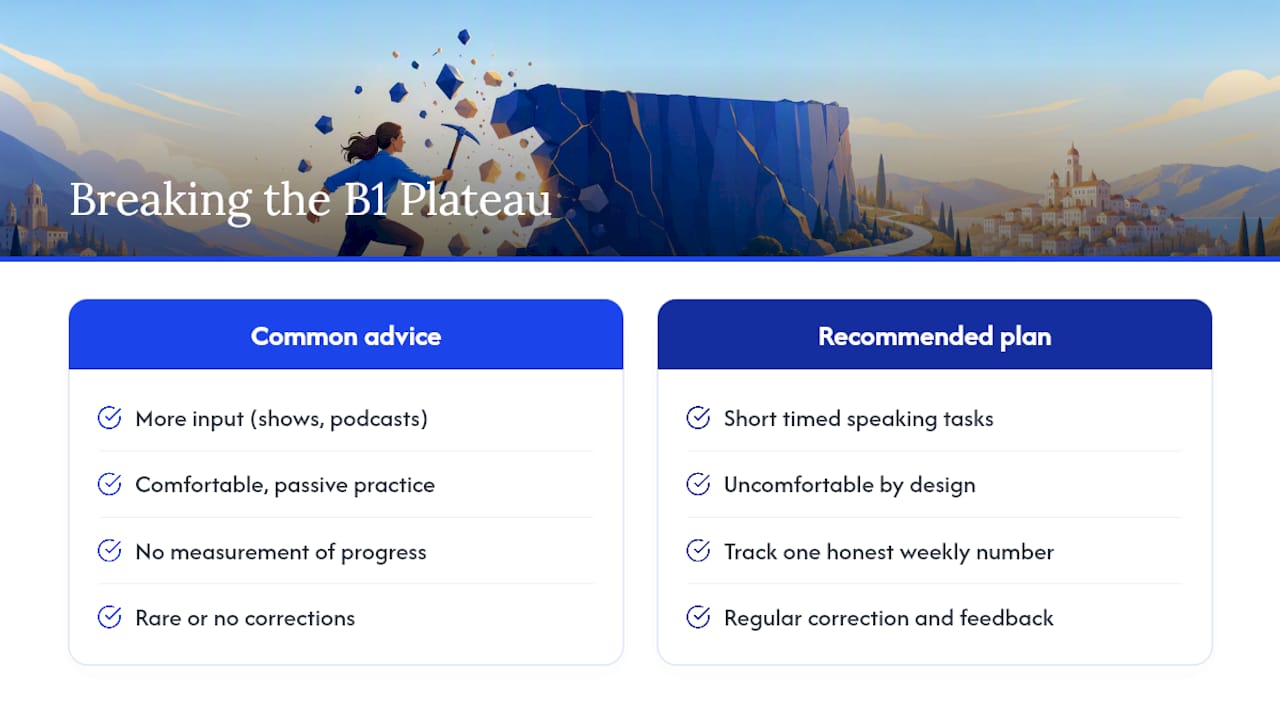
What the evidence actually supports is uncomfortable by design: short, timed speaking tasks that force you to talk before you feel ready, paired with input narrow enough to actually push your ceiling instead of just filling time. The learners who break through fastest are not the ones with the most study hours logged. They are the ones getting corrected regularly and tracking one honest number every week instead of a vague sense of “am I getting better?”
If you take one thing from this, prioritize output and feedback over more input. A guided structure, whether that is a tutor, a conversation partner, or a class built around correction, closes the gap that self-study cannot close alone.
— Paul
How Com Helps You Move From B1 to B2
If the audit above showed a real output deficit or fossilized errors nobody has corrected, that is precisely where guided practice earns its keep over another solo study app. Com runs adult group classes, private lessons, and online Zoom classes built around exactly the feedback loop this article describes: calibrated input pitched to your actual level, plus regular speaking practice with correction in the moment, not weeks later.

Group classes give you consistent conversation partners and structured push toward longer speaking turns. Private lessons work well if fossilized errors are the main issue, since a one-on-one tutor can target your specific patterns session after session. Both formats run from Com’s training center at 10 Anson Road, Level 22, International Plaza, Singapore 079903, right above Tanjong Pagar MRT, or fully online if that fits your schedule better.
Run your own four-skill audit this week, then book a trial class to see how targeted feedback changes your speaking turn length in a single session.
Sources
For deeper reading, the CEFR level descriptions explain what B1 and B2 actually require. The 30-day breakout plan and the 2026 science-backed guide both expand on the input and output methods covered here. For reducing lookup friction, look for reading tools that let you tap and save words without leaving the page.
- Common European Framework of Reference for Languages (CEFR) — level descriptions
- Escaping the intermediate plateau
- Why you plateau at B1 (and the 30-day plan to break out)
- Breaking through your language learning plateau: the 2026 science-backed guide
FAQ
What Is the 80/20 Rule for Learning Spanish?
Applied to language learning, it suggests roughly 20 percent of vocabulary and grammar patterns account for most everyday communication, so focusing on high-frequency words and structures within your chosen domain produces faster gains than spreading effort evenly across everything.
Why Is Spanish Considered So Difficult to Learn for Some Learners?
Spanish itself is relatively regular for English speakers, but plateaus happen because intermediate learners keep using beginner-level recognition tools, flashcards and simple apps, long after those tools stop challenging comprehension or production.
Can I Become Fluent in Spanish in 3 Months?
Meaningful conversational gains in three months are realistic with daily calibrated input and forced output, but full fluency at a B2 or higher level typically requires sustained practice well beyond that window, since vocabulary depth and automatic recall take longer to build.
What Is a Plateau in Language Learning?
A plateau is a period where measurable ability, comprehension percentage, speaking turn length, vocabulary recall, stays flat for several weeks despite consistent study, usually because the study method no longer matches the learner’s actual skill gaps.
Recommended
Start Learning Spanish Today
Book a trial class and see how quickly you can progress with a professionally trained native-speaker teacher guiding the way.
Book a Trial Class