 Spanish
TL;DR:
- Spanish listening comprehension involves understanding spoken Spanish through context and inference, not just word recognition.
- Practicing with familiar topics, deliberate strategies, and authentic audio materials accelerates skill development more effectively.
Spanish listening comprehension is the ability to understand spoken Spanish in real time by extracting meaning from context and inference rather than recognizing every individual word. According to the ACTFL framework, this skill centers on interpreting spoken input using context clues, prior knowledge, and inference rather than perfect word-by-word decoding. For adult learners pursuing conversational or professional Spanish, this distinction changes everything about how you should practice. The goal is not to catch every syllable. The goal is to understand what is being communicated.
What is Spanish listening comprehension and why does it matter?
Spanish listening comprehension, formally called interpretive listening in language education, is the process of actively connecting heard sounds with your existing knowledge of language and the world to construct meaning. The ACTFL Proficiency Guidelines define listening proficiency not as a single skill but as communicative ability across varied real-world spoken situations. This means your listening skill is measured by what you can do with spoken Spanish, not just what you can recognize.
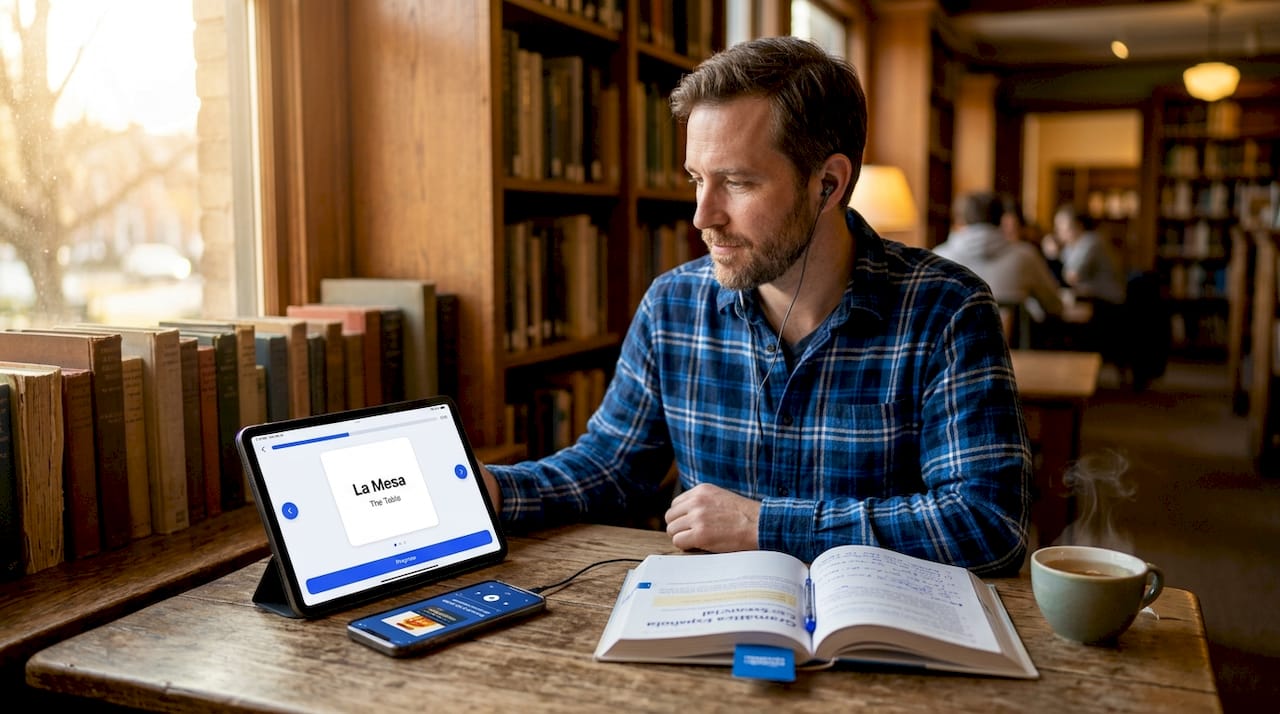
The practical implication is significant. Real-life conversations do not pause for you. A native speaker in Madrid, Mexico City, or Singapore’s Spanish-speaking business community will not slow down or repeat themselves indefinitely. Real-time comprehension requires processing speech as it happens, using context and inference to fill gaps when individual words are missed. Learners who train for this reality progress faster than those who chase perfect word recognition.
Spanish listening comprehension also differs meaningfully from what is Spanish reading comprehension. In reading, you control the pace. In listening, the speaker controls it. This makes audio comprehension a more demanding cognitive task, and it explains why many learners who read Spanish well still struggle to follow a native conversation.
What skills and subskills make up Spanish listening comprehension?
The ACTFL FACT criteria break listening proficiency into four dimensions: Functions and Tasks, Accuracy, Context and Content, and Text type. Together, these describe what a listener can do, how reliably they do it, in what situations, and with what kinds of spoken material. This framework is more useful than a simple “beginner to advanced” scale because it maps directly to real communication situations.
Within those four dimensions, several specific subskills drive comprehension:
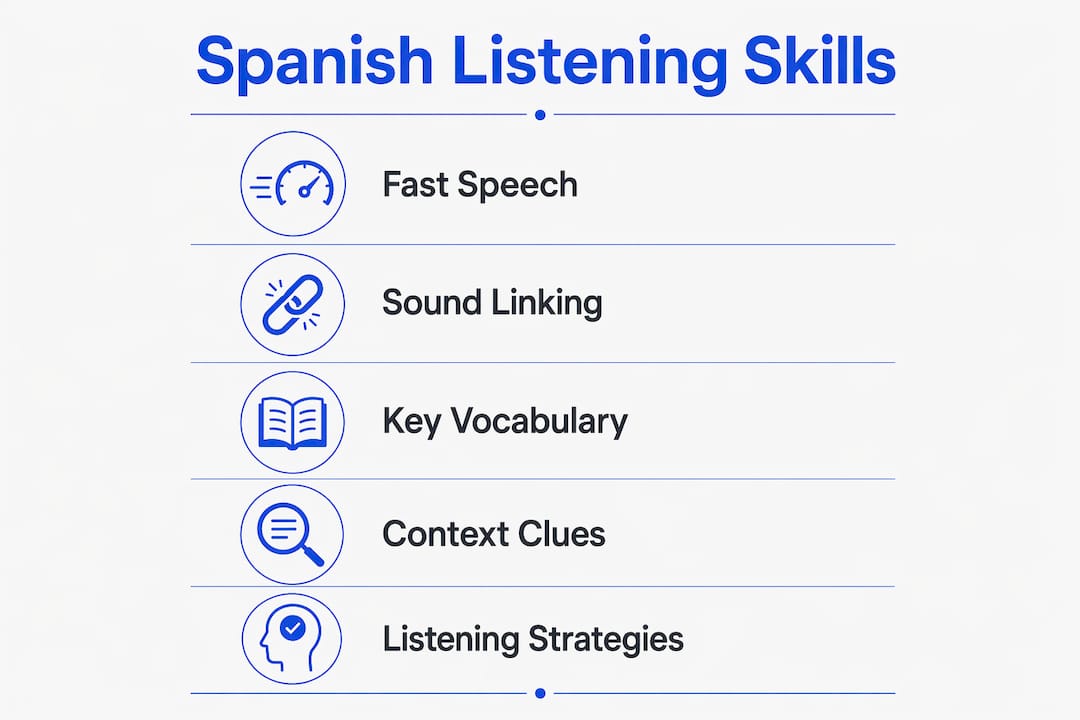
- Gist listening: Grasping the overall topic or main idea without understanding every word.
- Detail listening: Identifying specific facts, numbers, names, or instructions within a passage.
- Inferred meaning: Reading between the lines to understand speaker attitude, tone, or implied intent.
- Anticipatory listening: Using context and topic knowledge to predict what comes next, which reduces cognitive load.
- Connected speech processing: Recognizing how words link, blend, or drop sounds in natural spoken Spanish.
Fast speech is the most commonly cited challenge among learners. Native speakers link sounds across word boundaries, drop unstressed syllables, and speak at a pace that leaves little processing time. Cognitive load increases when learners try to decode every word, which is precisely why strategy training matters more than raw vocabulary size at intermediate and advanced levels.
Pro Tip: When you encounter fast speech you cannot follow, do not rewind immediately. Listen once for gist, then again for details. This trains your brain to work under real-time conditions rather than relying on the pause button.
How do topic familiarity and listening strategies improve comprehension?
A 2026 study on bilingual learners found that topic familiarity explains 13% of the variance in listening comprehension outcomes, while listening strategy use explains an additional 6%. Topic familiarity has the larger effect because prior knowledge lets you infer meaning even when specific words are unfamiliar. If you already know the topic is about a job interview, you can predict vocabulary, anticipate questions, and fill gaps intelligently.
This finding has a direct application for your practice routine. Choosing audio material on topics you already know well, whether business negotiations, travel, cooking, or current events, gives your brain a scaffold to work from. You are not starting from zero. You are matching new sounds to existing knowledge structures.
| Strategy | How it works | Best used when |
|---|---|---|
| Gist-first listening | Listen for overall meaning before focusing on details | First exposure to a new audio passage |
| Keyword spotting | Identify high-content words to anchor meaning | Fast speech or unfamiliar accents |
| Anticipatory listening | Predict content using topic and context knowledge | Before listening begins, during pre-listening phase |
| Chunking | Process speech in meaningful phrases, not word by word | Intermediate to advanced listening practice |
| Transcript review | Compare what you heard with the written text | Post-listening analysis and vocabulary building |
Strategy training produces measurable results. Listening for keywords over individual words reduces the cognitive pressure of real-time processing and keeps comprehension moving forward even when a word is missed. Learners who practice these strategies deliberately outperform those who rely on repeated passive exposure alone.
Pro Tip: Before you press play on any Spanish audio, spend 60 seconds activating your topic knowledge. Think about what vocabulary you already know on the subject. This simple pre-listening habit can noticeably improve how much you understand on the first listen.
What practical techniques can you use to build Spanish audio comprehension?
Structured listening practice produces faster gains than unstructured exposure. The most effective approach follows a three-phase method used by experienced language teachers worldwide.
- Pre-listening: Activate prior knowledge, preview the topic, and set a specific listening goal. Decide whether you are listening for gist, a specific detail, or speaker attitude before you press play.
- While-listening: Focus on your goal. Do not try to understand everything at once. Take brief notes on key words or phrases rather than attempting full transcription.
- Post-listening: Review what you understood, check against a transcript or subtitles if available, and identify the specific moments where comprehension broke down.
Authentic materials with transcripts are especially effective because they let you move between listening and reading to verify your understanding. Podcasts like Coffee Break Spanish, Notes in Spanish, and Español con Juan offer graded content with transcripts. YouTube channels from Spanish-language news networks like RTVE and Univision provide unscripted, natural speech that trains you for real conversations.
Language exchange platforms such as Tandem and HelloTalk connect you with native speakers for live conversation practice, which is the most direct form of Spanish listening practice available outside a classroom. Apps like Pimsleur and Speechling focus specifically on audio-based learning and give immediate feedback on comprehension. For learners building toward professional use, listening to business podcasts or recorded meetings in Spanish adds domain-specific vocabulary in a realistic context.
Repetition matters, but purposeful repetition matters more. Listening to the same passage three times with different goals, once for gist, once for detail, once for intonation and speaker attitude, builds more skill than listening to three different passages once each. This is how you develop the systematic practice routine that separates steady improvers from learners who plateau.
How can you assess and track your Spanish listening progress?
The ACTFL proficiency scale provides the clearest benchmark for tracking listening comprehension growth. At the Novice level, learners understand isolated words and memorized phrases on familiar topics. At Intermediate, they follow short conversations on everyday subjects. At Advanced, they comprehend extended speech, including narration and description, even when the topic is unfamiliar. Understanding where you sit on this scale tells you exactly what kind of audio material to target next.
The table below compares two practical self-assessment methods:
| Method | What it measures | Frequency |
|---|---|---|
| Repeated listening with comprehension questions | Accuracy of detail and gist retention | Weekly |
| Recording and reviewing your own listening notes | Gaps in vocabulary and inference skills | After each practice session |
Self-assessment works best when it is specific. After a listening session, ask yourself: Did I understand the main idea? Did I catch the key details? Where exactly did I lose the thread? This kind of targeted reflection is more useful than a general sense of whether the audio felt easy or hard. For a structured view of how proficiency levels map to listening benchmarks, external frameworks give you a clear progression path.
Seeking feedback from a qualified Spanish teacher accelerates this process significantly. A teacher can identify patterns in your comprehension gaps, such as consistent difficulty with a particular accent or with fast-paced informal speech, and design targeted practice to address them directly.
Key takeaways
Spanish listening comprehension improves fastest when learners combine topic familiarity, deliberate strategy use, and structured practice with authentic audio materials rather than passive repeated exposure.
| Point | Details |
|---|---|
| Definition of the skill | Listening comprehension means extracting meaning from context and inference, not recognizing every word. |
| ACTFL FACT framework | Proficiency is measured across Functions, Accuracy, Context, and Text type in real-world situations. |
| Topic familiarity effect | Choosing familiar topics for practice reduces cognitive load and improves comprehension by a measurable margin. |
| Gist-first strategy | Listening for overall meaning before details builds confidence and reduces comprehension anxiety. |
| Authentic materials | Podcasts, news audio, and transcripts with repeated purposeful listening produce the strongest skill gains. |
Why most learners practice listening the wrong way
I have worked with hundreds of adult Spanish learners, and the single most common mistake I see is this: they treat listening as a passive activity. They put on a Spanish podcast while commuting, half-follow it, and count that as practice. It is not. Passive exposure builds familiarity with the sound of Spanish, which has value, but it does not build the active processing skills that real conversations demand.
The second mistake is chasing difficulty too early. Learners find a native-speed news broadcast, understand almost nothing, and conclude they are bad at listening. What they are actually doing is practicing confusion, not comprehension. The research on topic familiarity is clear: start with content you know well, in Spanish you can mostly follow, and push the difficulty gradually. Confidence built on partial success compounds faster than frustration built on repeated failure.
What actually works, in my experience, is the combination of structured pre-listening, focused while-listening, and honest post-listening review. Pair that with a practical learning workflow and consistent feedback from a teacher who can identify your specific gaps, and progress becomes predictable rather than accidental. The learners I have seen make the fastest gains are not the ones with the most natural talent. They are the ones who practice with intention every single time.
— Paul
Build your listening skills with structured Spanish classes
Spanish Explorer offers adult Spanish courses in Singapore designed specifically for conversational and professional communication, with listening comprehension built into every lesson. Whether you prefer online Spanish classes via Zoom or a private Spanish class tailored to your pace and goals, the school’s certified instructors focus on real-world listening and speaking from day one. Group, private, and corporate formats are available, all taught by experienced teachers fluent in both Spanish and English. If you are ready to move from passive exposure to genuine comprehension, explore the full range of Spanish courses at Spanish Explorer and find the format that fits your schedule.
FAQ
What is Spanish listening comprehension exactly?
Spanish listening comprehension is the ability to understand spoken Spanish in real time by using context, inference, and prior knowledge to extract meaning. It does not require recognizing every word, only enough to understand what is being communicated.
How is listening comprehension different from reading comprehension?
Spanish reading comprehension lets you control the pace, while listening comprehension requires processing speech as it happens without the ability to pause or reread. This makes listening a more demanding real-time skill that requires specific strategy training.
How long does it take to improve Spanish listening skills?
Improvement depends on practice frequency and method, but learners who use structured techniques like gist-first listening and topic-familiar materials typically notice gains within four to six weeks of consistent daily practice.
What are the best resources for Spanish listening practice?
Podcasts like Coffee Break Spanish and Notes in Spanish, YouTube channels from RTVE and Univision, and language exchange apps like Tandem and HelloTalk are among the most effective resources for building Spanish audio comprehension at various levels.
Can a teacher really help with listening comprehension?
A qualified Spanish teacher can identify specific patterns in your comprehension gaps, such as difficulty with particular accents or fast speech, and design targeted practice that passive self-study cannot replicate. Structured feedback accelerates progress significantly.
Recommended
- Understanding Spanish: A practical guide for learners in Singapore
- Spanish Language Proficiency Levels Explained for Adults
- Master Spanish basics: a step-by-step guide for Singapore learners
Start Learning Spanish Today
Book a trial class and see how quickly you can progress with a professionally trained native-speaker teacher guiding the way.
Book a Trial Class