 Spanish
TL;DR:
- Spanish proficiency is a highly valuable career asset in 2026, significantly impacting salaries, hiring, and advancement. Most employers need Spanish skills but face shortages, offering professionals with the language a negotiation advantage and higher pay. Bilingualism also enhances executive functions and long-term cognitive health, providing further long-term benefits.
Spanish proficiency is defined as one of the most measurable career assets a professional can hold in 2026. The role of Spanish in career advancement goes well beyond communication. It directly affects salary, hiring outcomes, and long-term professional trajectory. Bilingual employees earn an average salary premium of 19%, with specialized roles reaching up to 35% higher pay. That is not a soft benefit. That is a concrete, negotiable financial advantage sitting on the table for professionals who invest in the language.
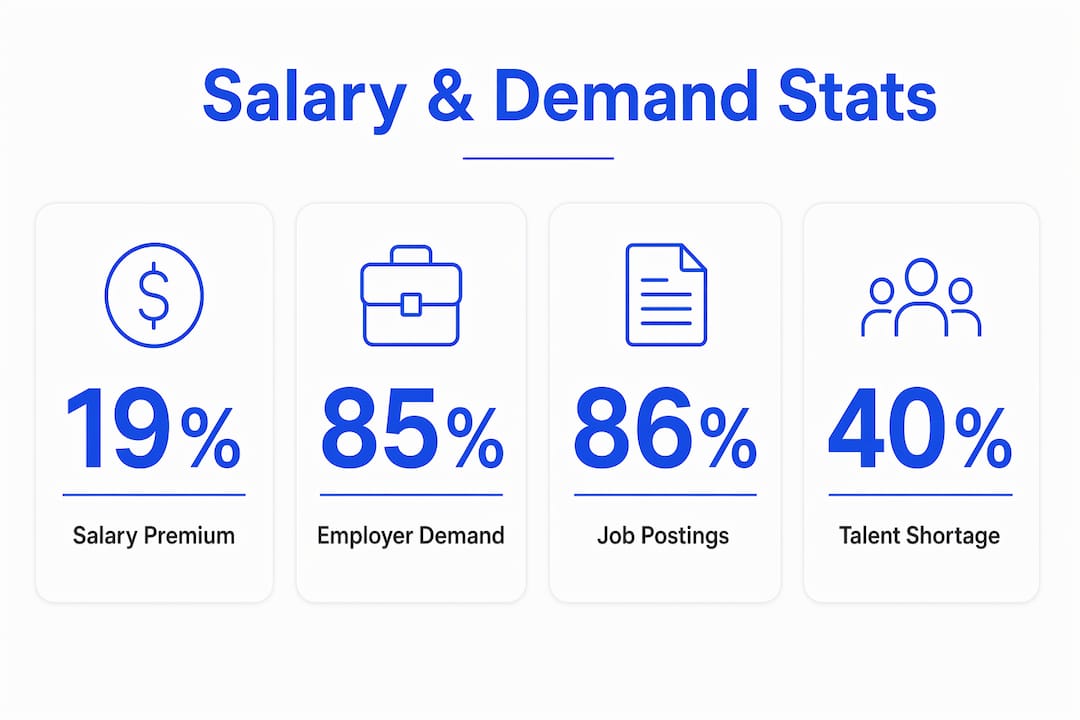
What salary benefits and job market demand exist for Spanish-speaking professionals?
The economic case for Spanish is built on hard numbers. Bilingual workers earn a 19% average salary premium, and 43% of multilingual professionals report annual earnings increases of at least $5,000 directly tied to their language skills. That premium compounds over a career, making Spanish one of the highest-return professional investments available.
Employer demand reinforces the salary story. 85% of companies rely on Spanish-speaking skills in their workforce, yet nearly 40% of those same employers report a shortage of qualified Spanish-speaking candidates. That gap is a direct opportunity for professionals who hold the skill.
The job posting data makes the picture even clearer. Spanish appears in 86% of all job postings requiring a second language. No other language comes close to that level of market penetration across bilingual roles.
| Metric | Data |
|---|---|
| Average bilingual salary premium | 19% above monolingual peers |
| Premium in specialized roles | Up to 35% higher pay |
| Workers reporting $5,000+ annual increase | 43% of multilingual professionals |
| Employers relying on Spanish skills | 85% of surveyed companies |
| Employers reporting Spanish talent shortages | Nearly 40% |
| Spanish share of bilingual job postings | 86% of all second-language listings |
The talent shortage is the detail most professionals overlook. When 85% of employers need Spanish skills but 40% cannot find qualified candidates, the professionals who hold that skill enter negotiations from a position of strength. That dynamic does not exist for most other professional credentials.
Which industries and roles benefit most from Spanish proficiency?
Spanish proficiency creates career advantages across a wide range of sectors, but the impact is not equal across all fields. Some industries pay a sharper premium and offer faster advancement for bilingual professionals.
The sectors where Spanish skills generate the clearest career lift include:
- Healthcare. Hospitals, clinics, and public health agencies actively recruit bilingual staff. Spanish-speaking nurses, physicians, social workers, and patient coordinators command higher pay and fill critical gaps in underserved communities.
- Education. Bilingual teachers and instructional coordinators are in high demand across the United States and internationally. Professionals with Spanish skills can access international teaching roles that monolingual candidates cannot reach.
- International business and finance. Sales directors, account managers, and financial advisors working with Latin American markets or Spanish-speaking client bases earn measurable premiums. Wall Street firms have specifically increased compensation for Spanish-speaking graduates in client-facing roles.
- Customer service and retail. Companies serving large Spanish-speaking populations prioritize bilingual representatives at every level, from frontline staff to team leads.
- Tourism and hospitality. Hotels, airlines, and travel agencies operating in Latin America or serving Spanish-speaking travelers treat bilingualism as a core competency, not a bonus.
- Diplomacy and international development. Government agencies, NGOs, and multilateral organizations working in Latin America require Spanish fluency for field and policy roles.
Emerging sectors are also raising their demand. Fintech companies expanding into Latin American markets, renewable energy firms operating in Spain and South America, and international development organizations all show growing appetite for Spanish-fluent professionals. Geographic location matters too. Professionals working in states with large Spanish-speaking populations, such as California, Texas, Florida, and New York, consistently see higher bilingual premiums than the national average.
How does bilingualism improve professional performance?
Bilingualism does more than add a line to a resume. Research confirms that learning and using a second language improves executive functions including selective attention, task-switching, and working memory. These are the exact cognitive tools that high-pressure professional environments demand every day.
Professionals who regularly use Spanish at work report stronger multitasking ability and faster decision-making under pressure. The brain’s constant management of two language systems builds mental flexibility that transfers directly to complex problem-solving and client communication. This cognitive edge is not limited to people who learned Spanish as children. Research shows the benefits apply regardless of the age at which a person acquires the language.
Pro Tip: If you already hold conversational Spanish skills, push yourself to use the language in professional contexts weekly, even informally. Active use in work settings accelerates the cognitive benefits and keeps your skills sharp for high-stakes moments.
“Bilingualism enhances critical thinking and multitasking skills vital for navigating complex professional environments.” — Spanish Authority
The long-term picture is equally compelling. Sustained bilingualism is associated with delayed onset of cognitive decline. For professionals planning 30-year careers, that is not a trivial detail. Staying mentally sharp longer translates directly into sustained performance and extended earning potential.
What practical strategies can professionals use to leverage Spanish skills?
Knowing Spanish is one thing. Positioning it effectively for career advancement is a separate skill entirely. Most professionals underuse their language abilities because they do not know how to surface them at the right moments.
Follow these steps to convert Spanish proficiency into concrete career gains:
-
Pursue formal certification. The American Translators Association credential and recognized proficiency assessments give HR departments a standardized way to verify and reward your skills. Formal credentials satisfy official job requirements and unlock salary differentials that informal self-reporting cannot access.
-
List Spanish skills with context on your resume. Specify your proficiency level and the professional contexts where you use it. “Conversational Spanish used in client-facing sales calls” carries more weight than a bare language listing.
-
Prepare to demonstrate Spanish in interviews. Spanish proficiency often acts as a tiebreaker during final hiring stages rather than an explicit job requirement. Candidates who can switch into Spanish naturally during an interview signal genuine fluency, not just resume padding.
-
Target job listings with language requirements. Roles that explicitly require or prefer Spanish speakers carry built-in salary premiums. Filtering your job search to include bilingual requirements puts you in a smaller, more competitive pool where your skills are directly valued.
-
Build industry-specific vocabulary. General conversational Spanish is a starting point. Professionals in healthcare need clinical terminology. Finance professionals need vocabulary for contracts, risk, and investment. The more specialized your Spanish, the harder you are to replace.
-
Invest in cultural competence, not just language mechanics. Understanding regional differences in business etiquette, communication styles, and relationship-building norms across Latin America and Spain separates genuinely effective bilingual professionals from those who simply translate words. Cultural fluency builds trust in ways that language alone cannot.
Pro Tip: Ask your employer whether your Spanish skills qualify for a formal pay adjustment. Many companies have bilingual pay policies that employees never request. The conversation itself signals initiative.
Is Spanish still relevant despite AI translation tools?

AI translation tools have improved significantly, but they do not replace bilingual professionals. AI cannot replicate the cultural nuance and trust-building that define effective bilingual communication in client-facing and high-stakes roles.
The gap is most visible in healthcare. Speaking Spanish in clinical settings lowers barriers to care by building trust and reducing stigma in ways that a translation app cannot achieve. A patient who feels genuinely understood by their provider responds differently than one communicating through a screen. That human connection has direct outcomes for care quality and patient compliance.
The same principle applies in sales, negotiation, and relationship management. Clients who sense that a professional understands their cultural context, not just their words, extend more trust and more business. The roles where this matters most include:
- Healthcare providers and patient navigators
- Sales representatives managing Latin American accounts
- Legal professionals working with Spanish-speaking clients
- HR professionals in bilingual workplaces
- Customer success managers at companies with Spanish-speaking user bases
Globalization continues to expand the demand for human bilingual skills. 39.9% of bilingual job postings are now remote, which means Spanish-speaking professionals in Singapore can compete for roles based in the United States, Spain, or Latin America without relocating. That geographic flexibility is a structural advantage that grows as remote work becomes the norm in knowledge-economy roles.
Key takeaways
Spanish proficiency delivers a measurable salary premium, reduces direct competition in hiring, and builds cognitive skills that compound across an entire career.
| Point | Details |
|---|---|
| Salary premium is real and significant | Bilingual professionals earn 19% more on average, up to 35% in specialized roles. |
| Employer demand outpaces supply | 85% of companies need Spanish skills, but 40% cannot find qualified candidates. |
| Certification converts skills to credentials | ATA credentials and proficiency assessments satisfy HR requirements and unlock formal pay differentials. |
| Cognitive benefits extend beyond language | Bilingualism improves executive function, multitasking, and long-term mental sharpness. |
| AI does not close the gap | Human bilingual professionals remain essential in healthcare, sales, and client-facing roles where cultural trust matters. |
Why I think most professionals are sitting on an untapped asset
Paul here. After years of working with professionals who are building careers across international markets, the pattern I see most often is this: people who speak Spanish treat it as a background fact about themselves rather than a front-line career tool.
They list it on a resume and then never bring it up again. They do not mention it in interviews unless asked. They do not request a bilingual pay adjustment. They do not seek out roles where the skill is explicitly valued. That is a significant missed opportunity, and it is almost entirely a positioning problem, not a skills problem.
The professionals I have seen advance fastest with Spanish are the ones who make it visible. They volunteer to handle Spanish-speaking client calls. They ask to join Latin American market projects. They get certified so the credential does the talking when they are not in the room. Cultural competence is the piece that separates them further. Knowing that business relationships in Mexico are built differently than in Argentina, or that directness reads differently in Spain than in Colombia, is the kind of knowledge that builds client loyalty over years.
My honest advice: treat your Spanish as a specialty, not a footnote. The career benefits of Spanish are well documented, but they only materialize for professionals who actively put the skill to work.
— Paul
Spanish Explorer: adult Spanish courses built for career-focused professionals
Spanish Explorer offers adult Spanish courses designed specifically for professionals who want to use the language at work, not just on vacation. Whether you need conversational fluency for client meetings, business Spanish for Latin American markets, or flexible online learning that fits around a full schedule, Spanish Explorer has a format that works.

Courses run as group classes, private sessions, and corporate training programs. All instruction is delivered by certified, bilingual teachers at the school’s central Singapore location above Tanjong Pagar MRT, or via live online classes. If you are ready to turn Spanish into a concrete career asset, the adult Spanish courses at Spanish Explorer are the structured, practical place to start.
FAQ
How much more do bilingual Spanish speakers earn?
Bilingual employees earn an average salary premium of 19%, with specialized roles reaching up to 35% higher pay. 43% of multilingual workers report annual earnings increases of at least $5,000 tied directly to their language skills.
Does Spanish proficiency help in job interviews?
Spanish proficiency frequently acts as a tiebreaker in final hiring stages, giving candidates an edge even when the role does not explicitly require bilingual skills. Demonstrating the language naturally during an interview signals genuine fluency and professional readiness.
Which industries pay the most for Spanish skills?
Healthcare, international finance, education, and customer-facing sales roles consistently offer the highest premiums for Spanish-speaking professionals. States and markets with large Spanish-speaking populations amplify those premiums further.
Can AI translation tools replace bilingual professionals?
AI translation tools cannot replicate the cultural nuance and trust-building that define effective bilingual communication in healthcare, sales, and client-facing roles. Human bilingual professionals remain essential wherever relationship quality drives outcomes.
What certifications validate Spanish proficiency for employers?
The American Translators Association credential and recognized language proficiency assessments provide standardized proof of Spanish skills that HR departments can formally evaluate. These credentials satisfy official job requirements and help access documented salary differentials.
Recommended
- Spanish Training for Professionals: Your Career Guide
- Why Study Spanish in 2026: Benefits Worth Knowing
- Spanish Language Proficiency Levels Explained for Adults
Start Learning Spanish Today
Book a trial class and see how quickly you can progress with a professionally trained native-speaker teacher guiding the way.
Book a Trial Class