 Spanish
TL;DR:
- Consistent daily reading at the appropriate level improves Spanish vocabulary, comprehension, and fluency. Using graded readers, chunking, and repetition drills accelerates progress, especially when enjoyment and motivation are prioritized. Tracking tasks like retelling and timed reading helps measure steady advancement.
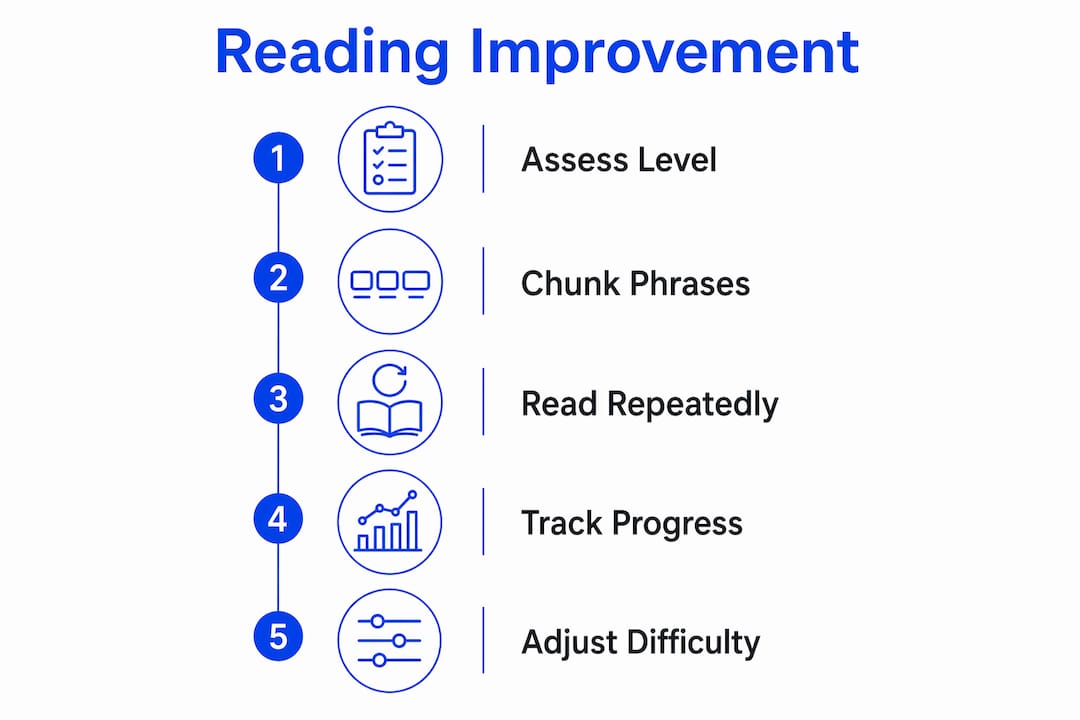
The Spanish reading improvement process follows five steps: Assess → Habit → Practice → Review → Progression. Start by finding your level and picking the right graded reader. Build a daily extensive-reading habit. Add chunking and repeated-reading drills. Review new vocabulary briefly. Then raise the difficulty when you’re ready.
Here’s the roadmap at a glance:
- Assess: Take a quick level check and pick a graded reader where you understand roughly 95% of the text.
- Habit: Read for pleasure daily, even 15 minutes, using material you actually enjoy.
- Practice: Do chunking drills and repeated-reading passes to break word-by-word decoding.
- Review: Spend 10 minutes on targeted vocabulary using spaced repetition.
- Progression: Move up a level when you can read a full page with fewer than 2–3 lookups.
Sample week (30–60 minutes/day):
- Monday: 15-min graded reader + 10-min chunking drill
- Tuesday: 20-min pleasure read (topic you enjoy)
- Wednesday: 15-min repeated reading (same short passage, 4 passes) + 10-min vocabulary review
- Thursday: 20-min graded reader + audio sync if available
- Friday: 15-min pleasure read + 5-min retell exercise (summarize aloud)
- Saturday: 30-min longer read, new material, one level up as a test
- Sunday: Rest or 10-min light review
Table of Contents
- Why this process produces measurable results
- The step-by-step reading improvement process in detail
- Practical exercises and a 4-week plan
- Resources that actually support this process
- How to measure progress and set realistic milestones
- Common obstacles and quick fixes
- Key Takeaways
- What actually separates learners who improve from those who stall
- Spanish Explorer: structured reading support for adult learners
- FAQ
- Useful sources and further reading
Why this process produces measurable results
Extensive reading produces gains across vocabulary, comprehension, fluency, writing, and speaking, according to a 2025 meta-analysis by Sangers et al. in Educational Psychology Review. That’s not one skill improving in isolation. It’s the whole system moving together, which is why pleasure-based reading sits at the center of this process rather than grammar drills.
The mechanism behind it is Paul Nation’s 95–98% comprehensibility rule: when you understand 95–98% of the words on a page, your brain acquires new vocabulary incidentally, without conscious effort. Below 95%, the cognitive load is too high and acquisition stalls. Above 98%, there’s almost nothing new to absorb. Graded readers hit that sweet spot by design.
“Reading for pleasure (free voluntary reading) is more effective long-term than reading strictly for study. Enjoyment sustains the consistency required for fluency.” — Extensive reading hypothesis, practitioner consensus
Chunking works for a different reason. Phrase-based reading shifts your brain from processing one word at a time to processing grammatical groups, which is how fluent readers actually read. Instructors who use chunking drills in class consistently report faster reading speed and less fatigue within a few weeks.
The step-by-step reading improvement process in detail
-
Assess your level and select a graded reader. Use a free online placement test or read a page of graded material. If you’re looking up more than 2–3 words per page, the text is too hard. Drop one level. Success looks like reading a full page without stopping.
-
Build a daily extensive-reading habit. Fifteen minutes of pleasure reading beats a two-hour study session you skip three days later. Pick topics you’d read about in English: news, sports, travel, food. Consistency over intensity.
-
Add focused practice: chunking and repeated reading. Mark phrase boundaries in a short paragraph (subject / verb / object / modifier). Read it aloud in chunks, not word by word. Then read the same passage 4–5 times until it flows. This is the drill that breaks the decoding bottleneck.
-
Review vocabulary and grammar briefly. Ten minutes with a spaced-repetition app after reading locks in words you flagged. Don’t study lists in isolation. Review words in the sentence where you found them.
-
Progressively raise difficulty. When you can read a full page of your current level with fewer than 2–3 lookups, move up. Track pages per week. If your speed and comprehension hold, the new level is right.
Pro Tip: Avoid reaching for the dictionary every time you hit an unknown word. Push through the sentence, use context, and only look up a word if it blocks meaning entirely. Pair audio with text from the intermediate stage onward to train pacing and prosody simultaneously.
Practical exercises and a 4-week plan
Chunking drill: Take any paragraph from your graded reader. Draw a slash between each meaningful phrase. Read aloud, pausing at each slash. Aim for 10 minutes per session. By week two, you’ll notice you’re reading phrases without marking them first.
Repeated reading script: Choose a 100–150 word passage. Read it once silently, once aloud slowly, once aloud at normal pace, and once more at a slightly faster pace. Four passes total. Record yourself on the final pass and compare it to the first.
Cloze exercise: Copy a short paragraph and delete every seventh word. Fill in the blanks from memory or context. This forces you to read for meaning rather than decoding.
4-week progression:
- Week 1: 15-min pleasure read + 10-min chunking drill daily. Stick to your current level.
- Week 2: Add a 10-min repeated-reading session three times a week. Introduce audio pairing on two days.
- Week 3: Increase pleasure reading to 20 minutes. Try one page at the next level up on Friday.
- Week 4: Mix intensive and extensive reading. Spend two days on close-reading drills, three days on free reading. Assess: are you hitting fewer than 2–3 lookups per page at the new level?
For a daily practice routine that fits around work, a 10-minute version works: one chunking drill only. A 20-minute version adds a pleasure read. Forty-five minutes covers all three elements.
Resources that actually support this process
- Graded readers: Graded readers outperform native-level texts at A1–B1 stages. Publishers like Penguin Readers (Spanish editions) and Alma Classics offer controlled-vocabulary titles. Use them as your primary reading material until B1.
- Audiobooks with text: Audible and Learning Spanish Like Crazy offer audio-text pairings. Use read-while-listening from A2 onward to train prosody and pacing alongside decoding.
- Learner-focused news: News in Slow Spanish (podcast + transcript) and El País América (simplified sections) give real-world vocabulary at a manageable pace for B1+ learners.
- Reading apps with tap-to-translate: LingQ and Readlang let you tap unknown words without breaking reading flow. Use sparingly; the goal is to reduce lookups over time, not to make them frictionless forever.
- Spaced-repetition tools: Anki is the standard. Save words in the sentence where you found them, not as isolated items. Review for 10 minutes after each reading session.
- Music and rhythm: Learning Spanish with songs builds prosody awareness that transfers directly to reading fluency, especially for learners who struggle with pacing.
Integrate these tools by saving flagged words to Anki immediately after reading, then reviewing before the next session. Track minutes read per day in a simple log.
How to measure progress and set realistic milestones
Measurable progress shows up in task-based checks, not vocabulary counts. Pages per week, reading speed in words per minute, and a two-minute retell are more reliable signals than how many words you’ve studied.

| Milestone | Approx. study hours | Practical reading target |
|---|---|---|
| A2 | 150–200 hours | Short graded texts; 95% comprehension |
| B1 | 350–450 hours | Graded readers + simple news; 95% comprehension |
| B2 | — | Authentic texts; minimal lookups |
Simple measurement templates:
- Retell rubric: After reading, summarize in 2 minutes without notes. Score yourself: Did you capture the main idea? Two supporting details? Any new vocabulary used correctly?
- Comprehension quiz: Write three questions before you read, answer them after. If you miss two of three, the text is too hard.
- Timed reading: Count words read in one minute. Track weekly. A rising trend means fluency is building.
Retest every two weeks. If speed and comprehension stall for three consecutive weeks, drop one level and add more audio pairing. For goal-setting frameworks that pair with these milestones, structured templates help keep progress visible.
Common obstacles and quick fixes
| Problem | Quick fix |
|---|---|
| Word-by-word decoding | Switch to chunking drills; mark phrase boundaries before reading |
| Dictionary dependence | Allow max 2–3 lookups per page; push through the rest with context |
| Boredom / low motivation | Switch to a topic you’d read about in English; try active learning techniques |
| Plateau (no progress) | Drop one level, increase volume, add audio pairing |
| Low reading stamina | Start with 10-minute sessions; add 5 minutes per week |
| Pronunciation confusion | Add read-while-listening; audio trains prosody faster than text alone |
Pro Tip: Habit-stack your reading onto something you already do. Read during your morning coffee, your commute, or right before bed. Pairing it with an existing habit removes the decision of when to start.
When progress stalls, the fix is almost always more volume at a slightly lower level, not harder material. Plateaus are normal and usually break within two to three weeks of steady, enjoyable reading.
Key Takeaways
A consistent daily habit at the right difficulty level is the single most important factor in improving Spanish reading skills.
| Point | Details |
|---|---|
| Assess before you start | Pick material where you understand 95% of words; max 2–3 lookups per page. |
| Extensive reading drives gains | A 2025 meta-analysis found pleasure reading improves vocabulary, comprehension, and fluency together. |
| Chunking breaks the bottleneck | Phrase-based reading drills shift processing from single words to meaningful groups, cutting fatigue. |
| Measure with tasks, not word counts | Track pages per week and use retell + timed reading checks every two weeks. |
| Spanish Explorer for structured support | Instructor-led courses at Spanish Explorer give adult learners graded input and real-time feedback. |
What actually separates learners who improve from those who stall
Most adult learners who plateau are reading material that’s either too hard or too boring. The research is clear: the right level plus genuine enjoyment is the combination that keeps daily practice alive. Consistency at a comfortable level beats occasional heroic effort at a level that exhausts you.
What instructors see repeatedly is that learners who choose topics they care about, whether that’s business news, travel writing, or fiction, read more often and retain more. The content pulls them back. Learners who treat reading as a chore find reasons to skip it.
The chunking transition is the other inflection point. Once a learner stops reading word by word and starts reading in phrases, speed and comprehension both jump. It usually happens faster than learners expect, often within two to three weeks of daily drills.
Start today with 15 minutes of a graded reader at your level. That’s the whole plan in its simplest form.
Spanish Explorer: structured reading support for adult learners
Reading improvement accelerates when you have a teacher who can calibrate your level, correct your comprehension errors in real time, and push you to the next stage at the right moment. That’s the gap self-study alone rarely closes.

Spanish Explorer’s adult Spanish courses in Singapore are taught by certified native-speaking instructors fluent in both Spanish and English, which means you get graded input, immediate feedback, and a structured progression from A1 through to conversational and business levels. Group classes, private sessions, and live online Zoom options are all available, so the format fits your schedule. If you want reading practice embedded in a real curriculum rather than managed entirely on your own, book a class with Spanish Explorer and get started this week.
FAQ
How long does it take to reach B1 Spanish reading level?
B1 typically requires about 350–450 hours of study and reading exposure. Daily 30-minute sessions with graded readers and vocabulary review can get you there with consistent effort over many months.
What is the 95% comprehension rule in Spanish reading?
Paul Nation’s research establishes that you need to understand 95–98% of words on a page for incidental vocabulary acquisition to happen. If you’re looking up more than 2–3 words per page, the text is too difficult.
What are the best resources for improving Spanish reading skills?
Graded readers (Penguin Readers Spanish editions), News in Slow Spanish, LingQ, and Anki for spaced repetition are strong starting points. Pair audio with text from A2 onward for faster fluency gains.
How do I know when to move to harder Spanish reading material?
Move up when you can read a full page with fewer than 2–3 dictionary lookups and your timed reading speed is holding steady or increasing. If comprehension drops sharply at the new level, return to the previous one for two more weeks.
Does reading in Spanish really improve speaking?
Yes. Extensive reading builds vocabulary, grammar intuition, and exposure to natural sentence patterns, all of which transfer directly to speaking. A 2025 meta-analysis confirmed reading gains extend across multiple language skills, including oral production.
Useful sources and further reading
- Eppika — How to Learn Spanish Through Reading: Covers the extensive reading hypothesis and the 95–98% comprehension rule with practical level-by-level guidance. Best for theory plus application.
- Language Transfer — How to Practice Spanish Reading: Practitioner-focused guide on the 2–3 lookups-per-page rule and building a reading habit. Best for practical routines.
- SpanishStep — Improve Reading Fluency in Spanish: Detailed breakdown of chunking and repeated-reading techniques with classroom context. Best for drill templates.
- Linguadrop — Improve Spanish Reading Fluency: Covers read-while-listening, realistic hour estimates for A2 and B1, and tracking methods. Best for milestones and audio integration.
- Rosetta Stone — Spanish Reading Practice: Level-by-level tips for beginner through advanced learners, including interest-based reading strategies. Best for beginners choosing their first materials.
Recommended
Start Learning Spanish Today
Book a trial class and see how quickly you can progress with a professionally trained native-speaker teacher guiding the way.
Book a Trial Class