


TL;DR:
- Getting proficient in Spanish tailored for business is essential for building credibility in professional settings requiring tone and register.
- Practicing role-specific vocabulary, active listening, and real-time feedback accelerates genuine workplace communication skills, not just grammar.
You already know enough Spanish to get by. The problem is that “getting by” costs you credibility in boardrooms, on client calls, and in high-stakes negotiations where tone and register matter as much as vocabulary. This spanish training for professionals guide cuts through the noise of generic language advice and gives you a practical, role-specific roadmap. Whether you are stepping into a new market, managing Spanish-speaking teams, or pitching to Latin American clients, what you need is not just more Spanish. You need the right Spanish, delivered the right way.
Table of Contents
- Key takeaways
- What this Spanish training for professionals guide covers first
- Step by step: building corporate Spanish that actually works
- Common mistakes that stall corporate Spanish training
- Measuring real progress in professional Spanish
- My honest take on what separates real progress from stagnation
- How Spanish Explorer can support your professional Spanish goals
- FAQ
Key takeaways
| Point | Details |
|---|---|
| B1 proficiency is the baseline | Reach at least intermediate Spanish before enrolling in specialized corporate training programs. |
| Build a role-specific phrase bank | Tailor your vocabulary to your job function for faster recall in live workplace situations. |
| Listening comes first | Prioritize listening comprehension over grammar drills to function effectively in real meetings. |
| Feedback accelerates results | Regular feedback on tone, pronunciation, and register beats self-study alone every time. |
| Measure progress with real tasks | Use recorded presentations and drafted emails to verify competency, not just quiz scores. |
What this Spanish training for professionals guide covers first
Assessing where you actually stand
Before you book a corporate Spanish training program, you need to be honest about your current level. Most business Spanish courses require at least B1 proficiency before enrollment, and that prerequisite exists for a reason. Specialized vocabulary, formal register, and industry shorthand make zero sense if you are still struggling to construct conditional sentences or follow a native speaker at conversational speed.
Take a free online placement test or request a proficiency assessment from your language school. Map your results against the Common European Framework of Reference (CEFR) scale. A1 to A2 means you need general Spanish first. B1 and above means you are ready to specialize.
Setting goals that reflect your actual job
Vague goals produce vague progress. Instead of saying “I want to improve my business Spanish,” define the exact scenarios you need to handle. Do you run weekly video calls with counterparts in Mexico City? Do you review contracts written in Spanish? Are you presenting to executives in Madrid?
Each of these demands a different skill emphasis. The professional who needs to read contracts should prioritize reading comprehension and legal register. The one running calls needs listening and speaking under pressure. Write down your top three workplace scenarios and use them as the filter for every training decision you make.

Organizing your resources before you start
Here is a quick overview of what effective preparation looks like before your first corporate Spanish lesson:
| Resource | Purpose |
|---|---|
| Role-specific vocabulary list | Build a starting phrase bank using job-function terms |
| Recording device or app | Capture and review your own speaking for self-assessment |
| Sample professional documents | Practice reading real emails, reports, and meeting agendas |
| Study schedule | Block 20 to 30 minutes daily rather than long weekend sessions |
| Qualified instructor | Find a teacher with real business communication experience |
Set these up before day one and you will cover ground significantly faster than someone starting blind.
Step by step: building corporate Spanish that actually works
Follow this sequence carefully. Skipping steps creates gaps that surface at the worst possible moment, usually mid-conversation with a client.
-
Build your personal phrase bank. Start by building a phrase bank targeted to your job function. Use sticky notes on your monitor, add phrases to draft emails you write in English first, and force yourself to swap in Spanish equivalents. This is not about memorizing a textbook. It is about encoding the exact language your role demands.
-
Prioritize listening before speaking. Listening comprehension is the most urgent skill in workplace Spanish because professional environments involve fast speech, regional accents, and industry shorthand that no textbook prepares you for. Before drilling your speaking, spend two weeks simply consuming authentic Spanish content: earnings calls, Spanish-language business news, or recorded team meetings if you have access to them.
-
Practice speaking with structured drills on tone and formality. Spanish has a pronounced hierarchy in professional settings. How you address a senior colleague in Mexico differs from how you address a peer in Buenos Aires. Work with a qualified instructor to run speaking drills that address formality levels (usted vs. tú), polite requests, and softened disagreement phrasing. These are the nuances that separate functional Spanish from genuinely professional Spanish. Review how to structure workplace Spanish lessons for concrete frameworks you can apply immediately.
-
Read and write professional documents weekly. Business Spanish emails require formal tone and correctness because poor tone undermines professionalism even when grammar is technically correct. Draft one professional email per week in Spanish, have it reviewed, and analyze the corrections. Do the same with short reports or meeting summaries. Writing forces precision in a way that speaking alone never does.
-
Set your study cadence and protect it. Daily sessions of 20 to 30 minutes, five days a week, outperform long weekend marathon sessions in every retention study. Block the time in your calendar the same way you would a client meeting. Treat it as non-negotiable.
Pro Tip: Change one existing work habit into a Spanish practice moment. Read the first email you draft each morning in Spanish before switching to English. Over time, small insertions compound into genuine fluency.
Common mistakes that stall corporate Spanish training
Even motivated professionals plateau. Here is what usually causes it:
-
Over-focusing on grammar rules instead of practical use. Grammar is the scaffolding, not the building. Professionals who spend 80% of their study time on grammar exercises and 20% on actual communication practice end up with technically accurate Spanish that sounds unnatural and slow in real conversations.
-
Ignoring the cultural layer. Spanish is not just a language. It is a set of cultural expectations around hierarchy, directness, and relationship-building. Tutors without business experience often miss this entirely, focusing on correct sentences while neglecting whether those sentences actually fit the professional context.
-
Treating all Spanish as equivalent. Spanish from Spain, Mexico, Colombia, and Argentina varies significantly in vocabulary, formality conventions, and idioms. Know which regional variety your primary audience uses and train specifically toward it.
-
Skipping feedback. Self-study without correction allows mistakes to fossilize. Consistent feedback on pronunciation, syntax, and tone accelerates improvement far more than grammar drills because it targets the exact habits holding you back.
-
Waiting until you feel ready to speak. Nothing replaces the pressure of live interaction. Role-playing workplace scenarios with a native speaker prepares you for the unpredictability of real professional conversations in a way that solo practice cannot replicate.
The most effective approach to corporate Spanish training is not about achieving perfection before you speak. It is about getting accurate, specific feedback early so you build correct habits from the start.
When motivation dips, revisit your original scenario list. Find one real task you can attempt in Spanish today, even imperfectly, and do it. Progress is rarely linear, but consistent exposure keeps the momentum alive.
Measuring real progress in professional Spanish
Knowing you have improved is one thing. Proving it to yourself and being ready to use it at work is another. Here is how to verify your progress meaningfully:
| Milestone | How to verify it |
|---|---|
| Can hold a formal phone conversation | Record a five-minute mock client call and compare with a native example |
| Can write professional emails with correct tone | Draft and submit emails for instructor review; track error reduction over time |
| Can follow a meeting without replay | Listen to a recorded business meeting and summarize the key decisions in writing |
| Can present a short topic with confidence | Record a five-minute presentation and review for clarity, tone, and pacing |
| Can manage unexpected questions | Participate in an unscripted role-play with an instructor or native speaker |
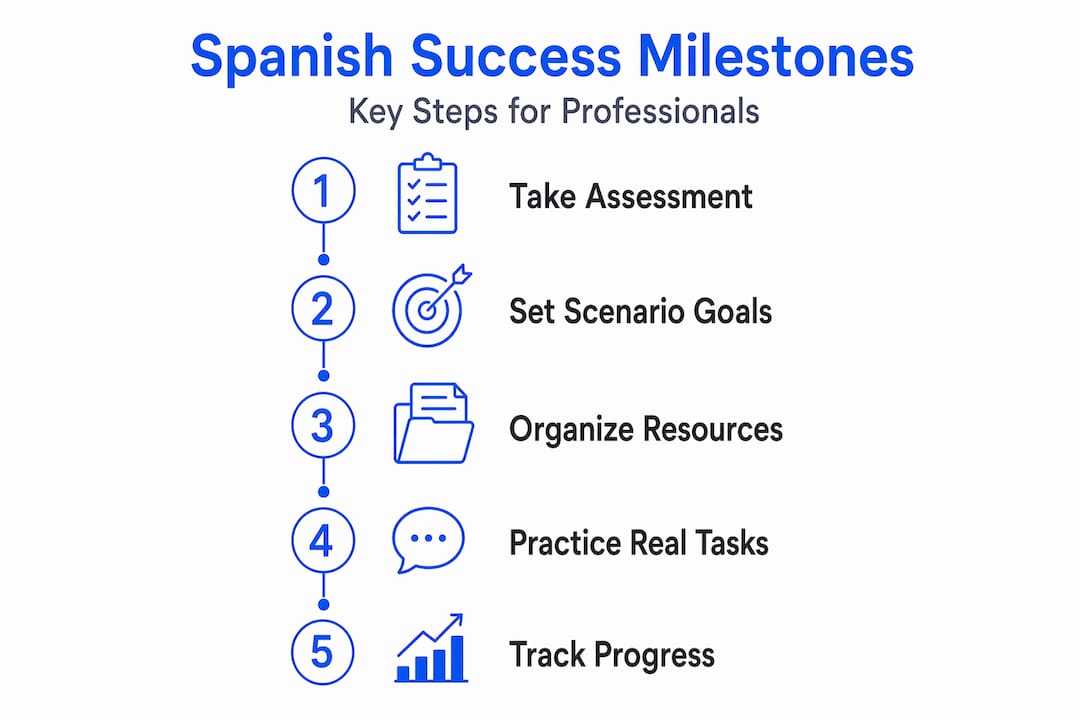
The goal is not to hit these milestones in order. It is to use them as a reality check every four to six weeks. Recording yourself and comparing the playback with native professional examples improves accuracy and tone faster than any grammar exercise you will find in a textbook.
Pro Tip: After every role-play or recorded session, write down three specific things you want to fix before the next one. This turns review into a targeted improvement cycle rather than a vague self-critique.
Once you hit consistent competency in your top three workplace scenarios, plan your next phase. That might mean expanding to a new regional variety of Spanish, tackling written negotiations, or moving from operational conversation to executive-level presentation skills. Professionals succeed when their Spanish signals respect, commitment, and trust. That level of communication goes well beyond correct grammar and is always worth continuing to develop.
My honest take on what separates real progress from stagnation
I have worked with professionals at every stage of Spanish language development, and the pattern I see repeatedly is this: the learners who succeed fastest are not the ones who study hardest. They are the ones who use their Spanish under pressure, earlier than feels comfortable.
The instinct to wait until you are fluent before speaking in a professional context is completely understandable and almost always counterproductive. Every week you spend drilling in isolation is a week you are not collecting real feedback from real interactions. The professional who drafts an imperfect Spanish email to a client in week three learns more from that one exchange than from three more weeks of grammar review.
What also matters enormously is finding an instructor who has operated in business environments, not just someone who speaks the language well. Language accuracy and professional communication competence are different skills. You need both in a teacher. When you find that combination, the progress is noticeably faster and the confidence you build translates directly to actual workplace moments, not just classroom performance.
View your Spanish as a career asset that compounds over time. Every interaction, every corrected email, every uncomfortable meeting you push through adds to a professional profile that your monolingual colleagues simply cannot match.
— Paul
How Spanish Explorer can support your professional Spanish goals
Spanish Explorer runs tailored professional Spanish courses specifically designed for working adults who need functional, professional-grade language skills, not just conversational basics. Programs cover business communication, professional writing, and role-specific speaking scenarios led by certified instructors who bring real-world corporate experience to every session.
For professionals with tight schedules, private Spanish classes offer fully customized curricula built around your job function, industry, and target markets. Online Zoom sessions are also available, so geography and office hours are no barrier to consistent progress. Companies looking to train teams can access corporate group programs designed to align Spanish skills with actual business objectives. Spanish Explorer is located at 10 Anson Road, Level 22, International Plaza, Singapore 079903, right above Tanjong Pagar MRT, making it easy to attend in person or connect online.
FAQ
What is corporate Spanish training?
Corporate Spanish training is a specialized form of Spanish language instruction focused on the vocabulary, tone, and communication conventions used in professional and business environments. It goes beyond general language learning to address workplace scenarios such as meetings, negotiations, emails, and presentations.
What level of Spanish do I need before starting business Spanish courses?
Most specialized business Spanish courses require at least a B1 intermediate level before enrollment, as professional contexts demand comfort with complex vocabulary and formal register.
How long does it take to become proficient in professional Spanish?
Progress depends on your starting level and study frequency, but professionals who train consistently at 20 to 30 minutes daily typically see measurable workplace competency within three to six months of structured corporate Spanish training.
Why should I choose a tutor with business experience?
Instructors with corporate experience understand the cultural nuances of tone, hierarchy, and professional phrasing that general language teachers often overlook. These nuances directly affect how your Spanish is received in business settings.
Can I do corporate Spanish training online?
Yes. Online learning via platforms like Zoom is fully effective for professional Spanish training, particularly for listening, speaking drills, and structured feedback sessions with a qualified instructor.
Sorry, the comment form is closed at this time.