 Spanish
For most English speakers weighing travel, career flexibility, or just wanting to speak a second language sooner rather than later, Spanish is the better first choice. It uses a familiar alphabet, shares thousands of cognates with English, and gets you to a working conversation faster than almost any other major world language.
Mandarin is the stronger pick if your career runs directly through Greater China: manufacturing, supply chain, tech partnerships, or diplomacy. It also rewards anyone with a personal or heritage connection to Mandarin-speaking communities, where the payoff justifies the steeper climb.
If you already know your goal, skip to the decision checklist below. If not, here’s the side-by-side comparison that actually settles it for most people.
Key Takeaways
Spanish delivers faster conversational results and broader practical use for most English speakers, while Mandarin pays off mainly for China-focused careers and requires roughly three times the study hours.
| Point | Details |
|---|---|
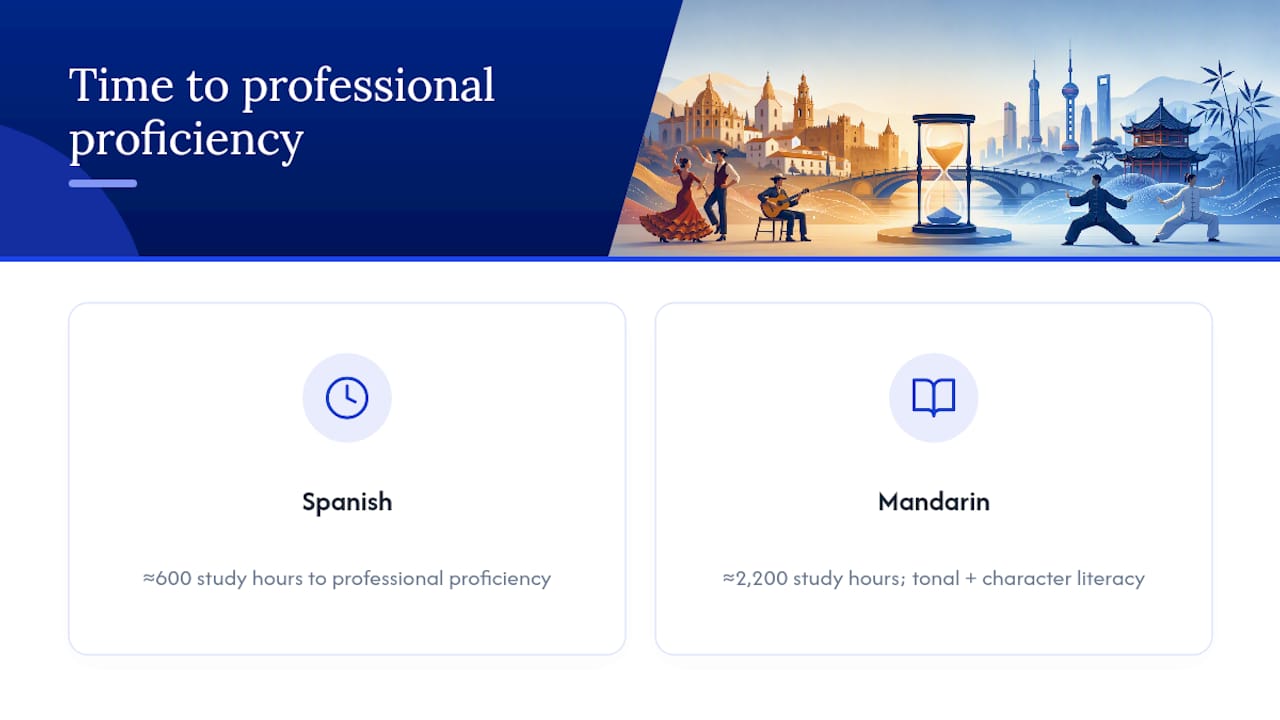
| Spanish wins on speed | Roughly 600 study hours to professional proficiency versus about 2,200 for Mandarin. |
| Mandarin wins on depth | Best suited to careers tied to Chinese manufacturing, trade, tech, or diplomacy. |
| Writing systems differ sharply | Spanish uses the Latin alphabet; Mandarin requires learning thousands of characters. |
| Reach favors Spanish | Official in 21 countries with over 500 million speakers worldwide. |
| Next step for Spanish learners | Com offers group, private, and online Zoom adult Spanish classes to start immediately. |
Table of Contents
- Spanish vs Mandarin: The Core Tradeoffs
- Why Is Mandarin Harder to Learn Than Spanish?
- Which Language Gives You Better Practical Returns?
- How Long Does It Take to Get Conversational?
- How Do You Decide Which One to Learn?
- What’s the Best Way to Start Learning Spanish or Mandarin?
- Ready to Start Learning Spanish?
- Sources
- FAQ
Spanish vs Mandarin: The Core Tradeoffs
Both languages open real doors. The difference is how fast you get through them and what’s waiting on the other side.
- Difficulty for English speakers: Spanish is rated among the easiest languages to learn; Mandarin sits in the hardest tier.
- Writing and pronunciation: Spanish uses the Latin alphabet with mostly predictable spelling; Mandarin requires learning thousands of characters plus four tones that change word meaning entirely.
- Geographic reach: Spanish is an official language in 21 countries with over 500 million speakers, according to Wharton’s analysis of Spanish’s global economic role; Mandarin’s reach concentrates heavily in China and its diaspora, per global speaker rankings.
- Career and travel value: Spanish helps across tourism, healthcare, and everyday U.S. commerce; Mandarin helps most in roles tied directly to Chinese markets.
- Time to conversational fluency: Spanish takes meaningfully fewer study hours than Mandarin for the average adult learner.
- Learning resources: Spanish has far more accessible media, tutors, and apps for English speakers; Mandarin resources exist but require more deliberate searching.
Difficulty and time investment decide this comparison for most learners before career value even enters the conversation.
Why Is Mandarin Harder to Learn Than Spanish?
Mandarin is harder because it stacks three separate learning curves on top of each other: tones, characters, and grammar built on entirely different logic than English. Spanish stacks far fewer.
Pronunciation is the first wall. Mandarin uses four tones, meaning the same syllable spoken with a rising versus falling pitch produces a completely different word. Spanish pronunciation, by contrast, is mostly about stress placement and a handful of sounds (the rolled r, the distinction between b and v) that English speakers pick up with practice, not years.

Writing systems widen the gap further. Spanish uses the same 26 letters you already know, and its spelling is close to phonetic. Mandarin uses thousands of unique logographic characters with no alphabet to fall back on, so literacy has to be built character by character rather than sounded out.

Grammar cuts the other way somewhat. Spanish requires memorizing verb conjugations and grammatical gender for every noun, which trips up beginners constantly. Mandarin, by comparison, has no verb conjugation and no gendered nouns. Its challenge is word order and a more isolating structure where meaning depends heavily on context and particles rather than word endings, as comparative linguistic analyses of the two languages point out.
Listening comprehension favors Spanish too. Regional accents (Mexican, Argentine, Castilian) vary, but the underlying sound system stays consistent. Mandarin’s tonal homophones mean dozens of words can sound nearly identical to an untrained ear.
Pro Tip: If tones are your biggest fear about Mandarin, shadow native audio clips daily for two weeks before opening a textbook. Your ear adjusts faster than your brain expects.
Practice availability tips the scale further. Spanish speakers and immersion content are everywhere in most cities; Mandarin practice partners and native media take more effort to find.
Pro Tip: Immersion accelerates both languages, but the effect is measurable: one study tracking Mandarin speakers learning Spanish during a year abroad found real gains in stress perception and pronunciation, proof that time in-country compounds fast.
Which Language Gives You Better Practical Returns?
Spanish wins on breadth. Mandarin wins on depth in a specific direction.
Spanish’s footprint spans Latin America, Spain, and large Hispanic communities across the United States, making it useful in tourism, healthcare, retail, education, and general corporate work almost anywhere you travel. A sales rep, nurse, or hospitality manager gets daily mileage out of it.
- Travel across 20+ Spanish-speaking countries without a language barrier by exploring recommended International Student Travel Programs that enhance language immersion and cultural understanding.
- Client-facing roles in industries with large Hispanic customer bases
- Everyday usefulness in healthcare, education, and public service work
Mandarin’s value is narrower but sharper. It matters most for roles that interface directly with Chinese manufacturing, supply chains, tech partnerships, or trade negotiation, and for anyone doing academic or cultural work centered on China.
- Supply chain, manufacturing, and sourcing roles tied to Chinese suppliers
- Diplomatic, trade, or China-focused academic and research careers
- Deep cultural access, illustrated by translation projects like the early Mandarin retelling of Don Quixote, which shows how differently each language frames the same story
How Long Does It Take to Get Conversational?
Widely cited Foreign Service Institute benchmarks put Spanish at roughly 600 class hours to reach general professional proficiency for native English speakers. Mandarin sits at roughly 2,200 hours, more than three times the investment for a comparable outcome.
Those numbers assume structured classroom study, not casual app use. Immersion, deliberate speaking practice, and prior exposure to another language all shrink the timeline; passive study and infrequent practice stretch it out considerably.
Spanish requires several hundred study hours to reach professional working proficiency; Mandarin requires significantly more time investment for the same benchmark.
- 600 hours ≈ Spanish to professional proficiency (FSI benchmark)
- 2,200 hours ≈ Mandarin to the same benchmark
- Immersion and daily practice compress both timelines; inconsistent study stretches them
The scale difference alone explains why so many adult learners default to Spanish when time is the limiting factor.
How Do You Decide Which One to Learn?
Run through these questions before committing months of study to either language.
- What’s the goal? Career advancement tied to China points to Mandarin; travel, general career flexibility, or heritage connection to Latin America or Spain points to Spanish.
- How much time do you actually have per week? Fewer than five hours favors Spanish, where progress compounds faster.
- Do you have practice partners nearby? Spanish speakers are easier to find in most cities; Mandarin practice often requires more deliberate searching or online tutors.
- Does the language sound enjoyable to you? Motivation matters more than any benchmark hour count.
Pro Tip: Run a two-week trial in each language before deciding for good. Take one beginner class or lesson in Spanish, then one in Mandarin. Whichever one you keep opening your notebook for after day ten is your answer, regardless of what the hour estimates say.
What’s the Best Way to Start Learning Spanish or Mandarin?
Momentum in the first 30 days determines whether you stick with either language past month two.
Focus the first month on three things: 100 to 150 high-frequency words, one weekly speaking session with a tutor or conversation partner, and daily listening input, podcasts or short videos work fine. Spanish learners benefit especially fast here because cognates let you guess meaning before you’ve formally studied it.
- Structured group classes for steady weekly accountability
- Private tutoring for faster, goal-specific progress
- Language exchange partners for free conversation practice
- Apps and spaced-repetition tools for daily vocabulary drilling
If Spanish is your pick, Com’s adult Spanish classes cover group, private, and online Zoom formats, so the format fits your schedule rather than the other way around. Companies building corporate language programs often start the same way: a short trial, then a structured weekly cadence.
A Realistic Take on the Spanish vs Mandarin Debate
Mandarin’s difficulty is real and worth respecting, not talked around. But for most adults chasing usable fluency without years of specialized study, Spanish still delivers the faster, broader return.
Ready to Start Learning Spanish?
If Spanish is your answer, the practical question becomes format, not motivation. Com runs adult Spanish courses built specifically around conversational and business use: small group classes for steady weekly progress, private lessons for learners who need a faster or more customized pace, and online Zoom classes for anyone who wants flexibility without commuting.

Match the format to what the checklist above told you about your time and goals. Busy professionals with unpredictable schedules tend to do best with private lessons or corporate language training; learners who thrive on accountability and group energy usually prefer the structured group classes. Either way, the fastest way to know if it clicks is to try one. Book a trial class and see how the first session feels before committing to a full course.
Sources
- Mandarin Or Spanish: How Do You Choose The Right Immersion Path?
- Why Spanish Is a Strategic Asset in the Global Economy – Knowledge at Wharton
- Don Quixote in Castilian Spanish and Mandarin — UNESCO Courier
- Languages by number of speakers — Wikipedia
- Mandarin speakers’ development of L2 Spanish lexical stress perception and production in a one-year study abroad program
FAQ
Is It Better to Learn Mandarin or Spanish?
Spanish is better for most English speakers because it takes less study time and offers broader everyday use across travel, business, and community settings. Mandarin is better if your career or heritage ties directly to Greater China.
Which Is the Toughest Language in the World?
Difficulty rankings vary by source and learner background, but Mandarin, Arabic, and Japanese consistently appear among the hardest for native English speakers due to writing systems, tones, or both.
Is Mandarin Chinese Harder to Learn Than Spanish?
Yes. Mandarin requires roughly 2,200 study hours to reach professional proficiency versus about 600 for Spanish, driven mainly by tonal pronunciation and character literacy.
Is Mark Zuckerberg Fluent in Mandarin?
Mark Zuckerberg has studied Mandarin publicly for years and can hold conversations in it, though reports describe his level as conversational rather than fully fluent.
How Do I Start Learning Spanish as an Adult?
Begin with high-frequency vocabulary, weekly speaking practice, and consistent listening input. Structured adult group or private Spanish classes build that routine faster than self-study alone.
Recommended
Start Learning Spanish Today
Book a trial class and see how quickly you can progress with a professionally trained native-speaker teacher guiding the way.
Book a Trial Class