 Spanish
TL;DR:
- Live online language schools, private tutors, self-study apps, and university courses offer adults practical options for learning Spanish. Spanish Explorer provides structured online classes, private lessons, and corporate training tailored for adult conversational and business goals. Most adults reach basic conversational fluency in 6 to 12 months with consistent practice using these alternatives.
The strongest alternatives to spanishworldgroup.com for U.S. adult learners are live online language schools, private tutors, self-study apps, and university continuing-education courses. For most adults who want to speak Spanish faster, Spanish Explorer stands out as a practical, structured option with Zoom-based group classes, private lessons, and corporate training built specifically for adult conversational and business goals.
Quick picks:
- Fastest speaking progress: Small live group classes combined with private tutoring sessions
- Best budget-first start: A free or low-cost app for daily vocabulary, paired with a weekly online conversation group
| Next action | Format | Time to start |
|---|---|---|
| Book a trial class with Spanish Explorer | Live Zoom group or private | This week |
| Start a free app trial (Duolingo, Babbel) | Self-study, mobile | Today |
| Contact a private tutor for a 1-hour assessment | 1:1 online or in-person | — |
Table of Contents
- What are the main alternatives to spanishworldgroup.com?
- How much do alternatives cost, and how long until you can hold a conversation?
- What is the 80/20 rule for Spanish, and where should you focus?
- How do you pick the right alternative quickly?
- Why Spanish Explorer is a strong alternative for U.S. adult learners
- What do user reviews say about top Spanish learning alternatives?
- Key Takeaways
- What actually works in adult Spanish learning
- Spanish Explorer online classes: try a session before you commit
- FAQ
What are the main alternatives to spanishworldgroup.com?
Five realistic categories cover almost every adult learner’s situation.
Live online language schools offer scheduled group classes with a qualified instructor, usually in small cohorts. Group Spanish classes with live instructors and groups of around six students give you consistent speaking practice and mirror in-person progression when sessions are regular. This format suits learners who want structure, accountability, and real conversation practice without commuting.
Private tutors (1:1) are the fastest route to targeted progress. A tutor adapts every session to your gaps, whether that’s business vocabulary, travel phrases, or pronunciation. The trade-off is cost: hourly rates run higher than group classes, and you lose the social dynamic that group settings provide.
Self-study apps and blended programs (Duolingo, Babbel, Pimsleur) work well for building vocabulary and basic grammar at your own pace. They rarely get you to conversational fluency alone, but they are a strong complement to live instruction.
University and community college continuing-education courses offer semester-length structure, often at lower per-hour cost than private schools. The downside: fixed schedules, larger class sizes, and a pace set by the slowest learner in the room.
Immersion and short-stay programs (weekend intensives, study-abroad trips) compress exposure dramatically. They work best as a booster after you have a foundation, not as a starting point.
How much do alternatives cost, and how long until you can hold a conversation?
Costs vary widely by format. Here is a practical reference for U.S. learners.
| Format | Typical monthly cost | Time to conversational |
|---|---|---|
| Self-study app | $15/month | 12 months (solo) |
| Live online group class | $80–$200/month | 6–12 months (2x/week) |
| Private tutor (online) | $200/month | 4–8 months (3x/week) |
| University continuing-ed | $150/semester | 12 months (2x/week) |
| Immersion program | $1,000/week | Accelerates existing skills |
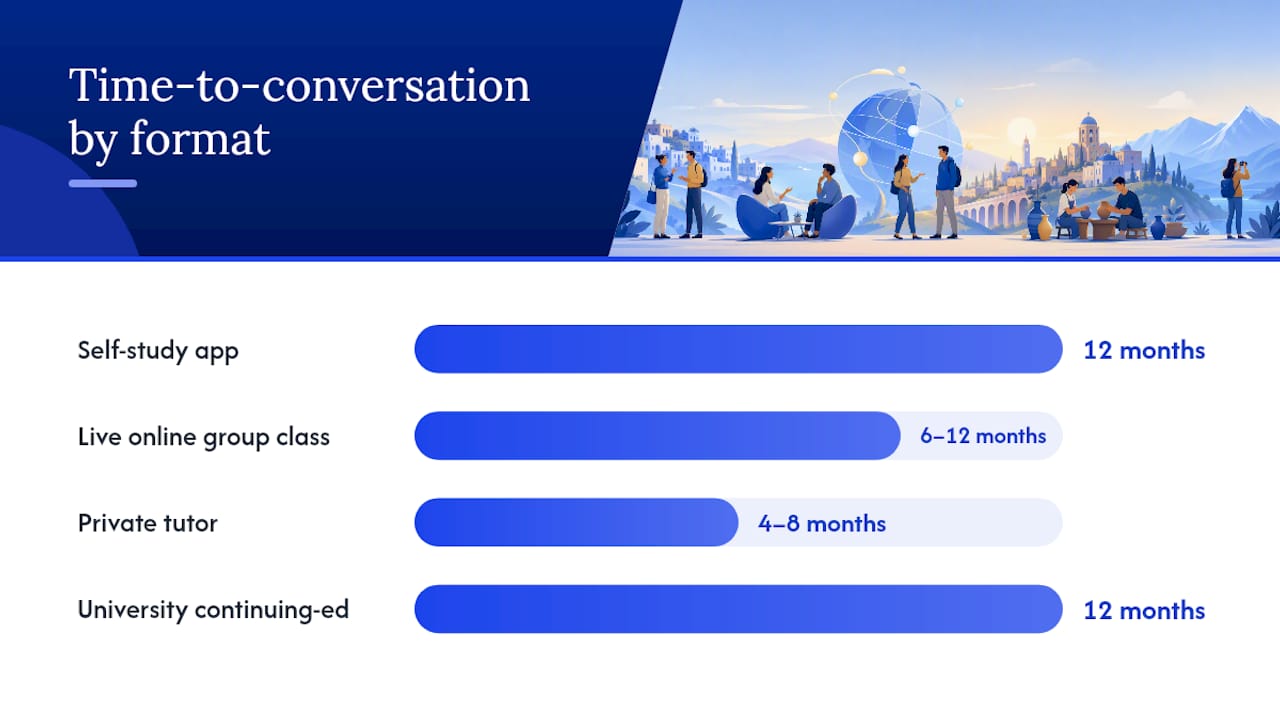
“Conversational” here means holding a real exchange on everyday topics: introductions, directions, ordering food, basic work situations. It does not mean fluency. Most learners reach that level in roughly 150–200 hours of active study and speaking practice, which typically means 6–12 months for regular group or blended lessons.
Block-plan pricing (packages of 4, 8, or 12 classes) is a common model among online schools. It balances commitment with flexibility and lets you measure progress in clear stages without locking into a long contract.
Statistic callout: Two live group sessions per week, each 50 minutes, with a small group of up to five students, is a proven schedule for building conversational confidence within a few months.
What is the 80/20 rule for Spanish, and where should you focus?
The 80/20 principle applied to Spanish means roughly 20% of the language covers 80% of everyday conversation. Specifically, that 20% is:
- The 500–1,000 most common Spanish words (survival vocabulary)
- Core verb conjugations: present, simple past (preterite), and near-future (“voy a…”)
- Common question forms: ¿Qué…? ¿Cómo…? ¿Dónde…? ¿Cuándo…? ¿Por qué…?
- High-frequency phrases for agreement, clarification, and transition
Master those and you can navigate most real-world conversations before touching subjunctive mood or advanced grammar.
A blended group-plus-private model puts this principle into practice: group sessions build fluency through cultural context and real dialogue, while private lessons target your specific weak spots without wasting time on grammar you already know.
Pro Tip: Pick one conversation topic each week (travel plans, your job, weekend activities) and prepare five sentences on it before your class. Then shadow a native speaker saying similar sentences out loud. That combination of preparation and imitation accelerates speaking speed faster than vocabulary drills alone.
How do you pick the right alternative quickly?
Work through this checklist before you commit to anything.
- Define your goal. Business Spanish, travel phrases, or general conversational fluency each call for different formats and pacing.
- Set your weekly hours. Two hours a week gets you conversational in roughly a year. Five hours cuts that roughly in half.
- Check format fit. Do you need a fixed schedule (group class) or maximum flexibility (app + tutor on demand)?
- Verify class size. Groups larger than eight students sharply reduce your speaking time per session.
- Confirm teacher background. Native-speaking instructors fluent in English are the standard to look for in adult programs.
- Ask about the trial policy. Any reputable school or tutor offers at least one trial or demo class before you pay for a package.
- Read the cancellation terms. Transparent refund and rescheduling policies signal a school that stands behind its product.
Red flags: no trial lesson offered, pricing only available after a sales call, classes with 15+ students, or a curriculum that is entirely scripted with no free conversation time.
Sample questions to ask any school or tutor:
- “What is the maximum class size? (Look for programs that cap groups at five or six students to maximize speaking opportunity.)”
- “Are instructors native speakers?”
- “What happens if I need to cancel or reschedule?”
- “Can I see a sample lesson or syllabus before I enroll?”
Why Spanish Explorer is a strong alternative for U.S. adult learners
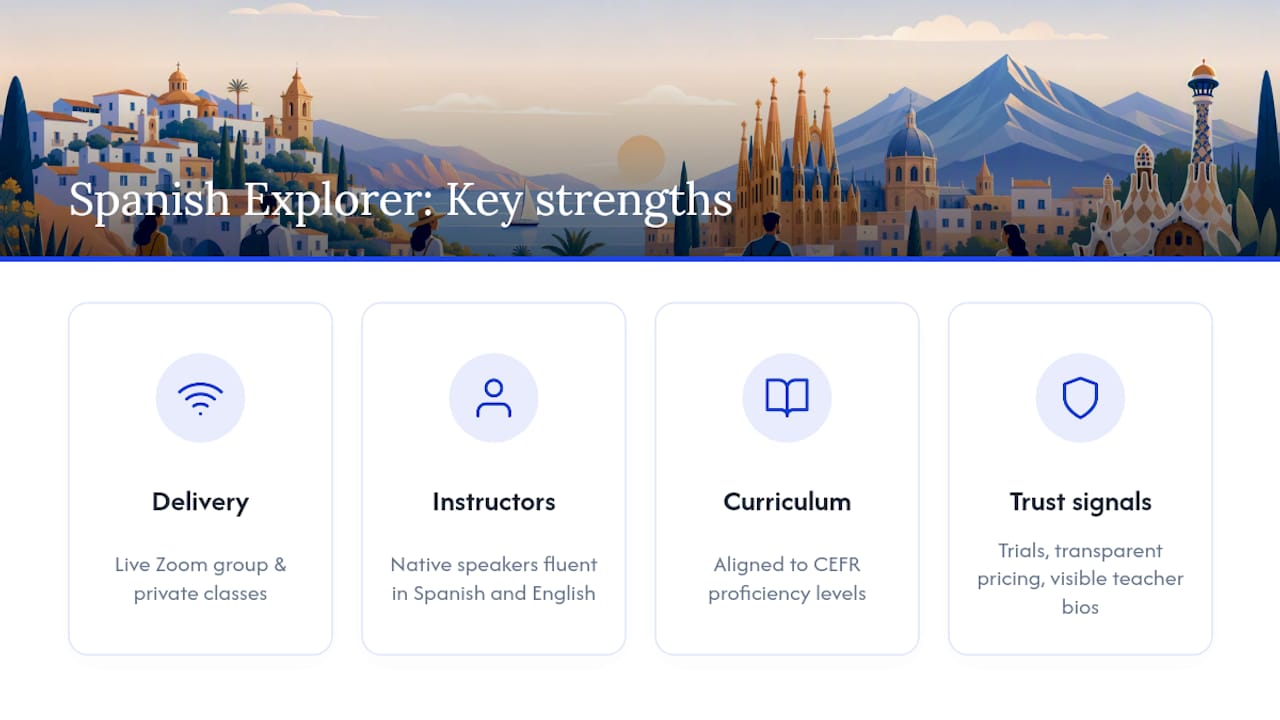
Spanish Explorer offers online Zoom group classes, private lessons, and corporate training designed for adult learners at every level. The curriculum is aligned to CEFR standards, which means your progress maps to internationally recognized proficiency levels rather than an arbitrary in-house scale.
For U.S.-based learners, the Zoom delivery removes geography entirely. The online class format runs live sessions with certified, native-speaking instructors who are fluent in both Spanish and English, so explanations are clear and class time stays focused on speaking rather than translation confusion.
Trust signals worth noting: trial lessons are available, course pages are transparent about format and content, and the school’s teacher roster is publicly listed. For credential-minded learners, institutional signals like exam-centre affiliations and structured curricula carry real weight when choosing between providers.
“Clear trial lessons, transparent pricing, and visible teacher bios are the trust signals adult learners look for when evaluating alternatives to a local school.” Source
Corporate teams get a dedicated training path: Spanish Explorer’s corporate program is structured around workplace communication goals, not generic textbook content, which matters when the objective is functional business Spanish rather than tourist phrases.
What do user reviews say about top Spanish learning alternatives?
Reputation patterns across online Spanish learning platforms follow a consistent shape. Learners rate small-group online schools highly when three things are present: a teacher who adapts to the group’s pace, a clear lesson structure, and easy rescheduling. Reviews turn negative most often over large class sizes, rigid cancellation policies, and instructors who read from a script rather than respond to the room.
Self-study apps collect strong ratings for accessibility and gamified motivation, but the most common complaint is a ceiling effect: learners plateau at a basic level and cannot break through to real conversation without a live speaking partner.
Private tutors earn the highest satisfaction scores for speed of progress, particularly when the tutor has a structured lesson plan rather than open-ended conversation sessions. The risk is inconsistency: tutor quality varies more than school quality, so checking credentials and reading reviews before booking matters more here than in any other format.
Spanish Explorer’s published course pages and teacher profiles give prospective learners the transparency that review data consistently shows adults want before committing.
Key Takeaways
The fastest path to conversational Spanish combines small live group classes with at least one private session per week, a clear weekly study schedule, and a school that offers a trial lesson before you pay.
| Point | Details |
|---|---|
| Pick your format first | Group classes build fluency; private tutoring fixes specific gaps; apps alone rarely reach conversational level. |
| Set weekly hours | Two hours a week reaches conversational in roughly 12 months; five hours cuts that to about 6 months. |
| Use block-plan pricing | Packages of 4, 8, or 12 classes let you commit and measure progress without a long contract. |
| Apply the 80/20 rule | Focus on the 500–1,000 most common words and core verb tenses before tackling advanced grammar. |
| Spanish Explorer trial | Book a trial class with Spanish Explorer to assess format fit before enrolling in a full course. |
What actually works in adult Spanish learning
Adult learners consistently underestimate one thing: the gap between understanding Spanish and producing it under pressure. You can recognize 800 words and still freeze when someone speaks at natural speed. That gap closes through speaking practice, not more vocabulary lists.
The checklist in this article exists because most adults skip the evaluation step and enroll in whatever is easiest to find. A trial lesson and a clear cancellation policy are not just nice-to-haves. They are the minimum standard that separates a school worth your time from one that is not.
The 80/20 focus areas are not a shortcut. They are a prioritization tool. Every hour you spend on high-frequency verbs and survival vocabulary returns more usable Spanish than an hour spent on irregular subjunctive forms you will use twice a year.
Spanish Explorer online classes: try a session before you commit
Spanish Explorer’s online Spanish courses give U.S. adult learners live Zoom instruction from certified native-speaking teachers, with group classes, private lessons, and corporate training all available remotely. The trial lesson lets you assess the teaching style, class size, and pace before you pay for a package.
No long-term contract required to start. Book a trial class or request a private-lesson assessment directly through the Spanish Explorer course page, and you will know within one session whether the format fits your goals.
FAQ
What is the best free program to learn Spanish?
Duolingo and Pimsleur’s free tier are the most widely used free options for building vocabulary and basic listening skills. Neither replaces live speaking practice, but both work well as a daily supplement to a structured class.
What is the 80/20 rule for Spanish?
It means roughly 20% of Spanish (the 500–1,000 most common words plus core verb tenses) covers about 80% of everyday conversation. Focus there before tackling advanced grammar.
What is the top app to learn Spanish?
Duolingo leads on user volume and accessibility; Babbel is often rated higher for structured grammar progression. For audio-first learners, Pimsleur is the strongest standalone app for speaking practice.
Can you become fluent in Spanish in 3 months?
Reaching full fluency in three months is not realistic for most adults starting from zero. Reaching basic conversational ability (everyday topics, simple work situations) is achievable in three months with five or more hours of study and speaking practice per week.
Recommended
Start Learning Spanish Today
Book a trial class and see how quickly you can progress with a professionally trained native-speaker teacher guiding the way.
Book a Trial Class