 Spanish
A 30–45 minute lesson built around comprehensible input, then guided practice, then communicative production is the most reliable way to get adult learners actually speaking Spanish. You don’t need a textbook series or a proprietary curriculum. You need a repeatable structure and a handful of good sources to pull materials from.
Here’s the core sequence you can run today:
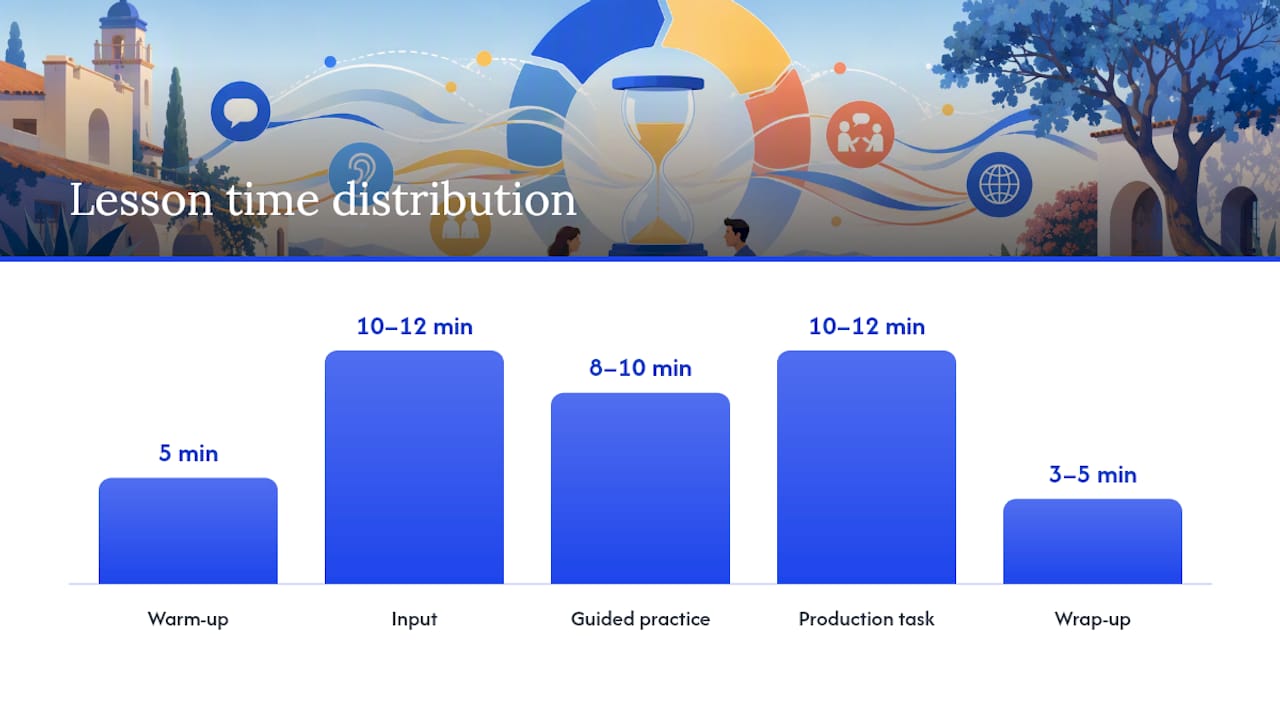
- Warm-up (5 min): A short question or quick vocabulary review to activate prior knowledge.
- Input (10–12 min): A listening clip, story, or reading at i+1 level (just above current ability) where meaning is clear from context.
- Controlled practice (8–10 min): Structured drills, fill-in-the-gap, or question-answer pairs using the input’s vocabulary.
- Communicative task (10–12 min): A role play, info-gap activity, or speaking prompt where learners produce language freely.
- Wrap-up (3–5 min): Exit ticket or one-sentence summary from each learner.
For materials, three sources cover most of what you need fast. Teaching Spanish 101 by Spanish Mama is a deep resource library covering comprehensible input, storytelling, and classroom-tested activity banks. Lawless Spanish offers a structured 30-unit beginner sequence with checklists and grammar notes you can lift directly into lesson plans. The Spanish Experiment provides short audio-supported lessons that work perfectly as 5-minute warm-up listening clips.
Pro Tip: Before your first session, download one printable activity from Teachers Pay Teachers to use as your controlled-practice stage. It takes ten minutes and saves you from building worksheets from scratch.
Key Takeaways
The most effective way to teach Spanish to adults is a tightly structured 30–45 minute lesson that moves from comprehensible input through guided practice to a communicative production task, with vocabulary recycled across at least three sessions.
| Point | Details |
|---|---|
| Use the 5-stage lesson template | Warm-up, input, guided practice, production task, wrap-up covers every session in 30–45 minutes. |
| Write the can-do objective first | A specific objective (e.g., “negotiate a meeting time”) filters every activity choice and keeps lessons focused. |
| Recycle vocabulary across lessons | Target words revisited in at least three sessions are retained far better than vocabulary introduced once. |
| Adapt by changing scaffolding, not structure | Beginners get sentence frames; advanced learners get only the scenario. The same activity works at every level. |
| Spanish Explorer for structured courses | Spanish Explorer’s adult and corporate Spanish courses offer a professionally sequenced alternative when learners need more than ad-hoc lessons. |
Table of Contents
- What methods actually work when you teach Spanish to adults?
- How do you structure a 30–45 minute Spanish lesson?
- What activities make Spanish lessons engaging and effective?
- How do you adapt lessons for adult and business learners at different levels?
- How do you teach Spanish effectively online via Zoom?
- How do you assess speaking progress without slowing the lesson down?
- Where do you find ready lesson plans and printable materials?
- Why do comprehensible input and communicative tasks work for adult Spanish learners?
- One thing most Spanish tutors get wrong
- Spanish Explorer: structured courses for adult and corporate learners
- Sources
- FAQ
What methods actually work when you teach Spanish to adults?
Four approaches have the strongest track record with adult learners, and they work best in combination rather than isolation.
Comprehensible input (CI) is the foundation. Stephen Krashen’s input hypothesis holds that acquisition happens when learners receive messages they can mostly understand, with a small stretch beyond their current level. For business learners, a short email thread or a simulated client call works better than a grammar passage, because the context carries meaning.
Communicative language teaching (CLT) shifts the goal from accuracy to communication. Instead of drilling conjugations in isolation, learners negotiate meaning in real tasks: booking a meeting, describing a product, asking for directions. CLT works especially well with adult professionals because the scenarios map directly to their actual goals.
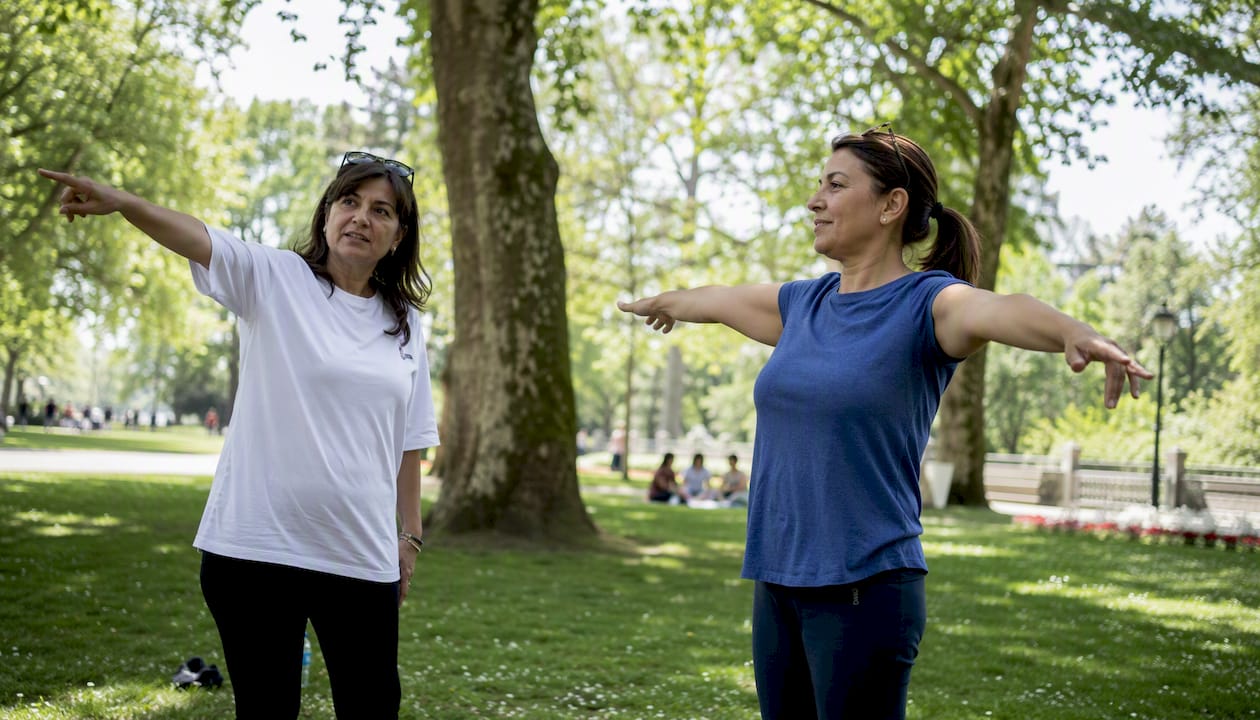
Total Physical Response (TPR) sounds like a classroom game, but adults respond to it too. Pairing commands with physical actions (“Stand up, point to the door, sit down”) builds vocabulary fast without translation. It’s most useful in the first 10–15 hours of instruction, then fades naturally as learners move into sentence-level production.
Task-based learning (TBL) organizes the lesson around a real-world outcome: write a complaint email, negotiate a price, summarize a meeting. The grammar emerges from the task rather than preceding it. For corporate learners, TBL is particularly effective because every task has an obvious professional payoff.
Spaced repetition sits underneath all of these. Vocabulary recycled at expanding intervals sticks far better than massed review. Tools like Babbel use spaced repetition with short real-world dialogues to reinforce vocabulary between lessons, and you can replicate the same principle manually by cycling target words across three consecutive lessons.
Pro Tip: Pair CI with a task-based production goal in the same lesson. Give learners a story or dialogue as input, then ask them to use three specific phrases from it in a role play. The production task forces retrieval, and retrieval is what converts passive recognition into active speech.
How do you structure a 30–45 minute Spanish lesson?
A reusable template saves you from reinventing every session. The structure below is based on the input-to-production arc and works across levels. Adjust the timing by a few minutes depending on class size and pace.
| Stage | Time | What happens |
|---|---|---|
| Warm-up | 5 min | Quick question, vocabulary review, or a 60-second audio clip |
| Input | 10–12 min | Story, dialogue, or listening at i+1 level; teacher checks comprehension |
| Guided practice | 8–10 min | Controlled exercises using input vocabulary (Q&A, sentence frames, gap-fill) |
| Production task | 10–12 min | Role play, info-gap, or speaking prompt; learner produces freely |
| Wrap-up | 3–5 min | Exit ticket, one-sentence summary, or quick vocabulary recall |
Sample can-do objectives by level:
- Beginner (A1–A2): “I can introduce myself and ask a colleague’s name and job title.” Lawless Spanish’s structured beginner units recommend spending 1–4 weeks per unit with repeated practice, so a single lesson at this level should target one narrow function, not five.
- Intermediate (B1): “I can describe a past project and explain what went well and what I’d change.”
- Advanced (B2+): “I can negotiate terms in a business meeting, including expressing disagreement politely.”
The key discipline is writing the can-do objective before you choose the activity, not after. When the objective is specific, every stage of the lesson has a clear filter: does this activity move learners toward that one outcome?
What activities make Spanish lessons engaging and effective?
A good activity bank means you never stall mid-lesson looking for something to do. The activities below are organized by lesson stage, with level adjustments built in.
Warm-ups
- “¿Qué ves?” (What do you see?): Show an image for 30 seconds, then ask learners to describe it in Spanish. Beginners name objects; intermediate learners describe actions; advanced learners speculate about context.
- Audio snippet: Play 60–90 seconds from The Spanish Experiment’s audio lessons and ask one comprehension question. Fast to set up, immediately activates listening.
- Vocabulary chain: Each learner says a word from the previous lesson, then the next learner adds one. Stops when someone repeats or blanks.
Pronunciation drills
Pronunciation is often skipped in adult classes because it feels remedial. It isn’t. Spanish vowel sounds are fixed and consistent, which means a 3-minute drill on the five vowels (a, e, i, o, u) pays dividends for months. For accent reduction, the Spanish Pronunciation Guide covers sounds and stress patterns in a format you can reference mid-lesson. Minimal pairs (pero/perro, caro/carro) work well for intermediate learners who have plateaued on accuracy.
Vocabulary recycling
- Flashcard race: Two teams, one flashcard shown at a time, first to call the correct word earns a point.
- Word map: Learners build a visual cluster around a target word (e.g., “reunión” → agenda, presentar, confirmar, cancelar). Effective for business vocabulary because it builds semantic networks rather than isolated items.
Communicative production tasks
- Info-gap role play: Learner A has a hotel booking confirmation with errors; Learner B is the hotel receptionist. They must resolve the discrepancy using only Spanish. Neither can see the other’s card.
- Meeting simulation: Give each learner a role card (project manager, client, finance lead) and a one-paragraph brief. Run a 5-minute meeting in Spanish. Debrief on three phrases they used well.
- Music gap-fill: Choose a song at the right level, remove 8–10 words from the lyrics, play it twice. Adults respond well to music when the song is chosen for vocabulary density rather than just popularity.
Pro Tip: The same role play scales across three levels by changing the role card. Beginners get sentence frames printed on the card. Intermediate learners get bullet points. Advanced learners get only the scenario and must generate all language independently. One activity, three versions, zero extra prep.
How do you adapt lessons for adult and business learners at different levels?
The lesson template stays the same across levels. What changes is the complexity of the input, the scaffolding on the task, and the vocabulary domain.
Beginner adults (A0–A2) need high-frequency vocabulary and predictable sentence structures. Keep input short (under 90 seconds of audio or 6–8 sentences of text). Use sentence frames during production: “Me llamo ___ y trabajo en ___.” Success at this level is measured by completing a transaction, not by grammatical precision.
- Reduce input length and pre-teach 5–8 key words before the listening stage.
- Provide sentence frames and word banks during the production task.
- Use visual support (images, diagrams) to carry meaning that language can’t yet carry alone.
Intermediate adults (B1) can handle longer input and more open tasks, but they often plateau on speaking because they rely on a small set of safe phrases. Push them into unfamiliar vocabulary domains deliberately.
- Remove sentence frames; replace with a list of 5 target phrases they must use.
- Introduce authentic materials: a short business email, a product description, a meeting agenda.
- Add a negotiation element to role plays (disagreement, clarification, compromise).
Advanced adults (B2+) benefit most from tasks that require precision and register awareness. The gap between B2 and C1 is largely about nuance, not vocabulary size.
- Use authentic audio or video (a podcast excerpt, a news clip) as input.
- Assign tasks that require formal register: a written proposal, a presentation opening, a complaint letter.
- Focus feedback on collocations and register rather than grammar errors.
For business Spanish training, the most effective move is replacing generic role plays with scenarios from the learner’s actual industry. A logistics manager practicing customs vocabulary retains it faster than the same person practicing a generic shopping dialogue. Authentic workplace materials, including real emails with names redacted, add cognitive relevance that no textbook scenario can replicate.
How do you teach Spanish effectively online via Zoom?
Online lessons lose energy fast if you run them like a face-to-face class with a camera on. The tech setup and activity design both need adjustment.
Essential tech checklist:
- A headset microphone (not laptop speakers) to eliminate echo and background noise.
- A ring light or window light facing you, so learners can see your mouth for pronunciation modeling.
- Shared Google Slides or a Jamboard link sent before class, so learners can annotate and contribute.
- Breakout rooms configured before the session starts, not during it.
- A polling tool (Mentimeter or Zoom’s built-in poll) for quick comprehension checks.
Activity adaptations for Zoom:
- Breakout rooms for pair work: Send pairs into 4-minute breakout rooms for the production task. Give a clear task card in the chat before they go. Bring them back and ask each pair to report one sentence.
- Annotation for vocabulary: Share a slide with an image and ask learners to use the annotation tool to label items in Spanish. Faster than typing answers and more visually engaging.
- Shared doc for collaborative writing: A Google Doc where all learners contribute to a single paragraph simultaneously creates a low-pressure production task with immediate peer modeling.
Classroom management online:
Turn-taking is the hardest part of remote language teaching. Establish a signal system in the first session: raised hand emoji for wanting to speak, thumbs-up for agreement, question mark for confusion. Use timed tasks (“You have 90 seconds in breakout rooms”) to prevent drift. For error correction, use the chat to type a corrected form quietly while the learner continues speaking, rather than interrupting.
For online Spanish classes, multilingual e-learning design principles suggest keeping any single activity under 8 minutes before switching format, since attention on screen drops faster than in a physical room. A guide on multilingual e-learning for educators covers this in more depth if you’re building a full remote curriculum.
Pro Tip: In a remote business class, assign one learner the role of “meeting chair” at the start of each session. They open the class in Spanish, call on others, and close the warm-up. It builds speaking confidence and reduces the teacher’s load simultaneously.
How do you assess speaking progress without slowing the lesson down?
Formative assessment doesn’t have to mean stopping to grade. The most useful checks take under two minutes and tell you exactly what to teach next.
Quick formative checks:
- Exit ticket: At the end of class, each learner writes or says one sentence using the lesson’s target structure. You scan for the three most common errors and address them at the start of the next session.
- One-minute oral check: Ask each learner one question using the lesson’s vocabulary. Their answer tells you whether they can retrieve the target language under mild pressure.
- Info-gap result check: After a pair task, ask each learner what information they got from their partner. Gaps in the answer reveal comprehension and production failures simultaneously.
Simple 3-point speaking rubric:
| Score | What it means |
|---|---|
| 3 | Communicates the message clearly; errors don’t impede understanding |
| 2 | Communicates the core message with some hesitation or minor errors |
| 1 | Attempts the task but meaning is unclear or heavily dependent on L1 |
This rubric works for in-class tasks and for short recorded speaking assignments. It’s fast to apply and gives learners a concrete target: “Get to a 3 on this task by next week.”
Corrective feedback that preserves fluency:
Interrupting a learner mid-sentence to correct grammar kills speaking momentum. Three techniques that don’t:
- Delayed recast: Wait until the learner finishes, then repeat their sentence correctly without comment. (“So you visited the office last week” after they said “I visit the office last week.”) Many learners self-correct when they hear the right form.
- Selective correction: Choose one error type per lesson to correct explicitly. Trying to fix everything at once teaches nothing.
- Peer feedback: After a role play, ask the listening learner to name one phrase their partner used well. Positive peer feedback reinforces target structures more durably than teacher correction.
Pro Tip: Keep a one-column error log per learner. After three lessons, patterns emerge: the same learner consistently drops the subjunctive, another always confuses ser and estar. That log becomes your next lesson’s input focus, not a random grammar point from a textbook.
Where do you find ready lesson plans and printable materials?
Building materials from scratch for every lesson is unsustainable. These three sources cover most of what you need.
Lawless Spanish is the most structured free resource for beginner lesson sequencing. Its 30-unit format includes grammar explanations, vocabulary lists, and comprehension checklists. Use it to map a beginner course arc and pull individual unit content into your lesson template’s input and guided-practice stages.
The Spanish Experiment offers short audio lessons with transcripts covering core beginner topics: greetings, ser vs. estar, question words, numbers. The audio clips are short enough to use as warm-up listening tasks without editing. Download the transcript, remove 5–8 words, and you have a gap-fill activity in three minutes.
Teachers Pay Teachers hosts teacher-created printables and interactive notebooks you can download and adapt. The Spanish Mama store specifically offers CI-aligned materials, interactive notebooks, and speaking activities. Search by level and topic rather than browsing broadly.
Additional sources worth bookmarking:
- Spanish Mama’s resource library at Teaching Spanish 101 covers CI techniques, storytelling scripts, and a large activity bank organized by classroom function.
- Memrise uses native-speaker video clips and an AI conversation partner for speaking practice, useful as a between-lesson homework tool for adult learners who want more exposure.
- Spanish Explorer’s speaking activities guide offers classroom-tested activity scripts adapted for adult learners.
For printable templates, the most practical format is a one-page lesson outline with five labeled boxes (one per stage), a can-do objective line at the top, and a three-line error log at the bottom. Attach it to every lesson plan and you have a running record of what was taught and what needs recycling.
Why do comprehensible input and communicative tasks work for adult Spanish learners?
The evidence behind CI and task-based production is consistent enough that most professional language teacher training programs have moved away from grammar-translation as a primary method.
The core argument is straightforward: adults acquire language through meaningful exposure and use, not through memorizing rules. When production tasks require real communication, learners must retrieve and deploy vocabulary under conditions that mirror actual use, which strengthens retention.
Research signal: Spanish Mama’s classroom-tested approach, documented in the Teaching Spanish 101 resource library, consistently points away from textbook-only instruction and toward CI and storytelling as the primary drivers of spontaneous student production. The practical implication: if your learners aren’t speaking freely by week four, the input is probably too difficult or the production tasks are too controlled.
Lawless Spanish’s modular, unit-based structure, with its recommendation to spend 1–4 weeks per unit and practice each item repeatedly before moving on, reflects the same spaced-repetition principle. Vocabulary recycled across multiple lessons at expanding intervals is retained significantly better than vocabulary introduced once and never revisited.
For adult learners specifically, the communicative approach has an additional advantage: it respects their existing cognitive sophistication. Adults don’t need to be protected from complex ideas. They need language that lets them express the complex ideas they already have. A task that asks a B1 learner to explain their job in Spanish is more motivating than a drill on present-tense conjugations, even if both cover the same grammar.
The practical classroom decision this evidence supports: keep input at i+1, recycle target vocabulary across at least three lessons, and schedule a production task in every single session, even a 90-second one.
One thing most Spanish tutors get wrong
Most tutors spend too much time on the input stage and not enough on production. It’s understandable: input is controllable. You choose the text, you control the pace, you can check comprehension with a quick question. Production is messier. Learners hesitate, make errors, go silent.
But silence during a production task is data, not failure. It tells you the input was too difficult, the task was under-scaffolded, or the learner hasn’t had enough retrieval practice. The fix is almost never more input. It’s a shorter, more constrained production task: one sentence instead of a paragraph, a sentence frame instead of open generation, a 60-second time limit instead of an open-ended role play.
The shortcut that saves the most class time: write the production task first, then work backward to design the input. If the task is “negotiate a meeting time with a colleague,” the input should model exactly that vocabulary and those sentence structures. When input and production are tightly aligned, learners succeed at the task more often, which builds the confidence that drives them to speak more outside class.
For adult and corporate learners, group dynamics also matter. Peer interaction during production tasks creates low-stakes speaking practice that a teacher-fronted class can’t replicate. Even in a two-person online session, having the learner “teach back” a phrase to you generates more retrieval than answering your questions.
Spanish Explorer: structured courses for adult and corporate learners
If you’re a tutor building your own lessons, the templates and resources above give you a solid foundation. But when your learners want a structured program with certified instruction and a clear progression path, Spanish Explorer offers exactly that.
Spanish Explorer’s adult Spanish courses in Singapore cover conversational and business Spanish in group, private, and corporate formats, taught by certified native Spanish-speaking instructors fluent in both Spanish and English. Lessons follow a structured curriculum aligned to CEFR levels, so learners always know where they are and what comes next. For professionals and companies, the corporate training program builds workplace-relevant vocabulary and communication skills directly into the course design. Classes run in-person at 10 Anson Road, Level 22, International Plaza, Singapore 079903 (above Tanjong Pagar MRT), and online via Zoom. Browse current course options or book a private Spanish lesson to get started.
Sources
- Teaching Spanish 101: A Resource Library of Tips and Techniques
- Learn Spanish – Spanish for Beginners – Lawless Spanish
- Free Online Spanish Lessons with Audio – The Spanish Experiment
FAQ
What is the Spanish verb for “to teach”?
The Spanish verb for “to teach” is enseñar. In some contexts, dar clases (to give classes) or instruir (to instruct) are also used, but enseñar is the standard everyday term.
What is the best method for teaching Spanish?
Comprehensible input combined with communicative production tasks is the most evidence-backed approach for adult learners. Pair a listening or reading activity at just above the learner’s current level with a role play or speaking task that uses the same vocabulary.
What is the 80/20 rule for learning Spanish?
A core set of high-frequency words and structures covers the vast majority of everyday communication. Focusing practice on the most common verbs, question words, and sentence patterns before expanding to specialized vocabulary gives learners faster speaking gains early on.
How can I teach myself Spanish?
Self-study works best with a structured resource like Lawless Spanish’s 30-unit beginner course, supplemented by daily listening practice (The Spanish Experiment’s audio lessons are a good starting point) and regular speaking practice with a tutor or language partner. Consistency across short daily sessions outperforms occasional long ones.
How do I keep adult learners engaged in a Spanish class?
Use tasks with a real-world payoff: a business email, a meeting simulation, a negotiation role play. Adults stay engaged when the activity connects directly to something they actually need to do in Spanish. Vary the format every 8–10 minutes, especially in online sessions, to maintain attention.
Recommended
Start Learning Spanish Today
Book a trial class and see how quickly you can progress with a professionally trained native-speaker teacher guiding the way.
Book a Trial Class