 Spanish
TL;DR:
- Structured language courses follow a deliberate sequence of grammar, vocabulary, and communication skills for lasting proficiency. They provide real-time instructor feedback, assessments, and milestones that help learners reach measurable goals. Learners using structured programs improve faster and develop better brain health and career prospects than those relying on self-study.
Structured language learning is defined as a curriculum-based approach that sequences grammar, vocabulary, and communication skills in a deliberate order to build lasting proficiency. For adults pursuing Spanish for career growth, professional communication, or personal enrichment, the importance of structured language courses cannot be overstated. Random study habits and app-based learning produce inconsistent results. A well-designed curriculum, delivered by certified instructors, creates the conditions where real fluency actually takes hold.
Why structured language courses matter for real progress
Structured language courses work because they sequence content the way the brain learns best. Rather than throwing grammar rules and vocabulary at learners in no particular order, a structured curriculum introduces regular patterns first, then builds toward exceptions and complexity. Sequenced exposure produces deeper understanding and stronger long-term retention than random or self-directed study. That sequencing is not just a teaching preference. It reflects how neural pathways actually form.
Think of content sequencing as “cognitive kindness.” When a course recycles foundational structures across different contexts, the brain builds coherence and flexibility at the same time. You learn to use a verb tense correctly in a simple sentence, then in a conversation, then in a written task. Each pass reinforces the last. That layered repetition is what separates a structured program from a vocabulary app.
Vocabulary retention follows the same logic. Spaced repetition in sequenced lessons moves terms into long-term memory far more efficiently than cramming or casual review. The key is that words appear in varied contexts across multiple lessons, not just once in a word list. This is why learners in structured programs consistently outpace self-study learners on retention benchmarks.
Key advantages of structured content sequencing include:
- Grammar patterns are introduced before exceptions, reducing confusion
- Core vocabulary recurs across lessons in different contexts, building recall
- Each unit builds on the previous one, so no foundational gap is left open
- Assessments confirm mastery before the course advances to harder material
- Learners always know where they are and what comes next
Pro Tip: If you feel like you have plateaued in Spanish, go back to a foundational unit in your course. Revisiting earlier material with your current level of understanding often unlocks fluency you did not know you were missing.
What does structured learning do to your brain?
The cognitive case for organized language study is stronger than most learners realize. Bilingual learners outperform monolinguals in multitasking, memory tests, and executive function tasks. That advantage does not come from casual exposure. It comes from the consistent, structured practice that builds and reinforces neural connections over time.

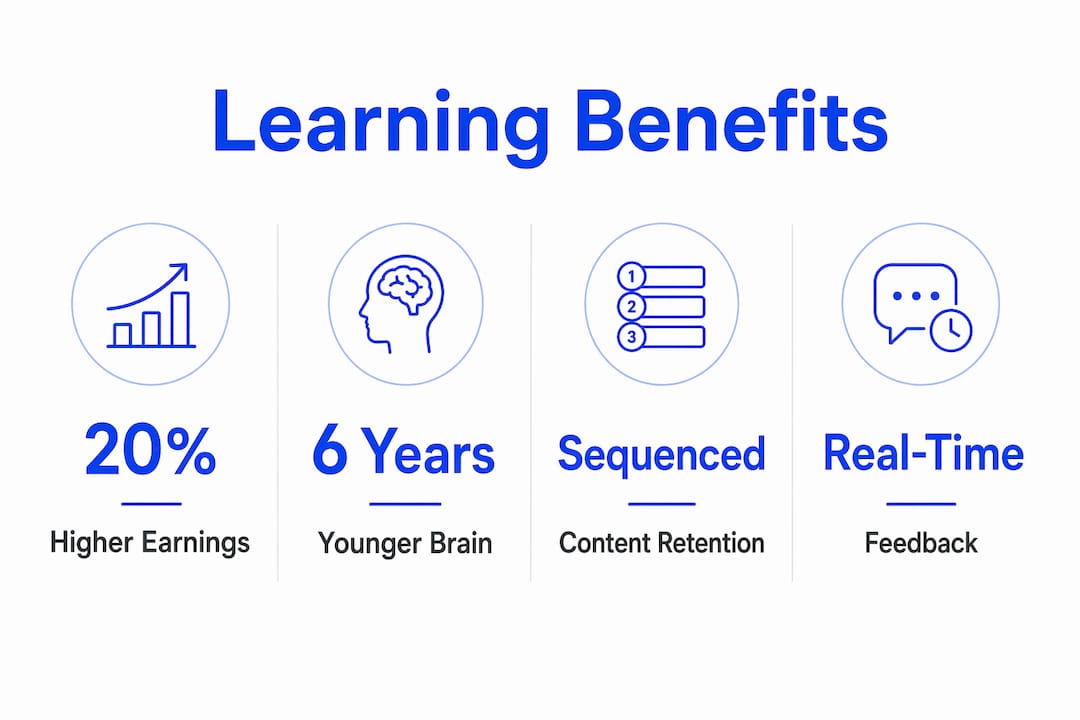
The most striking evidence comes from brain aging research. Brains of bilinguals appear 6 years younger than monolinguals, trilinguals 7 years younger, and quadrilinguals 13 years younger. That is not a minor statistical footnote. It means that learning Spanish through a structured program is one of the most concrete investments you can make in long-term brain health.
Structured courses accelerate these benefits because they create consistent feedback loops. You practice, receive correction, adjust, and practice again. That cycle is what drives neuroplasticity. A structured program with live instructor feedback creates far more of these loops per hour of study than passive listening or app-based drills.
The cognitive benefits of structured language learning include:
- Improved working memory from holding grammar rules and vocabulary simultaneously
- Stronger executive function from switching between Spanish and English in real time
- Better attention control from following structured lesson sequences
- Increased mental flexibility from applying language rules across varied contexts
Pro Tip: Schedule your Spanish practice at the same time each day, even if only for 20 minutes. Consistent timing reinforces the habit loop and maximizes the neurological gains from each session.
How does structured Spanish study advance your career?
The career case for organized language study is backed by clear data. Bilingual professionals earn up to 20% more than monolingual colleagues, and Spanish is one of the most in-demand second languages for international business roles. That salary premium reflects real market demand, not a soft benefit.
Structured courses matter here because career-relevant language skills require more than conversational ability. You need consistent vocabulary, professional register, and the cultural competence to communicate across contexts. A structured curriculum builds all three in a measurable sequence. You can point to specific milestones and demonstrate progress to an employer. That measurability is something self-study simply cannot replicate.
For professionals in Singapore, Spanish opens doors to Latin American markets, multinational corporations, and global teams. The structured curriculum advantages of a well-designed program align directly with the communication demands of those environments. Business Spanish requires precision. A course that sequences formal registers, negotiation vocabulary, and professional writing gives you that precision in a way that casual study never will.
Top career benefits of structured language programs:
- Measurable proficiency milestones that you can include on a resume or LinkedIn profile
- Business-specific vocabulary and register built into the curriculum from early levels
- Cultural competence developed alongside language skills, not as an afterthought
- Consistent progress that builds confidence for real workplace conversations
- Structured accountability that keeps you on track through a full program
How do structured courses differ from self-directed learning?
Self-directed learning has real value, but it has a ceiling. Most learners who rely on apps or informal study hit a plateau within a few months. They can order food and exchange pleasantries, but they cannot hold a professional conversation or write a business email. Structured programs prevent the gaps and plateauing that informal learning paths consistently produce.
The core difference is feedback. A tutor without a curriculum architecture can answer questions, but cannot guarantee measurable progress. A structured course combines instruction, homework, and assessments to consolidate knowledge at every stage. Scheduled classes and milestones also reduce dropout rates and build the habit strength that sustains learning over months, not just weeks.
Live instruction adds another layer that no app can replicate. Real-time error correction from a qualified instructor prevents bad habits from forming and accelerates speaking confidence. When you mispronounce a word or use the wrong verb tense in class, a teacher catches it immediately. An app gives you a red X and moves on. That difference compounds over hundreds of hours of practice.
| Learning approach | Feedback quality | Progress tracking | Speaking practice |
|---|---|---|---|
| Structured class-based program | Real-time instructor correction | Formal assessments and milestones | Live, scheduled, with peer interaction |
| Self-directed app or informal study | Automated, limited | Self-reported, inconsistent | Minimal or simulated |
Pro Tip: When choosing a Spanish program, match the format to your actual goal. If you need business Spanish for a specific role, look for a curriculum that explicitly sequences professional vocabulary and formal register, not just conversational phrases.
Key Takeaways
Structured language courses are the most reliable path to Spanish proficiency because they combine sequenced content, live feedback, and measurable milestones that self-study cannot replicate.
| Point | Details |
|---|---|
| Sequencing builds retention | Introducing grammar patterns before exceptions deepens understanding and long-term recall. |
| Brain health improves with structure | Consistent structured practice is linked to brains appearing years younger than those of monolinguals. |
| Career earnings increase | Bilingual professionals earn up to 20% more, and structured courses build the skills that drive that premium. |
| Live feedback prevents bad habits | Real-time instructor correction accelerates fluency and pronunciation in ways apps cannot match. |
| Accountability drives completion | Scheduled classes and formal milestones reduce dropout and build lasting study habits. |
What I have learned from watching learners succeed and stall
After years of advising adult language learners, the pattern I see most often is this: motivated people start strong with apps or casual study, plateau around the intermediate level, and then wonder why their Spanish is not improving. The answer is almost always the same. They never had a structured framework to begin with.
The learners who reach real fluency share one thing in common. They committed to a program with a clear sequence, a qualified instructor, and regular accountability. They did not just practice Spanish. They practiced it in a deliberate order, with someone correcting their errors in real time. That combination is what moves a learner from “I know some Spanish” to “I can use Spanish at work.”
The motivation argument against structured courses is that rigid programs kill enthusiasm. I disagree. In my experience, the opposite is true. Learners who follow a structured practice workflow feel more confident because they can see their progress. Confidence is the best motivator there is. A course that shows you exactly how far you have come, and exactly where you are going, keeps you engaged far longer than an app that just gives you a daily streak.
The uncomfortable truth is that fluency requires discipline. But discipline is much easier when the structure is already built for you. You do not have to figure out what to study next. You just show up, follow the sequence, and let the curriculum do its job.
— Paul
Spanish Explorer’s structured Spanish courses for adult learners
Spanish Explorer offers adult learners in Singapore a clear, sequenced path to Spanish proficiency through group, private, and corporate classes. Every course is designed by certified instructors who are fluent in both Spanish and English, so you get real-time correction and cultural context in every lesson.
Whether you are building conversational skills for personal enrichment or need business Spanish for a professional role, Spanish Explorer’s structured Spanish courses deliver measurable progress at every stage. Live online classes via Zoom make it easy to fit structured learning into a busy schedule. Corporate training programs bring the same curriculum quality to teams and organizations. Spanish Explorer is located at 10 Anson Road, level 22, International Plaza, Singapore 079903, right above Tanjong Pagar MRT. For professionals who want a more personalized pace, private Spanish classes offer one-on-one instruction with the same structured curriculum.
FAQ
What is a structured language course?
A structured language course is a curriculum-based program that sequences grammar, vocabulary, and communication skills in a deliberate order. It includes instructor feedback, assessments, and measurable milestones that guide learners from one proficiency level to the next.
Why do structured courses outperform self-study for Spanish?
Structured programs prevent the gaps and plateauing that informal learning consistently produces by combining sequenced content, live instructor correction, and formal progress tracking. Self-study lacks the feedback loops and accountability that sustain long-term improvement.
How does learning Spanish affect brain health?
Research shows that bilingual brains appear 6 years younger than monolingual brains, with the advantage increasing for those who speak three or more languages. Structured practice accelerates these neurological benefits by creating consistent feedback loops that drive neuroplasticity.
Can structured Spanish courses help my career in Singapore?
Bilingual professionals earn up to 20% more than monolingual colleagues, and Spanish is in high demand for international business roles. A structured curriculum builds the professional vocabulary, formal register, and cultural competence that employers in global markets value most.
How long does it take to reach conversational Spanish with a structured program?
The timeline depends on your starting level, study frequency, and program intensity, but structured courses with regular scheduled lessons and live feedback consistently produce faster results than self-directed study at the same number of hours.
Recommended
Start Learning Spanish Today
Book a trial class and see how quickly you can progress with a professionally trained native-speaker teacher guiding the way.
Book a Trial Class