 Spanish
TL;DR:
- International Spanish standards establish shared benchmarks for proficiency, instruction, and cultural knowledge across all regions. They underpin global credentialing systems like CEFR, DELE, and SIELE, ensuring clear, transferable, and recognized qualifications. Adopting these standards helps learners, educators, and professionals improve communication and career prospects worldwide.
International Spanish standards are defined as coordinated frameworks that set shared benchmarks for language proficiency, instruction quality, and cultural competency across all Spanish-speaking regions and learning contexts. The role of international Spanish standards shapes how educators design curricula, how learners measure progress, and how professionals demonstrate language ability to global employers. Bodies like the Real Academia Española and the Association of Spanish Language Academies have spent decades building these frameworks so that a learner in Singapore and a professional in Madrid operate from the same reference point. For adult learners, educators, and professionals, understanding these standards is not optional background knowledge. It is the foundation of every meaningful decision about how to learn, assess, and apply Spanish.
What is the role of international Spanish standards in language learning?
International Spanish standards define the proficiency levels, communicative goals, and cultural knowledge that a learner should reach at each stage of study. They translate abstract fluency goals into concrete, measurable outcomes. Without them, every school, employer, and institution would use a different definition of “intermediate” or “advanced,” making credentials meaningless across borders.
The most widely recognized framework for aligning Spanish instruction is the Common European Framework of Reference for Languages, known as the CEFR. It organizes proficiency into six levels from A1 through C2. Spanish language programs worldwide map their curricula to these levels, which means a learner who completes a B1 course in Singapore holds a credential that educators in Spain, Mexico, or Colombia can immediately interpret.
International standards act as transmission mechanisms, easing regulatory coherence and enabling consistent benchmarking across educational systems. For language learning, this means that when a school aligns its program to recognized norms, learners benefit from a curriculum tested and refined across thousands of classrooms globally.
Standards also shape what gets taught inside the classroom. A curriculum built on international Spanish guidelines emphasizes:
- Communicative competence: The ability to hold real conversations, not just recite grammar rules
- Cultural understanding: Knowledge of customs, registers, and social norms across Spanish-speaking countries
- Balanced skill development: Equal attention to speaking, listening, reading, and writing
- Measurable progression: Clear criteria for moving from one proficiency level to the next
- Transferable credentials: Qualifications that employers and institutions recognize internationally
Pro Tip: When evaluating a Spanish course, ask the school which international framework their curriculum maps to. A program aligned to CEFR levels gives you a clear progression path and credentials that travel with you.
How do Spanish standards influence proficiency evaluation and certification?
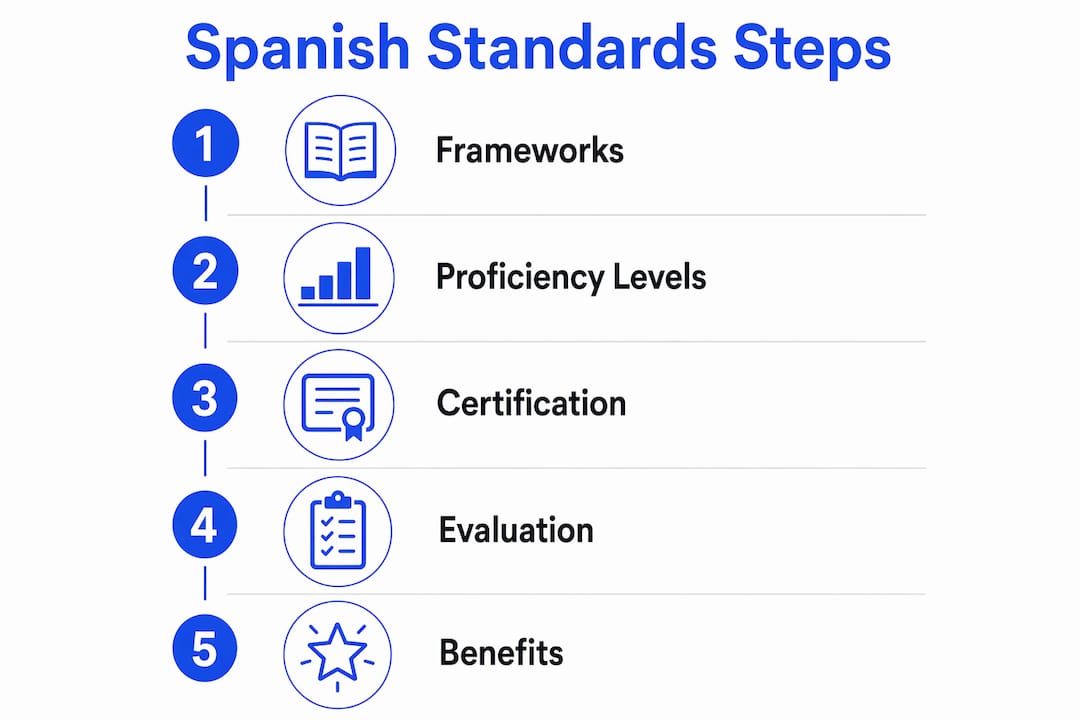
Proficiency evaluation is where international Spanish guidelines have their most direct and measurable impact. Standardized assessments give learners, employers, and academic institutions a shared language for describing ability. Without a common benchmark, a certificate from one school carries no weight at another institution.

The most globally recognized Spanish proficiency certification is the Diplomas de Español como Lengua Extranjera, known as DELE. Administered by the Instituto Cervantes under the authority of the Spanish Ministry of Education, DELE exams map directly to CEFR levels. A DELE B2 certificate tells any employer worldwide that the holder can communicate effectively in complex professional situations. Spanish Explorer’s curriculum is aligned with these international standards, giving learners a clear path from beginner to advanced with credentials that hold up in any professional context.
Another widely used certification is SIELE, a joint initiative by the Instituto Cervantes, the Universidad Nacional Autónoma de México, the Universidad de Buenos Aires, and the Universidade de São Paulo. SIELE takes a pan-Hispanic approach, recognizing that Spanish varies across regions and that proficiency should be measured against the full range of the language, not just one national variety. Understanding the differences between DELE and SIELE helps learners choose the certification that best matches their professional or academic goals.
Consistency in evaluation matters enormously for career advancement. Aligning language learning frameworks with dominant international standards significantly lowers barriers to global market entry and supports consistent evaluation practices. A professional in Singapore who holds a recognized Spanish certification can present that credential to a hiring manager in Madrid or Buenos Aires with full confidence it will be understood.
Pro Tip: Before registering for any Spanish certification exam, check that the exam is administered or recognized by the Instituto Cervantes. That single check confirms the credential meets international standards and will be accepted by employers and universities globally.
What challenges come with applying Spanish standards across diverse contexts?
Applying a single set of international Spanish guidelines across more than 20 countries and 500 million speakers is genuinely complex. The Spanish language is not monolithic. Vocabulary, pronunciation, and even grammar conventions differ meaningfully between Castilian Spanish, Latin American varieties, and regional dialects within each country.
The Real Academia Española and its partner academies across Latin America have worked for decades to foster unity across Spanish-speaking nations through shared linguistic norms. Their collaborative model acknowledges regional variation while maintaining a common standard that keeps the language mutually intelligible. This balance is the central challenge of any international language standard.
Several practical difficulties arise when institutions try to implement these standards:
- Dialect representation: Learners trained on one regional variety may struggle with assessments that favor another
- Access disparities: Smaller institutions in developing regions often lack the resources to fully implement international frameworks
- Institutional inertia: Established schools sometimes resist updating curricula to reflect revised standards
- Speed of language change: Living languages evolve faster than formal standards can be updated
- Passive adoption: Developing nations often adopt standards passively due to institutional limitations, missing the chance to shape frameworks that reflect their linguistic reality
That last point deserves attention. When a country or institution only receives standards rather than helping to create them, the resulting framework may not fully represent the learners it is meant to serve. The most effective international Spanish guidelines are those built through genuine collaboration across all major Spanish-speaking regions.
The translation of key international standards into Spanish has already demonstrated the power of language alignment. Translation of key international technical standards into Spanish opened access to multibillion-dollar Latin American markets. The same principle applies to language education: when standards reflect the full diversity of Spanish, they open doors for a far wider range of learners.
What are the practical benefits of knowing international Spanish standards?
Understanding how international Spanish guidelines work gives learners and professionals a concrete advantage. The benefits are not abstract. They show up in job applications, business negotiations, academic admissions, and everyday cross-cultural communication.
-
Clearer learning goals. When your course maps to CEFR levels, you always know exactly where you stand and what you need to reach the next level. Vague progress is replaced by specific, measurable milestones.
-
Stronger professional credentials. Employers in multinational companies recognize CEFR-aligned certificates immediately. A Spanish proficiency credential tied to an international standard carries far more weight than a school-issued certificate with no external benchmark.
-
Faster integration into Spanish-speaking environments. Learners trained on internationally recognized standards develop the communicative competence needed for real-world interaction, not just textbook exercises. That means faster, more confident communication when working or traveling in Spanish-speaking countries.
-
Better course selection. Knowing which standards a program follows helps you compare courses honestly. A business language program that explicitly maps to CEFR B2 or C1 gives you a far clearer picture of outcomes than one that simply promises “advanced” instruction.
-
Academic recognition. Universities in Spain, Latin America, and increasingly across Asia and Europe require proof of Spanish proficiency for admission or credit transfer. Internationally standardized certifications satisfy those requirements in a way that informal study records cannot.
Pro Tip: If your goal is professional Spanish, target CEFR B2 as your minimum benchmark. At B2, you can handle most workplace conversations, written correspondence, and professional presentations without significant difficulty.
The significance of Spanish compliance with international frameworks also extends to digital communication. As remote work and global business teams become the norm, the ability to communicate in standard, widely understood Spanish is a professional asset that compounds over time.
Key Takeaways
International Spanish standards provide the unified framework that makes language proficiency measurable, transferable, and professionally credible across every Spanish-speaking context.
| Point | Details |
|---|---|
| Standards define proficiency | CEFR levels give learners and employers a shared, internationally recognized measure of ability. |
| Certification matters | DELE and SIELE exams map directly to international benchmarks, making credentials globally portable. |
| Regional diversity is real | The Real Academia Española and partner academies balance local variation with a common standard. |
| Passive adoption limits learners | Institutions that only receive standards miss the chance to shape frameworks that serve their context. |
| Practical benefits are concrete | Standards improve goal clarity, career credentials, course selection, and academic recognition. |
Why I think most learners underestimate the power of standards
Most adult learners I have worked with treat language standards as bureaucratic background noise. They want to speak Spanish, not study frameworks. That instinct is understandable, but it leads to a costly mistake: spending months in a course that does not map to any recognized benchmark, then discovering the certificate carries no weight with an employer or university.
The global economy runs on standards, and language is no different. ISO has produced more than 20,000 standards that feed into global trade and development. Language proficiency frameworks operate on the same logic. They exist because consistency creates trust, and trust creates opportunity.
What I find genuinely underappreciated is how much standards protect the learner. When a school aligns its curriculum to CEFR, it is making a public commitment that its instruction meets an external, verifiable benchmark. That commitment is harder to fake than a glossy brochure. It also means your progress is portable. If you move cities, change schools, or apply for a job in another country, your level travels with you.
The Real Academia Española’s collaborative model with American academies is a good example of standards done right. Rather than imposing a single Castilian norm on 500 million speakers, the model seeks consensus. That approach produces standards with genuine legitimacy across the full Spanish-speaking world.
My advice to any adult learner in 2026: choose a program that names its framework explicitly, targets a specific CEFR level, and prepares you for a recognized certification. Everything else is guesswork dressed up as education.
— Paul
Spanish Explorer: courses built on international standards
Spanish Explorer’s adult courses are built directly on the international frameworks that make Spanish proficiency meaningful in the real world. Every program maps to CEFR levels, and instruction is delivered by certified teachers fluent in both Spanish and English.

Whether you are building conversational confidence, preparing for a professional role, or developing Spanish for corporate use, Spanish Explorer offers group classes, private Spanish lessons, and corporate training programs at its center in Singapore’s central business district at 10 Anson Road, level 22, International Plaza, above Tanjong Pagar MRT. Online classes via Zoom are also available for learners who prefer flexible scheduling. Explore the full range of Spanish courses at Spanish Explorer and find the program that fits your level and goals.
FAQ
What are international Spanish standards?
International Spanish standards are coordinated frameworks, such as the CEFR and guidelines from the Real Academia Española, that define proficiency levels, instructional quality, and linguistic norms across all Spanish-speaking regions and learning contexts.
How do Spanish standards affect language certification?
Standards like CEFR provide the benchmarks that exams such as DELE and SIELE use to measure and certify proficiency. A certification tied to these benchmarks is recognized by employers and universities worldwide.
Why does the Real Academia Española matter for learners?
The Real Academia Española, working with partner academies across Latin America, sets shared linguistic norms that keep Spanish mutually intelligible across more than 20 countries. Its standards directly influence what is taught and tested in internationally recognized Spanish programs.
How do international Spanish guidelines benefit professionals?
Professionals who hold CEFR-aligned Spanish certifications can present verifiable, internationally recognized credentials to employers in any Spanish-speaking market, supporting career advancement and cross-border communication.
What CEFR level should adult learners target for professional use?
CEFR B2 is the recognized minimum for professional Spanish communication. At B2, learners can handle complex workplace conversations, written correspondence, and presentations with confidence.
Recommended
Start Learning Spanish Today
Book a trial class and see how quickly you can progress with a professionally trained native-speaker teacher guiding the way.
Book a Trial Class