 Spanish
TL;DR:
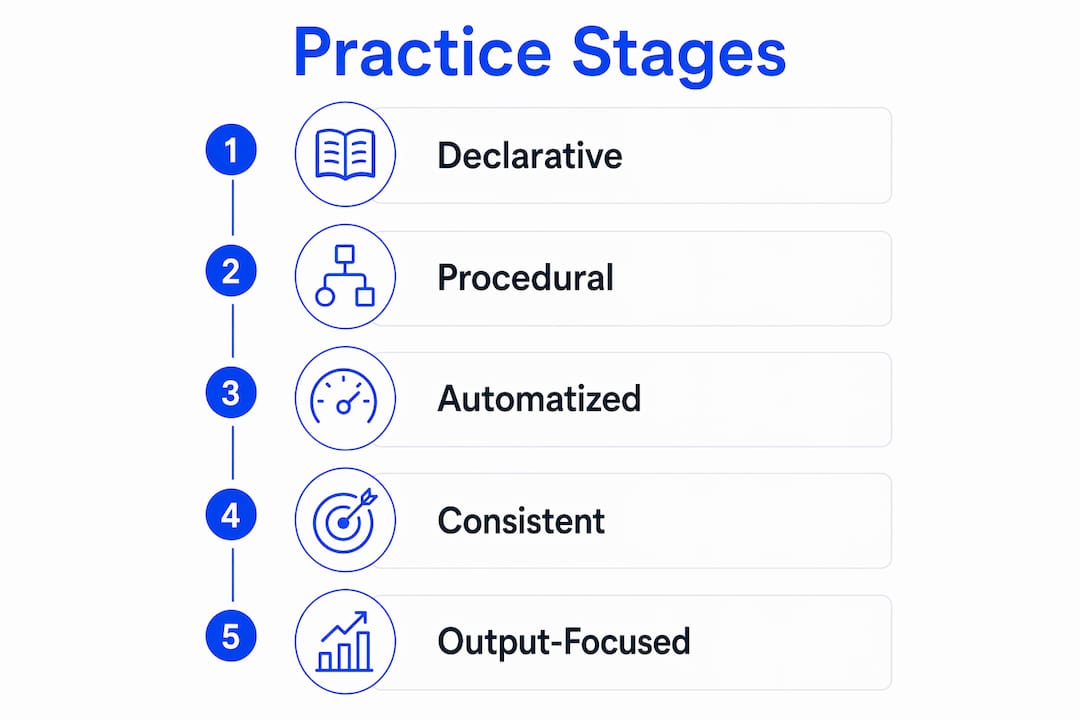
- Practice transforms explicit language knowledge into automatic speaking and writing skills through gradual stages.
- Short, daily practice sessions with feedback are more effective than infrequent, longer periods, promoting fluency.
Practice is the essential process that converts what you know about a language into fluent, automatic use. The role of practice in language acquisition is not supplementary. It is the core mechanism that separates learners who can recognize Spanish from those who can actually speak it. Skill Building Theory, a well-established framework in second language acquisition research, defines this process as the transition from declarative knowledge to procedural, automatic performance. For adult Spanish learners and the educators who guide them, understanding how practice works at a cognitive level is the difference between slow progress and real fluency.
How does practice transform declarative knowledge into procedural language skills?
Skill Building Theory identifies three stages every language learner moves through: declarative, procedural, and automatic. Declarative knowledge is what you can explain. You know that Spanish verbs change by subject, or that adjectives follow nouns. Procedural knowledge is what you can do under pressure, without stopping to think. Automatic performance is what fluent speakers have: language that flows without conscious effort.
The critical insight from Skill Building Theory is that practice must happen within the skill domain. Reading grammar explanations does not proceduralize speaking. Only speaking practice builds speaking skill. Writing practice builds writing skill. This is why learners who spend months studying grammar rules still freeze in real conversations.
The path from declarative to automatic follows a clear sequence. You learn a rule explicitly, you practice producing it in controlled contexts, and then you practice it in freer, more natural conditions. Effective practice progresses from drills to controlled contexts to free conversation. Skipping steps collapses the process and leaves gaps in real-world performance.
- Declarative stage: Learn the rule or pattern explicitly (e.g., the subjunctive mood in Spanish).
- Procedural stage: Practice producing the pattern in structured exercises with guidance.
- Automatic stage: Use the pattern naturally in conversation without conscious recall.
Pro Tip: Never skip the procedural stage by jumping straight from grammar study to free conversation. Controlled drills are not boring. They are the bridge that makes fluency possible.
Why is output-focused practice essential for achieving fluency?
Recognition and retrieval are not the same skill. You can recognize a Spanish word when you read it and still be unable to produce it when speaking. Output practice forces retrieval, which is harder than recognition but far more effective for building lasting fluency. The discomfort you feel when trying to speak Spanish from memory is not a sign of failure. It is a signal that your brain is identifying real gaps.
Active production, whether speaking or writing, reveals weaknesses that passive study hides completely. A learner who reads Spanish news articles may feel confident until they try to describe their weekend in Spanish and realize they cannot form a simple past tense sentence under pressure. That gap only surfaces through output.
“Producing language from memory is harder but essential, leading to better retention and fluency. Learners who practice output consistently develop active language skills that passive recognition alone cannot build.”
Structured, feedback-driven output practice is the most direct path to closing those gaps. The key elements of effective output practice include:
- Speaking drills: Repeating target structures aloud until production becomes automatic.
- Writing exercises: Producing sentences and paragraphs from memory, not copying from notes.
- Timed responses: Answering questions in Spanish within a set time to simulate real conversation pressure.
- Spaced review: Spaced repetition alongside output keeps vocabulary accessible for production, not just recognition.
For adult Spanish learners pursuing conversational or business proficiency, output practice is non-negotiable. You can read about Spanish for years. Fluency only comes from producing it.
What does research recommend about effective practice routines?
The most common mistake adult learners make is saving practice for the weekend. A two-hour Saturday session feels productive. Research on motor learning shows it is far less effective than daily short sessions. Sessions of 3–10 minutes strengthen language habit formation and motor pathways more reliably than long, infrequent blocks.
This is the 3-Minute Rule: brief, repeated practice builds neural pathways responsible for speech and language. Frequent practice strengthens the motor memory that fluent speaking requires. Three minutes of Spanish speaking practice every morning is more valuable than thirty minutes once a week.
| Practice Format | Frequency | Benefit |
|---|---|---|
| Daily speaking drills | 3–10 minutes per day | Builds motor memory and habit |
| Weekly output sessions | 30–60 minutes once a week | Lower retention, higher burnout risk |
| Spaced vocabulary review | 5 minutes daily | Maintains active recall for production |
| Structured conversation practice | 2–3 times per week | Develops real-time fluency under pressure |
Habit formation science supports the same conclusion. Small, manageable actions repeated consistently produce significant progress over time. Consistent short sessions prevent burnout and keep learners engaged across weeks and months, not just days.
Pro Tip: Attach your Spanish practice to an existing daily habit, like morning coffee or a commute. Habit stacking makes consistency automatic and removes the need for daily motivation.
For educators designing adult Spanish programs, this research has a direct implication. Courses that include structured daily practice components, even brief ones, produce better outcomes than those relying solely on weekly class time. Spanish Explorer builds this principle into its course design, pairing class sessions with guided practice frameworks for learners to use between lessons.
How can learners implement deliberate practice to accelerate Spanish proficiency?
Deliberate practice is not the same as regular practice. Deliberate practice requires targeting one specific skill at a time, working near the limit of your current ability, and receiving immediate feedback. Repeating what you already do well feels comfortable but produces minimal improvement.
The structure of a deliberate practice session for Spanish looks like this:
- Identify one specific weakness. Not “improve my Spanish” but “practice the preterite vs. imperfect distinction in spoken sentences.”
- Set a near-limit challenge. Choose sentences or scenarios that are slightly harder than your current comfort level.
- Practice with immediate feedback. Work with a teacher, a practice partner, or a recording that lets you compare your output to a model.
- Repeat with adjustment. Do not just repeat the same attempt. Adjust based on the feedback and try again.
Common pitfalls that undermine deliberate practice include:
- Setting goals that are too broad (“practice speaking” instead of “practice asking for directions in Spanish”).
- Practicing without any feedback mechanism, which can harden errors rather than correct them.
- Avoiding difficult areas and defaulting to content you already know well.
- Skipping the review loop after feedback, which is where consolidation actually happens.
For Spanish learners, deliberate practice might mean spending ten minutes on pronunciation of the Spanish “r” sound with a recording for comparison, or drilling business vocabulary in spoken sentences with a teacher who corrects errors immediately. The specificity is what makes it work. You can find a structured Spanish study process that applies these principles to adult learners at every proficiency level.
What are the best practices for sustaining motivation over time?
Motivation in language learning is not a fixed trait. It fluctuates based on how sessions feel, how much progress learners perceive, and how feedback is delivered. The most effective learners treat motivation as something they manage, not something they wait for.
Practical strategies that sustain consistent practice include:
- Keep sessions positive. End each practice session on a success, even a small one. Finishing on frustration trains your brain to avoid the next session.
- Balance focused practice with lighter input. Watching a Spanish film or listening to a podcast after a drilling session reduces cognitive fatigue without breaking immersion.
- Use feedback constructively. Specific, gentle feedback during dedicated practice sessions improves outcomes. Constant correction outside practice time harms confidence.
- Create a distraction-free environment. Even a 5-minute session loses its value if you are checking your phone. Full attention during short sessions outperforms distracted longer ones.
- Track visible progress. Keeping a simple log of what you practiced and what improved gives you concrete evidence of growth, which sustains motivation better than vague encouragement.
For adult learners balancing work and study, the daily Spanish practice routine that works is the one that fits realistically into your schedule. Perfection is not the goal. Consistency is.
Pro Tip: If you miss a day, do not try to compensate with a double session the next day. Just resume your normal routine. Overcompensating disrupts habit formation and increases burnout risk.
Key Takeaways
Consistent, output-focused practice is the single most effective method for converting Spanish language knowledge into fluent, automatic speaking and writing ability.
| Point | Details |
|---|---|
| Practice within the skill domain | Speaking practice builds speaking skill; grammar study alone does not proceduralize production. |
| Output reveals real gaps | Producing Spanish from memory exposes weaknesses that reading and listening cannot surface. |
| Short daily sessions outperform long ones | Sessions of 3–10 minutes daily build motor memory and habit more effectively than weekly blocks. |
| Deliberate practice requires specificity | Target one weakness at a time with immediate feedback and iterative repetition for fastest gains. |
| Motivation requires active management | End sessions positively, use feedback constructively, and track progress to sustain long-term consistency. |
Why I think most learners practice the wrong way
After working with adult Spanish learners across many proficiency levels, the pattern I see most often is this: learners practice what they already know. They review vocabulary they have already memorized. They drill verb conjugations they can already produce. It feels productive because it is comfortable. It is not productive because it does not push the boundary of their ability.
The research on deliberate practice is unambiguous on this point. Growth happens at the edge of your current skill, not inside your comfort zone. The learners who improve fastest are not the ones who practice the most hours. They are the ones who spend their practice time in the uncomfortable zone, attempting things they cannot yet do reliably, and getting specific feedback on what went wrong.
The other misunderstanding I see regularly is the belief that more input will eventually produce output. Learners watch Spanish content, read Spanish articles, and listen to Spanish podcasts for months, then wonder why they still cannot hold a conversation. Input builds comprehension. Output builds production. They are related but they are not interchangeable. If your goal is to speak Spanish, you need to practice speaking Spanish. For learners who want to see what output-focused fluency looks like in practice across languages, the principles transfer directly.
The most honest advice I can give is this: embrace the discomfort of not knowing. The moment you try to say something in Spanish and cannot find the words is the most valuable moment in your practice session. That gap is exactly where your next lesson should begin.
— Paul
Structured Spanish practice with expert guidance
Spanish Explorer offers adult conversational and business Spanish courses designed around the practice principles that research supports. Every course includes certified instructors who provide the specific, immediate feedback that deliberate practice requires.

Whether you prefer group or private Spanish courses or the flexibility of online Spanish classes via Zoom, Spanish Explorer structures each lesson to move you from declarative knowledge to real speaking ability. Corporate training options are also available for teams building Spanish proficiency for professional use. The school is located at 10 Anson Road, level 22, International Plaza, Singapore 079903, directly above Tanjong Pagar MRT, with online options available for learners across Singapore and beyond.
FAQ
What is the role of practice in language acquisition?
Practice converts explicit language knowledge into automatic, fluent use by moving learners through declarative, procedural, and automatic stages, as defined by Skill Building Theory. Without consistent practice, knowledge stays theoretical and does not transfer to real speaking or writing.
How much should I practice Spanish each day?
Research supports sessions of 3–10 minutes daily as more effective than long, infrequent blocks. Short, consistent practice builds motor memory and habit formation without burnout.
Why is speaking practice more effective than studying grammar?
Grammar study builds declarative knowledge, but only speaking practice proceduralize that knowledge into automatic production. Practice must occur within the skill domain to transfer to real conversation.
What is deliberate practice in language learning?
Deliberate practice means targeting one specific weakness at a time, working near your ability limit, and receiving immediate feedback with iterative repetition. It produces faster improvement than repeating comfortable content.
How does output practice improve Spanish fluency?
Output practice forces retrieval from memory, which reveals gaps that passive recognition hides and strengthens active language use. Structured feedback during output sessions corrects errors before they become habits.
Recommended
Start Learning Spanish Today
Book a trial class and see how quickly you can progress with a professionally trained native-speaker teacher guiding the way.
Book a Trial Class