 Spanish
TL;DR:
- Spanish enhances communication, trust, and safety in multicultural teams, leading to measurable improvements. Proper cultural understanding and structured activities accelerate language skills and team cohesion, while tracking specific metrics demonstrates business impact. Avoid relying on one bilingual employee and focus on integrating Spanish as a strategic, ongoing capability.
Spanish is the second most spoken native language worldwide, with over 500 million speakers making it one of the most consequential languages for workplace communication. For managers leading multicultural teams, the role of Spanish in team building goes far beyond translation. It shapes trust, reduces friction, and creates the shared context that high-performing teams depend on. This guide breaks down exactly how Spanish language skills improve team dynamics, where cultural nuance matters most, and how to measure real business outcomes from language investment.
How does Spanish improve communication in multicultural teams?
Spanish proficiency directly reduces misunderstandings and builds trust in teams where Spanish-speaking employees are present. When managers and colleagues communicate in a worker’s native or preferred language, engagement rises and compliance improves. This is not a soft benefit. Spanish in leadership communication in sectors like manufacturing, logistics, and healthcare produces measurable gains in policy comprehension and operational safety.

The mechanism is straightforward. Workers who understand instructions clearly make fewer errors. Teams that share a communication channel bond faster. Spanish accelerates employee integration and strengthens professional relationships in ways that English-only environments simply cannot replicate when a significant portion of the team is Spanish-speaking.
Here is what changes when Spanish is used effectively in team communication:
- Onboarding time shortens because new employees grasp procedures faster
- Safety compliance improves in high-risk environments like construction and logistics
- Team meetings produce clearer decisions when all participants follow the discussion
- Peer relationships form more quickly across language groups
- Employee retention increases when workers feel understood and included
Pro Tip: Start with the highest-stakes communication first. Safety briefings, compliance training, and performance reviews in Spanish deliver the fastest measurable return before you expand to broader team activities.
Why do cultural nuances in Spanish matter for team dynamics?
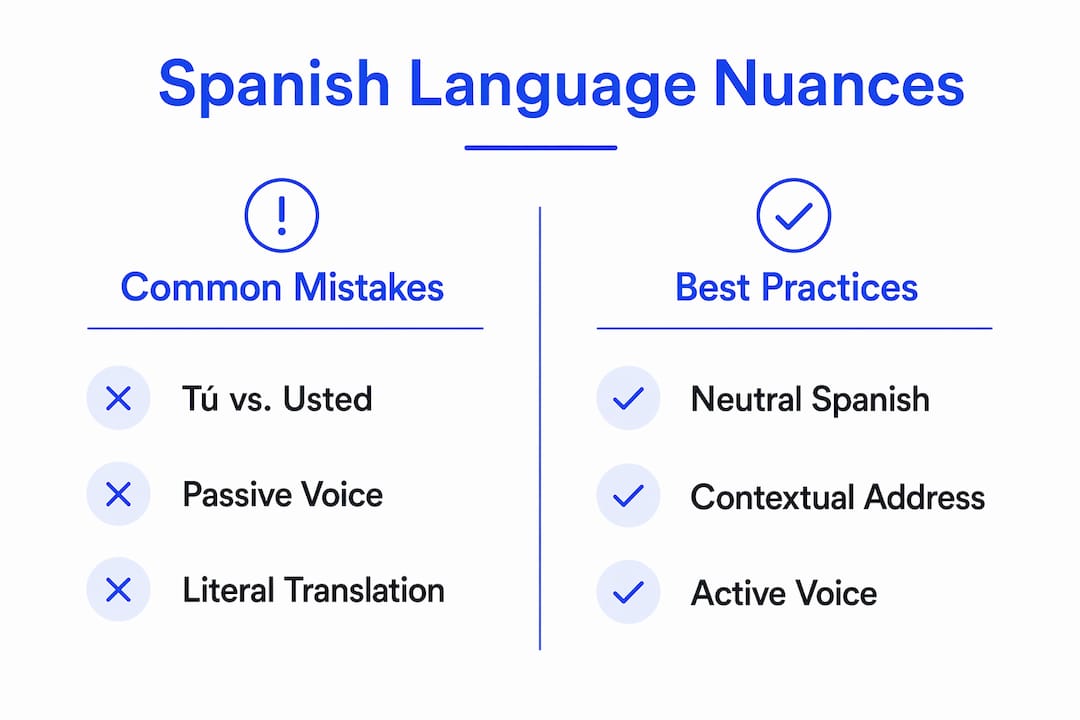
Literal, word-for-word translation is one of the most common and costly mistakes in multinational team communication. Direct translation often causes disengagement because it strips out the cultural logic that makes communication feel respectful and credible. A message that reads naturally in English can come across as cold, confusing, or even condescending when translated without cultural awareness.
The pronoun choice between tú (informal) and usted (formal) is a clear example. Using tú with a senior colleague or client in many Latin American and Spanish business contexts signals a lack of respect. Using usted in a casual team setting can feel stiff and create distance. Neither is universally correct. The right choice depends on the country of origin, the industry, and the relationship between speakers.
Passive voice is another frequent pitfall. English business writing leans heavily on passive constructions. Spanish business communication, particularly in formal contexts, favors active voice and direct address. Teams that carry English passive-voice patterns into Spanish communications often produce text that feels evasive or bureaucratic to native speakers.
The table below summarizes the most common Spanish language nuances that affect team credibility and morale in business settings.
| Language element | Common mistake | Best practice |
|---|---|---|
| Pronoun choice (tú vs. usted) | Defaulting to tú in all contexts | Match formality to relationship and regional norms |
| Passive voice | Translating English passive constructions directly | Use active voice and direct address in Spanish |
| Regional vocabulary | Using Spain-specific terms with Latin American teams | Use neutral Spanish that works across regions |
| Gendered language | Ignoring grammatical gender in titles and roles | Apply correct gender agreement consistently |
| Tone in written messages | Translating English directness literally | Soften requests with culturally appropriate phrasing |
Neutral Spanish is the standard recommendation for internal communications that reach teams across multiple Spanish-speaking countries. It avoids regional slang, uses widely understood vocabulary, and maintains a professional tone that does not favor one national variety over another.
Pro Tip: Before distributing any Spanish-language team document, have a native speaker from the target region review it. A five-minute review catches the pronoun, tone, and vocabulary issues that automated translation tools consistently miss.
What are the best ways to integrate Spanish into team building?
Structured Spanish language activities produce stronger results than informal exposure alone. The goal is to create repeated, low-stakes opportunities for team members to use Spanish together, which builds both language skills and interpersonal bonds. Spanish team-building exercises increase morale, safety awareness, and productivity when they are designed around real workplace scenarios rather than generic language drills.
The following strategies work across industries and team sizes.
-
Language challenges tied to job tasks. Pair Spanish vocabulary practice with actual work procedures. A logistics team learns shipping terminology in Spanish. A healthcare team practices patient communication phrases. The language sticks because it is immediately useful.
-
Role-playing exercises. Simulate real workplace conversations: a performance review, a safety briefing, a client call. Role-playing in Spanish reduces anxiety around real interactions and builds confidence faster than classroom study alone.
-
Cultural workshops. Bring in context about the countries your Spanish-speaking team members come from. Understanding regional holidays, communication styles, and professional norms builds empathy and reduces friction in daily interactions.
-
Bilingual team meetings. Rotate which language is used for different agenda items. This normalizes Spanish as a working language rather than a special accommodation, and it gives non-native speakers structured practice in a supportive setting.
-
Peer language partnerships. Pair Spanish-speaking employees with colleagues who are learning Spanish. Both sides benefit. The native speaker gains recognition as a cultural resource. The learner gains a practical conversation partner.
Technology supports all of these strategies. Platforms like Rosetta Stone Enterprise offer corporate Spanish learning programs that integrate with team schedules and track individual progress. For teams in Singapore, workplace Spanish lessons designed around business communication goals deliver faster results than general language courses.
How do you measure the impact of Spanish on team performance?
Measuring the return on Spanish language investment requires tracking specific outcomes, not just language proficiency scores. Organizations that treat Spanish strategically and measure tangible results consistently outperform those that treat language training as a diversity checkbox. The difference is in what you track.
The table below outlines the key performance indicators most relevant to Spanish language initiatives in team environments.
| KPI | What it measures | How to track it |
|---|---|---|
| Employee comprehension | Understanding of policies and safety procedures | Pre and post training assessments |
| Onboarding speed | Time for new hires to reach full productivity | Manager evaluations at 30, 60, and 90 days |
| Operational error rate | Mistakes linked to miscommunication | Incident reports before and after training |
| Employee engagement score | Team morale and sense of inclusion | Quarterly surveys with language-specific questions |
| Customer satisfaction | Quality of Spanish-language client interactions | Customer feedback scores and complaint rates |
Engagement scores and error rates are the fastest-moving indicators after Spanish training begins. Comprehension of safety and compliance materials tends to show measurable improvement within the first training cycle. Customer satisfaction metrics take longer but often show the most significant business impact in client-facing roles.
Language investment creates clarity, confidence, and connection that shows up in these numbers. Managers who track outcomes from the start build the internal business case for sustained Spanish language programs rather than one-off workshops.
The benefits of learning Spanish extend beyond team metrics. Employees who develop Spanish skills report stronger career confidence and broader professional networks, which feeds back into team retention and performance over time.
Key takeaways
Spanish language investment in teams produces measurable gains in communication, safety, engagement, and retention when it is treated as a structured business capability rather than an informal perk.
| Point | Details |
|---|---|
| Spanish improves team communication | Spanish proficiency reduces errors and builds trust in manufacturing, logistics, and healthcare teams. |
| Cultural nuance matters as much as vocabulary | Pronoun choice, tone, and regional vocabulary directly affect team credibility and morale. |
| Structured activities outperform passive exposure | Role-playing, cultural workshops, and bilingual meetings build skills faster than informal learning. |
| Measure outcomes, not just proficiency | Track comprehension, error rates, and engagement scores to prove the business value of Spanish training. |
| Avoid overloading one bilingual employee | Structured Spanish training distributes communication responsibility and prevents burnout. |
What I have learned from watching teams get Spanish wrong
The most common mistake I see managers make is assigning all Spanish communication to the one bilingual person on the team. It feels efficient. It is not. That employee becomes a bottleneck, a cultural interpreter, and an informal HR resource all at once. Relying on a single bilingual employee creates burnout and leaves the organization dependent on one person’s availability and patience.
The second mistake is treating Spanish as a translation problem rather than a communication strategy. Teams that invest in Spanish only to convert English documents into Spanish miss the point entirely. The goal is not translated content. The goal is shared understanding. Those are very different outcomes.
What actually works is treating Spanish as a structural capability, the same way you treat project management tools or compliance training. You build it into onboarding. You practice it in team meetings. You measure it against real outcomes. When you do that, Spanish stops being a nice-to-have and starts functioning as a genuine competitive advantage.
The unexpected benefit I keep seeing is career growth for non-Spanish-speaking team members who pick up the language through workplace programs. They gain access to a broader professional network, stronger client relationships, and a skill that strengthens career opportunities in ways that most employees do not anticipate when they start. That is a retention driver worth paying attention to.
— Paul
Build your team’s Spanish communication skills with Spanish Explorer

Spanish Explorer offers corporate Spanish training programs designed specifically for adult professionals and teams in Singapore. Courses cover business communication, workplace vocabulary, and cultural fluency through group classes, private instruction, and flexible online Zoom sessions that fit around demanding work schedules. Every program is taught by certified, experienced instructors fluent in both Spanish and English. Whether your team is starting from zero or building on existing skills, Spanish Explorer’s Spanish courses provide a structured, practical pathway to stronger team communication and real workplace results. Located in Singapore’s central business district above Tanjong Pagar MRT at International Plaza.
FAQ
What is the role of Spanish in team building?
Spanish functions as a communication tool that reduces misunderstandings, builds trust, and accelerates integration in multicultural teams. Its role extends to safety compliance, employee engagement, and cultural cohesion across industries like manufacturing, healthcare, and logistics.
How does Spanish improve collaboration in multicultural teams?
Spanish proficiency gives team members a shared communication channel that reduces errors and strengthens professional relationships. Teams that use Spanish in structured activities like role-playing and bilingual meetings report faster bonding and higher morale.
Why does cultural nuance matter in Spanish team communication?
Literal translation strips out the cultural logic that makes Spanish communication feel respectful and credible. Choices like tú versus usted and the use of neutral Spanish versus regional vocabulary directly affect how team members perceive professionalism and inclusion.
How can managers measure the impact of Spanish language training?
Track employee comprehension scores, operational error rates, onboarding speed, and engagement survey results before and after training. These KPIs reveal the business value of Spanish investment faster than language proficiency tests alone.
What is the best way to start integrating Spanish into team activities?
Begin with the highest-stakes communication: safety briefings, compliance training, and onboarding materials. Then expand to structured team activities like cultural nuance workshops and bilingual meetings to build broader language confidence across the team.
Recommended
- Spanish Training for Professionals: Your Career Guide
- Why Study Spanish in 2026: Benefits Worth Knowing
- Essential Spanish for Meetings: A Professional’s Guide
Start Learning Spanish Today
Book a trial class and see how quickly you can progress with a professionally trained native-speaker teacher guiding the way.
Book a Trial Class