 Spanish
TL;DR:
- Spanish is a widely spoken Romance language with over 519 million native speakers and official status in 21 countries. Its rich history, diverse dialects, and cultural influence make it a strategic global language, especially in the Americas and the United States. Learning Spanish offers vast opportunities in business, culture, and professional development worldwide.
Spanish is a Romance language descended from Vulgar Latin, spoken today by approximately 519 million native speakers and around 636 million people in total — roughly 7.5% of the global population. It holds official status in 21 countries and ranks among the six official languages of the United Nations. For adult learners and professionals, that reach translates directly into opportunity: Spanish opens doors across the Americas, Europe, and Africa, and it is the most strategically valuable second language for English speakers working in business, healthcare, media, or public service.
A few headline figures worth anchoring to:
- The number of native speakers worldwide is approximately 519 million according to Instituto Cervantes 2025 data
- Total speakers, including second-language and heritage speakers, are estimated to be around 636 million
- Spanish is recognized as an official language in multiple countries globally
- There are tens of millions of Spanish speakers in the United States, making it the most widely spoken non-English language in the country
The practical implication is straightforward. Whether you are pursuing Spanish for career advancement, cultural literacy, or personal enrichment, you are investing in one of the most widely used and economically significant languages on earth.
Table of Contents
- What is the Spanish language, and how is it classified?
- How did Spanish evolve from Latin to a global language?
- Where in the world is Spanish spoken today?
- Why does Spanish matter so much in the United States?
- What are the major Spanish dialects and how do they differ?
- What are the core phonology and grammar features you need to know?
- Where does Spanish vocabulary come from?
- How is Spanish written, and what are the key orthographic rules?
- Which institutions govern and promote Spanish worldwide?
- How significant is Spanish in literature, film, music, and media?
- What are the current trends and future projections for Spanish?
- Key Takeaways
- Why structured learning still beats going it alone
- Authoritative sources and further reading
- FAQ
What is the Spanish language, and how is it classified?
Spanish belongs to the Indo-European language family, specifically the Romance branch, and within that branch it sits in the Ibero-Romance subgroup alongside Portuguese, Catalan, and Galician. Its closest relative by mutual intelligibility is Portuguese; Italian and French are more distant but still share substantial vocabulary and structure.
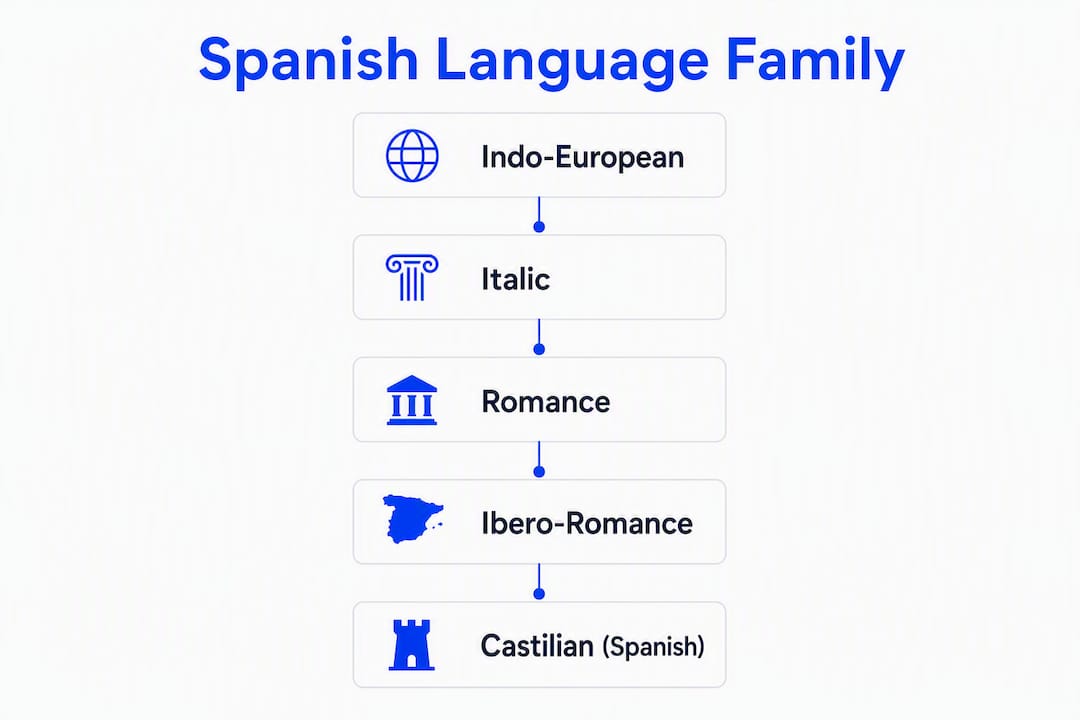
The family tree in brief:
Indo-European → Italic → Romance → Ibero-Romance → Castilian (Spanish)
Why “Spanish” and why “Castilian”?
Both names are correct, and the distinction matters in practice. Español (Spanish) refers to the language as a whole. Castellano (Castilian) emphasizes its origin in the medieval Kingdom of Castile and is the preferred term in several Latin American countries, particularly Argentina, Bolivia, and Paraguay. In Spain, both terms coexist, though official documents often use castellano to distinguish it from other co-official languages like Catalan, Basque, and Galician.
Core typological features
Spanish is a fusional language, meaning a single verb ending encodes multiple grammatical categories simultaneously. The ending -amos on a verb tells you first person, plural, present tense, indicative mood — all at once. That density is what makes verb conjugation feel like a mountain at first and a superpower later.
Key features that define the language structurally:
- Grammatical gender: All nouns are masculine or feminine, and adjectives, articles, and pronouns must agree.
- Rich verb morphology: Spanish verbs conjugate for person, number, tense, aspect, and mood across dozens of forms. The subjunctive mood alone has present and past tenses used regularly in everyday speech.
- Clitic pronouns: Object pronouns attach to infinitives and imperatives (dímelo — “tell it to me”) and precede conjugated verbs (me lo dijo — “she told it to me”). Placement rules trip up learners at intermediate stages.
- Relatively flexible word order: The default is Subject-Verb-Object, but Spanish allows significant reordering for emphasis and information structure without becoming ungrammatical.
- Pro-drop: Spanish regularly omits subject pronouns because the verb ending makes the subject clear. Hablo español means “I speak Spanish” — no yo required.
How did Spanish evolve from Latin to a global language?
Spanish evolved from Vulgar Latin — the spoken, colloquial Latin of Roman soldiers and settlers — and expanded through a series of political and military events that reshaped the Iberian Peninsula and then the Americas. The story is not a smooth progression; it is a series of ruptures and absorptions.
Roman Hispania (218 BCE – 5th century CE)
Rome conquered the Iberian Peninsula beginning in 218 BCE. Over roughly six centuries, Vulgar Latin displaced the pre-Roman languages of the region (Iberian, Celtiberian, and others), though Basque survived as the sole pre-Roman language still spoken in Iberia today. The Latin that took root was not classical literary Latin but the everyday spoken variety, already diverging from written norms.
Visigothic period and early medieval fragmentation (5th–8th centuries)
When the Western Roman Empire collapsed, Germanic Visigothic tribes moved into Iberia. Their linguistic influence on Spanish was modest — a few hundred words, mostly related to warfare and personal names — but their political fragmentation of the peninsula set the stage for the emergence of distinct regional Romance dialects.
The Reconquista and the rise of Castilian (8th–15th centuries)
The Moorish conquest of 711 CE introduced Arabic as the prestige language of much of Iberia for nearly eight centuries. During this period, the northern Christian kingdoms gradually pushed southward in what historians call the Reconquista. The Kingdom of Castile, positioned in the center of the peninsula, became the dominant political force, and its dialect — Castilian — gained prestige over competing Ibero-Romance varieties like Leonese and Aragonese.
Arabic left a deep mark on the vocabulary. Words like almohada (pillow), aceite (oil), azúcar (sugar), and algebra entered Castilian through centuries of contact, trade, and coexistence. Estimates of Arabic-derived words in Spanish run into the thousands, making it the single largest non-Latin influence on the lexicon.
The 13th century was a turning point. King Alfonso X of Castile (“Alfonso the Wise”) used Castilian as the language of his court and commissioned major literary and scientific works in it, establishing a written standard and lending the dialect institutional prestige. By 1492 — the year Columbus sailed and the year the Real Academia Española would later mark as the symbolic birth of modern Spanish — Antonio de Nebrija published the first grammar of any modern European language, Gramática de la lengua castellana.
Colonial expansion and the formation of American varieties (16th–19th centuries)
Spanish crossed the Atlantic with Columbus in 1492 and spread rapidly through military conquest and colonial administration. Within a century, it was the administrative language of a vast empire stretching from Mexico to the southern tip of South America. Contact with hundreds of indigenous languages — Nahuatl in Mexico, Quechua in the Andes, Guaraní in Paraguay, Taíno in the Caribbean — produced new vocabulary and, in some regions, distinct phonological and syntactic patterns.
The varieties of Spanish that developed in the Americas diverged from Iberian Spanish in ways that still define the major dialect zones today. Crucially, the Spanish that arrived in the Americas was not uniform: settlers came from different regions of Spain, and the mix of Andalusian, Canarian, and Castilian speech patterns shaped different colonial varieties differently.
Standardization and modern growth (19th century onward)
The 19th century brought independence to most Spanish-speaking nations in the Americas, raising the question of whether a unified standard could survive political fragmentation. The RAE and, later, the Asociación de Academias de la Lengua Española worked to maintain a shared orthographic and grammatical standard across the now-independent nations. The 20th century brought mass literacy, radio, television, and eventually the internet — each medium reinforcing a broadly shared written standard while allowing spoken varieties to flourish.
Where in the world is Spanish spoken today?
Spanish is official in 21 countries and spoken across four continents, with significant diaspora communities on a fifth. No other language has official status in as many sovereign nations except English and French.

Regional breakdown
Europe: Spain is the language’s historical homeland, with roughly 47 million speakers. Spanish also has a small official presence in Andorra (alongside Catalan) and is widely spoken in Gibraltar.
Latin America and the Caribbean: This is where the majority of native speakers live. Mexico alone accounts for the largest single national population of Spanish speakers in the world. The region stretches from Mexico through Central America, the Caribbean (Cuba, Puerto Rico, Dominican Republic), and all of South America except Brazil and the Guianas.
North America: The United States has over 50 million Spanish speakers, making it one of the largest Spanish-speaking countries by population. Canada has a smaller but growing Spanish-speaking community, concentrated in major cities.
Africa: Equatorial Guinea is the only country in sub-Saharan Africa where Spanish holds official status, alongside French and Portuguese. Western Sahara also has historical Spanish ties.
Asia and Oceania: The Philippines was a Spanish colony for over 300 years (1565–1898), and Spanish left traces in Filipino vocabulary and place names, though it is no longer widely spoken there. Guam and other former Spanish territories in the Pacific retain some linguistic heritage.
Diaspora communities: Large Spanish-speaking communities exist in the United Kingdom, Germany, France, Italy, Israel, and Australia, driven by migration from Latin America and Spain.
Speaker counts by major country
| Country | Approximate native speakers |
|---|---|
| Mexico | ~130 million |
| Colombia | ~51 million |
| Spain | ~47 million |
| Argentina | ~45 million |
| United States | ~41 million (native/primary) |
| Venezuela | ~32 million |
| Peru | ~32 million |
| Chile | ~19 million |
| Ecuador | ~17 million |
| Guatemala | ~17 million |
Sources: Instituto Cervantes Global Observatory; U.S. Census Bureau
The Instituto Cervantes 2025 report confirms that the native-speaker community exceeded 500 million and that total speakers — including those who use Spanish as a second or foreign language — reached approximately 636 million. That figure places Spanish second globally by native speakers, behind only Mandarin Chinese.
Why does Spanish matter so much in the United States?
Spanish is the most widely spoken non-English language in the United States by a significant margin. U.S. Census Bureau data put the Spanish-speaking population at over 50 million as of 2015, and demographic trends point to continued growth. The Hispanic population is the largest ethnic minority group in the country, and Spanish-language use is sustained by both immigration and multigenerational heritage communities.
Where Spanish speakers are concentrated
Geographic concentration is pronounced:
- Southwest: California, Texas, Arizona, New Mexico, and Nevada have the largest absolute numbers and the highest proportional concentrations. New Mexico has historically had the highest percentage of Spanish speakers relative to total state population.
- Florida: Miami is effectively a bilingual city; the Cuban-American community and more recent arrivals from Venezuela, Colombia, and Central America make South Florida one of the most Spanish-dominant metro areas in the country.
- New York metro area: Puerto Rican, Dominican, and Mexican communities make New York City home to one of the most linguistically diverse Spanish-speaking populations in the world.
- Chicago, Houston, Los Angeles: Each has millions of Spanish speakers and robust Spanish-language media, retail, and civic infrastructure.
What this means for professionals and organizations
The implications run across nearly every sector:
- Healthcare: Hospitals and clinics in high-density areas face daily demand for Spanish-language patient communication. Providers with Spanish proficiency reduce errors, improve patient trust, and satisfy federal language-access requirements.
- Education: Bilingual education programs, dual-language schools, and English Language Learner (ELL) services depend on Spanish-proficient educators and administrators.
- Media and marketing: Spanish-language television, radio, and digital media represent a multi-billion-dollar market. Brands that localize content in Spanish reach a consumer base with substantial purchasing power.
- Legal and financial services: Immigration law, real estate, banking, and insurance all require Spanish-capable professionals to serve clients effectively.
- Politics and public service: Spanish-language outreach has become standard practice in federal, state, and local elections. Government agencies at every level publish materials in Spanish.
Bilingual English-Spanish fluency is a marketable professional skill in sectors like healthcare, banking, and technology — and the demand is not shrinking. For adult learners weighing the return on time invested in language study, the U.S. labor market makes a strong case for Spanish over almost any other option.
What are the major Spanish dialects and how do they differ?
Spanish is not monolithic. The varieties spoken in Madrid, Mexico City, Buenos Aires, Havana, and Bogotá are mutually intelligible, but they differ enough in pronunciation, vocabulary, and some grammatical features that learners who trained on one variety sometimes feel disoriented in another. Understanding the major groupings helps.
The main dialect zones
Iberian/Castilian (Spain): The variety most associated with “standard” European Spanish. Characterized by the ceceo/seseo distinction — specifically, the use of the th-like sound /θ/ for the letters c (before e or i) and z, so cena (dinner) sounds like “thena.” This feature does not exist in Latin American Spanish. Castilian also retains the vosotros pronoun (second person plural informal), which has disappeared entirely from Latin American varieties.
Mexican and Central American: The largest single variety by speaker count. Generally considered a prestige variety for learners in the United States given the size of the Mexican-American community. Characterized by clear vowel pronunciation, retention of /s/ at the end of syllables, and a relatively conservative consonant inventory.
Caribbean (Cuba, Puerto Rico, Dominican Republic): Marked by aspiration or deletion of syllable-final /s/ (los amigos sounds closer to loh amigo), weakening of intervocalic consonants, and a rapid, rhythmic speech pattern. Caribbean Spanish can be challenging for learners trained on textbook varieties.
Rioplatense (Argentina and Uruguay): The most distinctive variety in the Americas. Uses vos instead of tú for the second person singular (a feature called voseo), with its own conjugation forms. Also features lleísmo or sheísmo — the letters ll and y are pronounced like the English “sh” sound, so yo (I) sounds like “sho.” Argentine Spanish has strong Italian influence in its intonation, a legacy of 19th- and 20th-century immigration.
Andean (Peru, Bolivia, Ecuador, highland Colombia): Often considered the most conservative variety in the Americas, with clear vowel distinction, retention of /s/, and strong indigenous language influence (particularly Quechua) in vocabulary and some phonological patterns.
Equatoguinean: The variety spoken in Equatorial Guinea reflects contact with Fang, Bubi, and other local languages, as well as French influence. It is the least studied major variety.
Hallmark features by region
- Seseo: All Latin American varieties and the Canary Islands use a single /s/ sound for s, c (before e/i), and z — no /θ/ distinction.
- Ceceo: A minority feature in parts of Andalusia where /θ/ is used for all three letters.
- Yeísmo: Merger of ll and y into a single sound — now the majority pattern across most of the Spanish-speaking world, including most of Spain and Latin America.
- Voseo: Use of vos instead of tú, with distinct verb forms, in Argentina, Uruguay, Paraguay, and parts of Central America.
- Aspiration of /s/: Syllable-final /s/ weakens to an /h/-like sound or disappears in Caribbean, Andalusian, and some South American varieties.
Pro Tip: If you are learning Spanish for professional use in the United States, start with a Mexican or neutral Latin American variety — it is the most widely represented in U.S. Spanish-language media and the most familiar to the majority of U.S. Spanish speakers. Once you have a solid base, exposure to Caribbean and Rioplatense varieties through podcasts, films, and music will sharpen your comprehension across the board.
Intelligibility between varieties is generally high in formal registers. The differences become more pronounced in fast, colloquial speech — which is exactly where learners need the most practice.
What are the core phonology and grammar features you need to know?
Spanish phonology and grammar combine regular, learnable patterns with a handful of features that catch learners off guard. Getting these right early prevents fossilized errors that are hard to undo later.
Phonology highlights
Spanish has five pure vowel sounds — /a/, /e/, /i/, /o/, /u/ — and they are pronounced consistently regardless of position or stress. This is a significant advantage for English speakers, whose vowels shift dramatically depending on stress and context. Spanish vowels do not reduce to a schwa; every vowel is pronounced clearly.
Consonant contrasts worth knowing:
- The /θ/ sound exists only in Castilian Spanish (Spain) for c before e/i and for z. In all Latin American varieties, these are pronounced as /s/.
- The letters b and v are pronounced identically in Spanish — both as a bilabial sound. There is no distinction in speech.
- The letter h is always silent in Spanish (hola = “ola”).
- The rr (double r) is a trilled sound distinct from the single r, and the distinction is phonemic: pero (but) vs. perro (dog).
- The j and g (before e/i) represent a velar fricative /x/ — like the “ch” in Scottish “loch” — not the English /dʒ/ sound.
Grammar highlights and common learner pitfalls
Spanish verb conjugation is the most demanding structural feature for English speakers. A single verb like hablar (to speak) has distinct forms for six subject pronouns in each tense, and there are dozens of tenses and moods. The subjunctive mood — used to express doubt, desire, emotion, and hypothetical situations — has no direct equivalent in English and requires deliberate study.
Common pitfalls:
- Ser vs. estar: Both mean “to be,” but ser expresses permanent or defining characteristics while estar expresses states, conditions, and locations. Mixing them produces sentences that are grammatically formed but semantically wrong.
- Clitic placement: Object pronouns must be placed correctly relative to the verb. Lo quiero ver and quiero verlo are both correct; quiero lo ver is not.
- False cognates: Embarazada means pregnant, not embarrassed. Sensible means sensitive, not sensible. These trip up even advanced learners.
- Subjunctive triggers: Learners often omit the subjunctive after verbs of wanting, doubting, or emotion (quiero que vengas, not quiero que vienes).
- Gender assignment: Most nouns ending in -o are masculine and most ending in -a are feminine, but there are enough exceptions (el problema, la mano) that rote memorization of gender with each new noun is the only reliable strategy.
A mini verb paradigm to illustrate conjugation scope:
| Pronoun | Present | Preterite | Imperfect |
|---|---|---|---|
| yo | hablo | hablé | hablaba |
| tú | hablas | hablaste | hablabas |
| él/ella | habla | habló | hablaba |
| nosotros | hablamos | hablamos | hablábamos |
| vosotros | habláis | hablasteis | hablabais |
| ellos | hablan | hablaron | hablaban |
Pro Tip: The fastest way to internalize verb forms is not drilling tables in isolation — it is producing them in context. Write five sentences a day using a new tense, then say them aloud. The combination of production and pronunciation embeds the form faster than passive review.
Where does Spanish vocabulary come from?
Spanish vocabulary reflects layered historical influences: mainly Latin, then Arabic, then indigenous American languages, and most recently English. Each layer is traceable and gives the language much of its richness and regional variation.
The Latin core
The vast majority of Spanish words derive directly from Latin. This shared Latin base is why Spanish, Italian, French, Portuguese, and Romanian speakers can often read each other’s written texts with partial comprehension even without formal study.
Arabic influence
Arabic contributed an estimated 4,000 or more words to Spanish, concentrated in areas of science, agriculture, architecture, and everyday objects — a direct legacy of eight centuries of Moorish presence in Iberia. Representative examples:
- Aceite (oil) from Arabic az-zayt
- Almohada (pillow) from al-mukhadda
- Azúcar (sugar) from as-sukkar
- Algebra from al-jabr
- Ojalá (hopefully/I hope) from inshallah
The al- prefix on many Spanish words is the Arabic definite article, preserved in the borrowed form.
Indigenous American languages
Contact with indigenous civilizations produced hundreds of loanwords, many of which passed from Spanish into English and other European languages:
- Nahuatl (Aztec): chocolate, tomate, aguacate (avocado), chile, cacao
- Quechua (Inca): papa (potato), llama, cóndor, quinua (quinoa), puma
- Taíno (Caribbean): hamaca (hammock), canoa (canoe), huracán (hurricane), tabaco (tobacco)
- Guaraní (Paraguay/Argentina): jaguar, ñandú (rhea), mandioca (cassava)
Modern English borrowings (Anglicisms)
Contemporary Spanish absorbs English words rapidly, particularly in technology, business, and popular culture:
- Internet, email, selfie, marketing, software, streaming
The degree of Anglicism use varies by country and register. Formal written Spanish tends to resist or adapt borrowings (correo electrónico for email), while colloquial speech in urban centers embraces them freely.
Regional lexical variation
The same concept can carry entirely different words across countries. “Car” is coche in Spain, carro in Mexico and much of Central America, and auto in Argentina. “Computer” is ordenador in Spain and computadora or computador in Latin America. For learners, this is not a problem to solve but a feature to embrace — regional vocabulary is a marker of cultural authenticity.
How is Spanish written, and what are the key orthographic rules?
Spanish uses the Latin alphabet with a small set of diacritics that carry real grammatical and phonological weight. The writing system is among the most phonetically consistent of any major language — once you know the rules, you can pronounce almost any written word correctly.
The Spanish alphabet
The standard Spanish alphabet has 27 letters: the 26 of the English alphabet plus ñ. The digraphs ch and ll were treated as single letters until the RAE removed them from the official alphabet in 1994, though they remain phonologically distinct.
Accent marks and their functions
The written accent (tilde) in Spanish serves two distinct purposes:
1. Stress marking: Spanish has predictable stress rules. Words ending in a vowel, n, or s are stressed on the second-to-last syllable; words ending in any other consonant are stressed on the last syllable. Any word that violates these rules gets a written accent to signal the exception. Teléfono needs the accent because the stress falls on the third-to-last syllable.
2. Contrastive (diacritical) accents: Some single-syllable words use an accent to distinguish between two otherwise identical forms:
- sí (yes) vs. si (if)
- más (more) vs. mas (but/however)
- tú (you) vs. tu (your)
- él (he) vs. el (the)
- mí (me, object) vs. mi (my)
These pairs are among the most frequently confused in written Spanish, even by native speakers.
RAE orthographic reforms
The RAE periodically updates orthographic norms. The 2010 Ortografía de la lengua española introduced several changes, including the recommendation to write solo (alone) without an accent even when it could theoretically be confused with sólo (only), on the grounds that context almost always resolves the ambiguity. The RAE’s website at rae.es is the authoritative reference for current spelling and usage questions — its online dictionary (DLE) and usage guide (DPD) are free and comprehensive.
Which institutions govern and promote Spanish worldwide?
Spanish’s norms and international promotion are coordinated by a network of institutions, with the RAE and the Asociación de Academias at the center of normative authority, the Instituto Cervantes handling global promotion, and the United Nations conferring international status.
Real Academia Española (RAE)
Founded in Madrid in 1713, the RAE is the principal normative body for the Spanish language. It publishes the Diccionario de la lengua española (DLE), the Ortografía, and the Nueva gramática de la lengua española — the three reference works that define standard usage. The RAE does not legislate language use, but its publications carry enormous institutional weight in education, publishing, and media across the Spanish-speaking world.
Asociación de Academias de la Lengua Española
The RAE does not work alone. The Asociación de Academias brings together 23 national language academies — one for each Spanish-speaking country plus the United States (the Academia Norteamericana de la Lengua Española). All major normative publications are produced jointly, reflecting a pan-Hispanic rather than Spain-centric standard. This structure means that the Nueva gramática describes and validates features like voseo and Latin American vocabulary rather than treating them as deviations.
Instituto Cervantes
Named after Miguel de Cervantes, the Instituto Cervantes was established by Spain in 1991 to promote the Spanish language and the cultures of Spanish-speaking countries internationally. It operates over 80 centers in more than 45 countries, administers Spanish-language proficiency exams, and publishes the annual El español: una lengua viva report through its Global Observatory. For learners and institutions, the Instituto Cervantes is the primary source of standardized proficiency frameworks and Spanish language resources.
Spanish at the United Nations
Spanish is one of the six official languages of the United Nations, alongside Arabic, Chinese, English, French, and Russian. All UN documents are published in all six languages, and Spanish-speaking member states conduct official business in Spanish. This status reflects both the number of sovereign states that use Spanish and the combined geopolitical weight of the Spanish-speaking world.
Where to find authoritative references
- Spelling and usage: rae.es — DLE dictionary and DPD usage guide
- Speaker statistics and reports: observatoriodelespanol.cervantes.org
- Proficiency standards and exams: Instituto Cervantes centers and their official website
- Academic and open educational resources: University library guides such as the University of Washington’s Spanish OER collection
How significant is Spanish in literature, film, music, and media?
Spanish has a vast cultural output across literature, cinema, music, and digital media, with influence that extends well beyond the Spanish-speaking world. For language learners, cultural engagement is not a supplement to study — it is one of the most effective learning tools available.
Literature
The Spanish literary tradition is one of the oldest and richest in the world. Don Quixote by Miguel de Cervantes (1605) is widely cited as the first modern novel in any language. The 20th century produced a wave of Latin American writers whose work reshaped world literature: Gabriel García Márquez (One Hundred Years of Solitude), Jorge Luis Borges (Ficciones), Pablo Neruda, Octavio Paz, Isabel Allende, and Mario Vargas Llosa, among many others. García Márquez and Vargas Llosa both received the Nobel Prize in Literature.
Contemporary Spanish-language publishing is among the most productive in the world, with major publishing houses in Spain, Mexico, and Argentina producing thousands of titles annually.
Film and television
Spanish-language cinema has a global following. Directors like Pedro Almodóvar (Spain), Alfonso Cuarón, Guillermo del Toro, and Alejandro González Iñárritu (all Mexican) have won Academy Awards and shaped international film culture. Netflix, Amazon Prime, and other streaming platforms have invested heavily in Spanish-language original content — La Casa de Papel (Money Heist) became one of Netflix’s most-watched non-English series globally, and Narcos, Club de Cuervos, and Elite have built international audiences.
Music
Spanish-language music spans an enormous range: flamenco, salsa, cumbia, reggaeton, bachata, bossa nova (Portuguese-influenced but deeply connected to the Spanish-speaking world), and Latin pop. Artists like Bad Bunny, J Balvin, Shakira, and Rosalía regularly top global streaming charts. Reggaeton in particular has crossed language boundaries so thoroughly that its rhythms and vocabulary appear in mainstream English-language pop.
Digital media and cultural literacy
Spanish ranks among the top languages on the internet by content volume and user activity. Spanish-language YouTube channels, podcasts, and social media accounts reach audiences of tens of millions. For learners, this means an almost unlimited supply of authentic input at every level of difficulty. The cultural literacy that comes from engaging with this content — understanding references, humor, social norms, and regional identity — is what separates functional speakers from truly fluent ones.
Cultural immersion in Spanish learning accelerates acquisition in ways that grammar drills alone cannot replicate.
What are the current trends and future projections for Spanish?
Spanish continues to grow in speakers and digital presence, with demographic and economic trends pointing toward further expansion over the coming decades.
The Instituto Cervantes 2025 report documents that native speakers exceeded 500 million and total speakers reached approximately 636 million. Population growth in Latin America and the continued expansion of the U.S. Hispanic community are the primary demographic drivers. The U.S. Spanish-speaking population alone is projected to grow substantially through mid-century, potentially making the United States one of the two largest Spanish-speaking countries in the world by total speakers.
On the digital side, Spanish is consistently among the top languages by internet content volume, social media activity, and streaming consumption. Spain’s Ministry of Foreign Affairs has identified digital presence and AI localization as strategic priorities for Spanish-language promotion, reflecting the language’s growing importance in technology sectors.
What this means for professionals and businesses
- Business localization: Companies that localize products and services in Spanish access consumer bases across 21 countries and the U.S. Hispanic market. The combined GDP of Spanish-speaking countries and U.S. Hispanic purchasing power represent a compelling economic argument for Spanish-language investment.
- AI and technology: Natural language processing, machine translation, and voice interfaces all require high-quality Spanish-language training data. Demand for Spanish-language AI expertise is growing.
- Education: Dual-language programs in U.S. schools are expanding. Adult learners who develop Spanish proficiency now are positioned ahead of a curve that is only moving in one direction.
- Media and content: Spanish-language content production is a growth sector. Writers, journalists, marketers, and creators with Spanish proficiency have access to a larger total audience than any other single-language addition could provide.
For professionals evaluating Spanish proficiency and career advancement, the trajectory is clear: the language’s economic and demographic weight will only increase.
Key Takeaways
Spanish is the world’s second-largest language by native speakers, official in 21 countries, and the most strategically valuable second language for English speakers in the United States and globally.
| Point | Details |
|---|---|
| Global scale | Spanish has approximately 519 million native speakers and 636 million total speakers worldwide, per Instituto Cervantes 2025 data. |
| Official reach | Spanish holds official status in 21 countries and is one of six official UN languages, giving it unmatched geopolitical breadth. |
| U.S. relevance | Over 50 million people in the United States speak Spanish, making it the most widely spoken non-English language in the country. |
| Dialectal variety | Major varieties include Castilian, Mexican, Caribbean, Rioplatense, and Andean — mutually intelligible but distinct in pronunciation and vocabulary. |
| Professional value | Bilingual English-Spanish fluency is a marketable skill in healthcare, finance, technology, and media, with demand growing alongside U.S. Hispanic demographics. |
Adult learners and professionals ready to move from reading about Spanish to actually speaking it can explore structured Spanish courses — group, private, and corporate formats — through Spanish Explorer, taught by certified instructors in Singapore with online Zoom options available.
Why structured learning still beats going it alone
There is a version of this argument that gets made constantly and is almost always wrong: that motivated adults can learn Spanish adequately through apps, YouTube, and casual exposure. They can make progress. They rarely reach professional fluency without structured instruction.
The gap shows up in the subjunctive, in clitic placement, in the register shifts between formal negotiation and casual conversation. These are not features that resolve themselves through exposure alone. They require feedback, correction, and a curriculum designed to sequence complexity in a way that builds rather than overwhelms.
What I find most underappreciated in the learning-Spanish conversation is the cultural dimension. Knowing the words is not enough in most professional contexts. Business communication in Spanish-speaking markets runs on confianza — trust built through relationship, not transaction. A professional who speaks grammatically correct Spanish but misreads the social register of a meeting, or who rushes to the point in a culture that values extended relationship-building, will underperform relative to their linguistic ability.
The best adult learners I have seen combine structured instruction with deliberate cultural engagement: they take classes, yes, but they also watch films, listen to podcasts in their target variety, and seek out real conversations. The instruction gives them the framework; the cultural immersion gives them the instincts. Neither works as well without the other.
For professionals in Singapore or working with Spanish-speaking markets globally, Spanish Explorer offers in-person classes at 10 Anson Road, Level 22, International Plaza (above Tanjong Pagar MRT), along with online Zoom classes and corporate training programs designed for adult learners and teams. The certified instructors are native Spanish speakers fluent in English, which matters more than it sounds — bilingual instruction lets you ask the questions that monolingual immersion environments do not accommodate.
Authoritative sources and further reading
The sources below are the primary institutional and academic references for the claims in this article. Each is worth bookmarking if you plan to go deeper.
| Source | What it provides |
|---|---|
| Real Academia Española (RAE) | Official dictionary (DLE), orthography guide, and usage reference — the normative standard for written Spanish |
| Instituto Cervantes Global Observatory | Annual demographic reports, speaker statistics, and projections; the most cited source for global Spanish data |
| Instituto Cervantes 2025 Report | Full 2025 monograph on Spanish demographics, digital presence, and economic weight |
| United Nations — official languages | Confirms Spanish’s status as one of six UN official languages |
| U.S. Census Bureau — language statistics | U.S. Spanish-speaker population data, demographic breakdowns, and projections |
| Spain Ministry of Foreign Affairs — Spanish in the World | Spain’s institutional strategy for promoting Spanish globally, including digital and AI priorities |
| Knowledge at Wharton — Spanish as a Strategic Asset | Economic analysis of Spanish’s value for business and professional contexts |
| Wikipedia — Spanish language | Encyclopedic overview with extensive references on history, phonology, and vocabulary |
| Google Arts & Culture — Why Is Spanish Important? | Cultural and digital metrics from Fundación Antonio de Nebrija |
| University of Washington Libraries — Spanish OER Guide | Curated open educational resources for Spanish language learning, including free textbooks |
| Instituto Cervantes at Harvard — Spanish in the United States | Focused data and analysis on Spanish-speaker demographics and trends in the U.S. |
FAQ
What is Spanish known for as a language?
Spanish is known for its phonetic consistency, rich literary tradition, and global reach across 21 countries. It is the world’s second-largest language by native speakers, with approximately 519 million, and is one of six official UN languages.
Is Spanish the number one language in the world?
No. Spanish ranks second by native speakers, behind Mandarin Chinese. By total speakers (native plus second-language), it ranks among the top four globally, with approximately 636 million speakers according to the Instituto Cervantes 2025 report.
What are some basic Spanish words for beginners?
Common Spanish phrases for beginners include hola (hello), gracias (thank you), por favor (please), sí (yes), no (no), buenos días (good morning), ¿cómo estás? (how are you?), and me llamo… (my name is…). These cover the core of everyday polite interaction.
What are the main languages spoken in Spanish-speaking countries?
Spanish is the dominant language in 21 countries, but many also have co-official or widely spoken indigenous languages. Guaraní is co-official in Paraguay, Quechua and Aymara in Bolivia and Peru, Catalan and Basque in Spain, and dozens of indigenous languages hold regional status across Latin America.
How long does it take to learn Spanish?
For English speakers, the U.S. Foreign Service Institute classifies Spanish as a Category I language — one of the closest to English — indicating that it is among the easier languages to learn. Structured adult instruction, combined with regular practice outside class, is the most reliable path to that level.
Recommended
Start Learning Spanish Today
Book a trial class and see how quickly you can progress with a professionally trained native-speaker teacher guiding the way.
Book a Trial Class