 Spanish
TL;DR:
- Choosing the right Spanish curriculum format is crucial for adult learners to develop functional communication skills efficiently. Skill-based, proficiency-aligned curricula delivered through flexible modes enable rapid progress, while immersion formats require significant time investment. Personal goals, learner profiles, and resource constraints should guide the selection of an effective, outcome-focused program.
Choosing among the many types of Spanish curriculum formats is one of the most consequential decisions an educator, curriculum developer, or motivated adult learner can make. The wrong format produces frustration and stagnation. The right one accelerates real communication skills in months, not years. With corporate Spanish programs, online learning, and proficiency-based adult courses all competing for attention in 2026, the differences between formats matter more than ever. This article breaks down the major curriculum types, compares their strengths and limitations, and tells you exactly which format fits which situation.
Table of Contents
- Key takeaways
- Types of Spanish curriculum formats: the core evaluation criteria
- 1. Dual-language immersion curriculum
- 2. Foreign language immersion programs
- 3. Intensive adult immersion programs
- 4. Skill-based proficiency-aligned curriculum
- 5. Comparison of main Spanish curriculum formats
- 6. How to choose the right format for your situation
- My take on what actually drives results
- Find a Spanish curriculum format that actually fits your goals
- FAQ
Key takeaways
| Point | Details |
|---|---|
| Format shapes outcomes | The structure of a Spanish curriculum directly determines how fast adult learners build functional communication skills. |
| Proficiency alignment is non-negotiable | Modern Spanish curriculum design must link learning activities to measurable proficiency targets, not just thematic units. |
| Immersion intensity varies widely | Programs range from 90% Spanish exposure daily to a few structured hours per week, each serving different learner goals. |
| Adults need skill-based design | Functional communication, high-frequency verbs, and real exchanges outperform vocabulary memorization for adult learners. |
| Blending formats often wins | Combining online delivery with structured in-person or corporate training maximizes flexibility and retention. |
Types of Spanish curriculum formats: the core evaluation criteria
Before comparing specific formats, you need a framework for judging them. Not every format serves every learner, and mismatches between curriculum design and learner profile are the most common reason adult programs fail to deliver results.
Start with the learner profile. Adult learners pursuing conversational or business Spanish have fundamentally different needs from school-aged students. They bring existing cognitive frameworks, busy schedules, and specific real-world goals. A format built for early childhood acquisition will not translate effectively to a professional in Singapore trying to hold a client meeting in Spanish.
Next, consider proficiency alignment. ACTFL Proficiency Guidelines provide a research-backed framework that modern curricula use to map content to measurable outcomes. Programs that lack this alignment tend to drift, producing learners who can recite vocabulary but cannot hold a conversation.
Instructional delivery mode matters as well. Key delivery formats include:
- In-person group classes: High interaction, lower cost per learner, best for conversational practice
- Private one-on-one instruction: Fast progression, customized pace, ideal for business Spanish
- Online live sessions (Zoom): Maximum scheduling flexibility, effective for working adults
- Corporate training programs: Goal-oriented, tied to workplace communication needs, often delivered in cohorts
Pro Tip: If you are evaluating a Spanish program for a corporate team, always ask whether the curriculum maps directly to job-relevant scenarios. A generic curriculum rarely satisfies a business communication goal.
Finally, consider immersion intensity. This refers to how many contact hours per week learners spend in Spanish and how deeply the format requires them to use the language rather than just hear it.
1. Dual-language immersion curriculum
Dual-Language Immersion (DLI) is widely regarded as the gold standard for bilingualism and long-term cognitive gains. The defining feature is a structured language split between Spanish and English used as mediums of instruction throughout the program.
Most DLI programs begin at a 90/10 or 80/20 split, with Spanish taking the dominant share in early stages. Over time, the ratio transitions toward 50/50. The logic is deliberate: building a strong foundation in Spanish first creates a literacy base that actually accelerates English skill development later, countering the common concern that heavy Spanish exposure delays English proficiency.
For adult and corporate learners, a modified DLI approach is highly relevant. Key characteristics include:
- Instruction in both Spanish and English across different content domains
- Gradual increase in English use as learners build Spanish confidence
- Use of authentic bilingual materials to build cultural as well as linguistic competency
- Collaborative classroom environments that transfer learning between languages
“A solid foundation in the first language improves second-language acquisition.” This principle, supported by dual-language research, is why DLI programs produce stronger outcomes than submersion-only approaches for most adult learners.
The limitation for adult programs is time. A true DLI curriculum requires significant daily exposure over months or years. For professionals with limited hours, a compressed or blended version tends to be more practical.
2. Foreign language immersion programs
Foreign Language Immersion, sometimes called FLES in academic literature, targets learners who speak primarily English and want structured exposure to Spanish as a subject, not as a medium of classroom instruction. It is one of the most common Spanish language program types for adult continuing education contexts.
This format typically allocates a fixed number of hours per week to Spanish instruction, delivered entirely in Spanish. Learners are not using Spanish to learn math or science. They are studying Spanish itself, with the target language as both the subject and the vehicle of instruction.
Key distinctions from DLI include:
- Spanish is the focus of class time, not the medium for learning other subjects
- Instruction hours range from 3 to 10 hours per week depending on program intensity
- Works well for adult learners with moderate time commitments
- Proficiency gains are steady but slower than full immersion models
This format suits adults who want structured, scheduled Spanish learning alongside a full work and personal life. Many professional language schools, including Spanish Explorer, operate within this structure for group and private classes.
3. Intensive adult immersion programs
Intensive adult immersion is a short-duration, high-contact-hour format designed to accelerate language acquisition in a compressed timeframe. Short-term intensive programs typically run 1 to 8 weeks with roughly 40 contact hours per week, sometimes including a language pledge where learners commit to speaking only Spanish throughout the program.
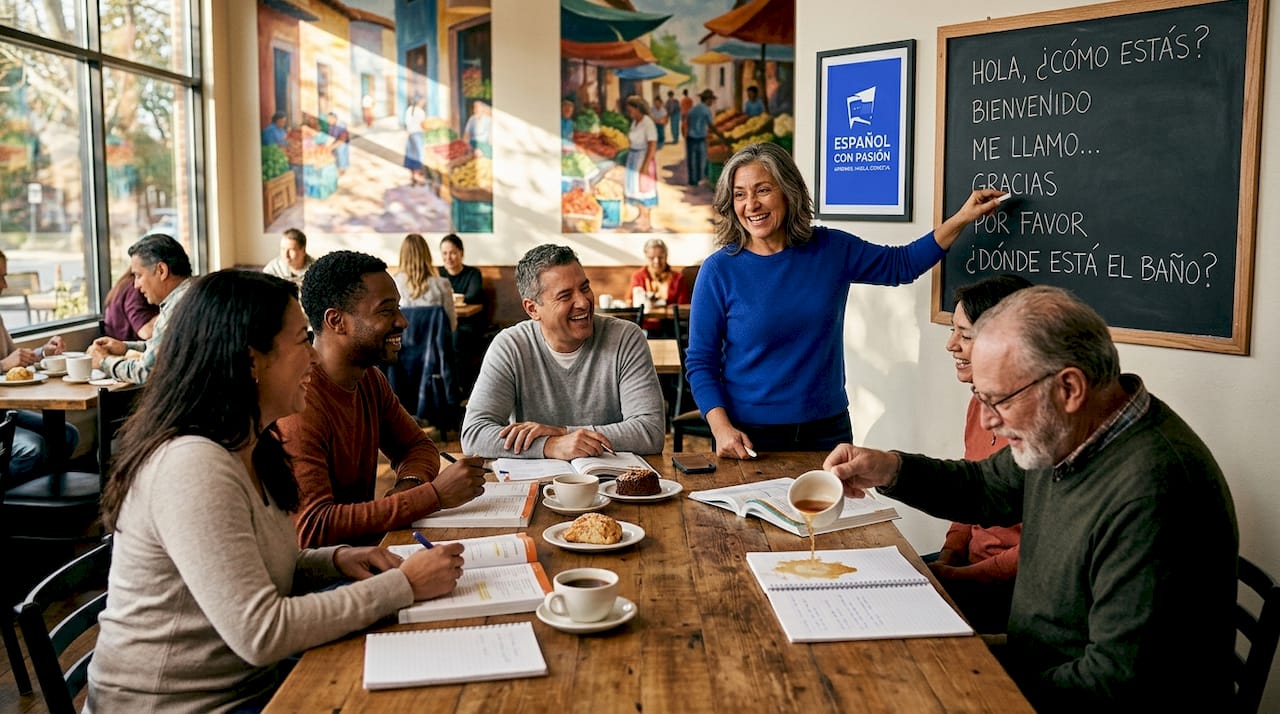
These programs are genuinely powerful accelerants. A professional who arrives at an intermediate level and completes a focused two-week intensive can emerge with dramatically improved fluency and confidence. However, research consistently shows this format is insufficient on its own for full proficiency. It functions best as a catalyst, not a complete curriculum.
Pro Tip: Intensive immersion works best for intermediate learners, not beginners. If you or your team members are starting from scratch, a structured foundational curriculum first will make any subsequent intensive program far more effective.
For corporate training applications, a compressed intensive delivered over consecutive days can be adapted to target specific communication functions: client presentations, negotiation language, or technical vocabulary. This makes it one of the most flexible formats for teaching Spanish in business contexts.
Limitations to consider:
- High cost per learner and significant time off work or study
- Retention drops sharply without a follow-up maintenance curriculum
- Not suitable for absolute beginners
- May create temporary fluency spikes that fade without continued practice
4. Skill-based proficiency-aligned curriculum
This format represents the most significant shift in Spanish curriculum design over the past decade. Rather than organizing content around themes (“food,” “travel,” “family”), skill-based curricula organize around what learners can do with the language at each proficiency level.
Curriculum mapping is moving away from thematic units toward functional language use, high-frequency verbs, and real interpersonal exchanges aligned with ACTFL proficiency targets. The difference in outcomes for adult learners is significant. A learner who studies the “food” theme may memorize 40 food words but be unable to order a meal confidently. A learner in a skill-based program practices the exact conversational structures needed to interact in real situations from day one.
Assessment in this format often uses tools like the AAPPL, which measures actual communicative ability across all four language skills rather than grammar test scores alone.
Pro Tip: When reviewing a Spanish program’s syllabus, look for “Can-Do statements” at each level. Statements like “I can introduce myself and my professional role in Spanish” signal a skill-based design. Generic topic lists signal a thematic one.
| Feature | Thematic curriculum | Skill-based curriculum |
|---|---|---|
| Content organization | Topics (food, travel, culture) | Proficiency-based functions |
| Assessment method | Vocabulary and grammar tests | Communicative performance tasks |
| Learner outcome | Passive knowledge of words | Active use of language in real contexts |
| Best suited for | Low-frequency exposure contexts | Adult learners with practical communication goals |
5. Comparison of main Spanish curriculum formats
Here is a consolidated view of how the major formats compare across the criteria that matter most for adult educators and learners.
| Format | Learner profile | Delivery mode | Proficiency focus | Immersion intensity | Ideal use case |
|---|---|---|---|---|---|
| Dual-Language Immersion | Bilingual or heritage learners | In-person | High | Very high (daily) | Long-term biliteracy programs |
| Foreign Language Immersion | English-dominant adult learners | In-person or online | Moderate to high | Moderate (weekly hours) | Conversational and structured adult programs |
| Intensive Adult Immersion | Intermediate adult learners | In-person intensive | High | Very high (full days) | Rapid acceleration, corporate prep |
| Skill-based Proficiency | Adult learners at any level | In-person, online, or corporate | Very high | Moderate to high | Business Spanish, conversational fluency goals |
A few patterns stand out. Skill-based proficiency-aligned curricula are the most versatile across learner profiles and delivery modes. They work for a working professional taking two evening classes a week just as well as for a corporate cohort going through a structured business Spanish track.
DLI produces the deepest bilingualism but requires the greatest time investment and consistent daily exposure. For most adult professionals, it is an aspirational model to draw inspiration from rather than a directly applicable format.
Foreign language immersion sits in the middle ground. It is the format most adult learners experience in structured language school programs, and when delivered well with proficiency alignment, it produces solid functional communication outcomes.
Intensive adult immersion is the power tool. Use it strategically, not as a sole curriculum strategy.
6. How to choose the right format for your situation
Selecting among Spanish course structure options is not a purely theoretical exercise. It depends on specific constraints and goals.
-
If your goal is conversational fluency for personal enrichment: Foreign language immersion with a skill-based curriculum design gives you the best balance of structure and speaking practice within a manageable weekly schedule. Look for programs that use Can-Do frameworks and include regular interpersonal exchange practice.
-
If your goal is business Spanish for professional use: Prioritize a skill-based proficiency curriculum delivered in private or small-group formats. Corporate training programs tailored to your industry produce faster workplace-relevant outcomes than general conversational classes. Spanish Explorer’s structured teaching approach is built precisely around this kind of proficiency-mapped design.
-
If you need rapid progress before a specific deadline: An intensive adult immersion block of one to two weeks, ideally combined with a prior foundational curriculum, is your fastest route to a functional skill jump. Follow it with a maintenance schedule to retain gains.
-
If you are a curriculum developer designing a program from scratch: Structured curriculum design that connects every learning activity to measurable proficiency outcomes is the standard you should aim for. Thematic-only design is a common novice error. Always link activities to outcome targets as part of your planning process.
-
If you are evaluating online versus in-person delivery: Online formats via platforms like Zoom are highly effective for adult learners when the curriculum design is strong. The delivery mode is secondary to content quality. A rigorous skill-based curriculum delivered online outperforms a weak in-person program every time.
Pro Tip: Blending formats works. Many adult learners make the fastest progress by combining weekly structured group or private classes with periodic intensive workshops and self-directed practice between sessions. You do not have to choose just one format.
For educators designing or selecting programs, incorporating well-designed classroom materials that reinforce communicative functions rather than isolated vocabulary lists will sharpen any format’s effectiveness.
My take on what actually drives results
I have spent years working with adult Spanish learners and corporate clients, and the single biggest misconception I keep encountering is that format alone determines success. It does not. A poorly designed skill-based curriculum underperforms a well-designed thematic one. What actually drives results is whether the curriculum connects every lesson to a real communicative outcome that the learner genuinely needs.
The second thing I have learned is that motivation is far more powerful than format. I have seen adult learners thrive in every type of program described in this article. What they shared was not a particular format. They had a specific reason to speak Spanish: a job opportunity, a relationship, a business expansion. Format selection matters, but it matters less than helping learners find that personal anchor for why fluency is worth the work.
The third thing worth saying directly: the shift from thematic to skill-based curricula is real and the research supports it. If you are evaluating a program and its syllabus still looks like a topic list from a 2005 textbook, ask hard questions about how it maps to actual proficiency outcomes. That is the single most important quality check you can apply to any Spanish curriculum format in 2026.
— Paul
Find a Spanish curriculum format that actually fits your goals
Spanish Explorer offers adult Spanish courses built on the proficiency-aligned, skill-based design principles described throughout this article. Whether you want conversational Spanish for personal enrichment, business Spanish for professional advancement, or a corporate training program for your team, the courses are structured around real communicative outcomes at every level. Classes run in-person at 10 Anson Road, Level 22, International Plaza, Singapore 079903, directly above Tanjong Pagar MRT, and online via Zoom for maximum flexibility. Explore the full range of adult Spanish courses or consider private class options for a faster, personalized path to fluency. For corporate inquiries, online Spanish classes are also available for distributed teams.
FAQ
What are the main types of Spanish curriculum formats?
The main types include Dual-Language Immersion, Foreign Language Immersion, Intensive Adult Immersion, and skill-based proficiency-aligned curricula. Each differs in instructional time, learner profile, delivery mode, and proficiency outcomes.
Which format is best for adult business Spanish learners?
Skill-based proficiency curricula delivered through private or corporate training formats produce the fastest results for adult business learners. These programs map directly to workplace communication goals rather than general thematic content.
How does a skill-based curriculum differ from a thematic one?
A thematic curriculum organizes content around topics like food or travel, while a skill-based curriculum organizes around what learners can functionally do in Spanish at each proficiency level. Skill-based design consistently produces stronger communicative outcomes for adult learners.
Are intensive Spanish immersion programs worth it for adults?
Yes, but only for intermediate or advanced learners and only when followed by a maintenance curriculum. Short-term intensive programs accelerate progress effectively but do not build lasting proficiency on their own.
Can online Spanish courses match in-person curriculum quality?
Yes. Delivery mode is secondary to curriculum design quality. A well-structured, proficiency-aligned Spanish curriculum delivered online via live sessions produces comparable outcomes to in-person instruction when interaction and speaking practice are built into the format.
Recommended
Back to all articlesStart Learning Spanish Today
Book a trial class and see how quickly you can progress with a professionally trained native-speaker teacher guiding the way.
Book a Trial Class