 Spanish
Use vosotros for informal plural “you” in most of Spain, and use ustedes everywhere in Latin America, plus for formal plural address in Spain. The grammatical consequence matters as much as the choice itself: vosotros takes its own verb endings, like habláis, while ustedes takes the same third-person plural form as ellos, like hablan.
TL;DR:
- Ustedes is the standard plural “you” in Latin America and in formal situations in Spain, so it covers most regional use cases.
- Vosotros is exclusively used in most of Spain for informal address, with endings that include -áis, -éis, or -ís, and pairs with the “os” object pronoun.
- Verb conjugations differ: vosotros takes second-person plural endings, while ustedes uses third-person plural forms similar to ellos or ellas.
- In regions like the Canary Islands and western Andalusia, ustedes often replaces vosotros even informally, aligning with Latin American patterns.
- Learners should first determine their regional target, then match verb endings and object pronouns accordingly, practicing aloud to avoid common errors.
Table of Contents
- Where each pronoun is used across the Spanish-speaking world
- How the grammar changes between vosotros and ustedes
- Choosing the right level of formality
- Fixing the mistakes learners make most often
- Quick reference: conjugations and sample sentences
- What learners consistently get wrong about this pair
- How guided practice helps you use these pronouns correctly
- Sources
- FAQ
Where each pronoun is used across the Spanish-speaking world
The split between vosotros and ustedes is mostly geographic, not stylistic. According to the RAE’s dictionary of doubts, vosotros is the informal plural “you” used across most of Spain, while ustedes covers plural “you” throughout Latin America in both casual and formal settings, and also serves as the formal plural in Spain itself.
There are two well-known exceptions inside Spain. The Canary Islands and western Andalusia favor ustedes over vosotros even in informal speech, mirroring the Latin American pattern rather than the mainland Spanish one. A learner traveling to Seville will hear vosotros; a learner in the Canary Islands may hear ustedes instead, even among friends.
Vosotros also survives in a handful of places outside Spain, including some Spanish-influenced communities in the Philippines and Equatorial Guinea, though these are not the varieties most courses teach.
For practical purposes, regional defaults look like this:
- Targeting Spain: learn and use vosotros for friends, family, and peers.
- Targeting Latin America: use ustedes for every plural “you,” formal or not.
- Unsure of your audience’s origin: default to ustedes since it works correctly almost everywhere.
How the grammar changes between vosotros and ustedes
The difference is not just vocabulary. It changes verb morphology and object pronouns throughout the sentence. Vosotros pairs with true second-person plural endings, distinct forms built specifically for “you all,” according to a grammar comparison of vosotros and ustedes. Ustedes, by contrast, borrows third-person plural agreement, the same verb forms used for ellos and ellas.
That single fact explains a lot of learner confusion: ustedes looks like “you,” but the verb behaves like “they.”
Object pronouns follow the same split. Vosotros uses the clitic os (“Os veo,” I see you all), while ustedes uses los, las, or les depending on gender and function (“Los veo,” I see you all, masculine or mixed group).
| Verb | Vosotros form | Ustedes form |
|---|---|---|
| Hablar (to speak) | habláis | hablan |
| Tener (to have) | tenéis | tienen |
| Ser (to be) | sois | son |
| Ir (to go) | vais | van |
Key patterns to remember:
- Vosotros endings almost always contain áis, éis, or ís.
- Ustedes endings match the ellos/ellas conjugation exactly.
- Imperatives follow the same split: “¡Hablad!” for vosotros versus “¡Hablen!” for ustedes.
- Past tenses keep the pattern too: “hablasteis” (vosotros) versus “hablaron” (ustedes).
Choosing the right level of formality
Spanish marks formality differently depending on whether you’re in Spain or Latin America, and the plural pronouns carry that weight. The RAE’s own discussion of treatment forms explains that familiar address (tú, vos, vosotros) contrasts with respectful address (usted, ustedes), and that contemporary Spanish is trending toward more informal speech overall.
In Spain, that means vosotros for friends and peers, ustedes reserved for elders, strangers, or professional settings. In Latin America, ustedes handles both jobs, so the formality signal shifts entirely onto tone, word choice, and context rather than pronoun choice.
Mixed-age or mixed-nationality groups are the trickiest case. A group with both Spaniards and Mexicans in a casual setting still tends to default toward ustedes, since it never sounds wrong, while vosotros risks sounding presumptuous to someone from a region where it is not standard.
- Address unfamiliar groups with ustedes until someone signals otherwise.
- Reserve vosotros for confirmed Spain-based, informal contexts.
- Match written formality to the occasion: invitations and formal letters often default to ustedes even in Spain.
Pro Tip: When drafting anything written, like an email or invitation, ustedes is the safer plural choice unless you know every reader is from mainland Spain and the tone is clearly casual.
Fixing the mistakes learners make most often
Most errors come from pairing the wrong verb ending with the pronoun you picked, not from picking the wrong pronoun itself. Saying “vosotros hablan” mixes vosotros with a third-person ending and immediately signals a learner error to a native speaker.
- Pick your region first. Decide whether you’re speaking Spain-Spanish or Latin American Spanish before choosing a pronoun.
- Match the ending to the pronoun. Vosotros always takes áis, éis, or ís patterns; ustedes always mirrors ellos.
- Watch your clitics. Os belongs only with vosotros; los, las, and les belong only with ustedes.
- Practice out loud. Say “¿Vosotros tenéis tiempo?” and “¿Ustedes tienen tiempo?” back to back until the endings feel automatic.
- Check yourself in writing. Before sending a message, scan for any verb that doesn’t match the plural pronoun you used earlier in the sentence.
Two quick drills: translate “Do you all speak Spanish?” for a group of friends in Madrid, then again for a business meeting in Bogotá. If the verb changes but the meaning doesn’t, you’ve got the rule.
Quick reference: conjugations and sample sentences
A short table is often the fastest way to lock these forms in.
| Verb | Vosotros | Example (vosotros) | Ustedes | Example (ustedes) |
|---|---|---|---|---|
| Hablar | habláis | “¿Habláis español?” (Do you all speak Spanish?) | hablan | “¿Hablan español?” (Do you all speak Spanish?) |
| Tener | tenéis | “Tenéis razón.” (You all are right.) | tienen | “Tienen razón.” (You all are right.) |
| Ser | sois | “Sois muy amables.” (You all are very kind.) | son | “Son muy amables.” (You all are very kind.) |
| Ir | vais | “¿Vais al cine?” (Are you all going to the movies?) | van | “¿Van al cine?” (Are you all going to the movies?) |
Clitics follow the same split: “Os llamo mañana” (I’ll call you all tomorrow, vosotros) versus “Los llamo mañana” (I’ll call you all tomorrow, ustedes, masculine or mixed group).
What learners consistently get wrong about this pair
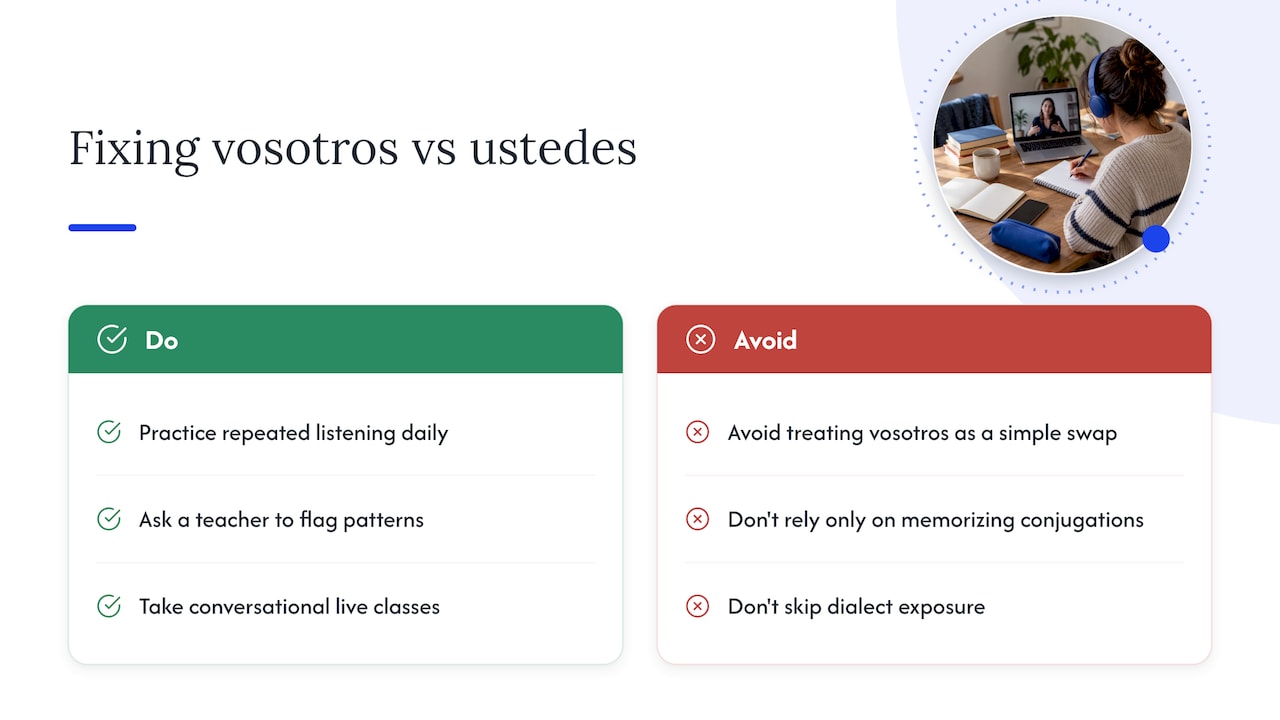
Learners tend to treat vosotros and ustedes as a simple formal or informal swap, but the reality is messier. Even native speakers blur the lines sometimes: a study on second-person plural pronoun use across Spanish dialects found that usage is not perfectly binary even within Spain, and that Latin American speakers sometimes misread vosotros verb forms as singular when they encounter them in media or writing.
That comprehension gap matters more than production gaps. You can memorize the conjugation table in an afternoon. Recognizing vosotros instantly in fast, natural speech takes repeated listening practice, ideally with a teacher who can flag the pattern the moment it trips you up. Conversational Spanish classes often build that kind of listening and speaking repetition into live sessions rather than leaving it to self-study.
— Paul
How guided practice helps you use these pronouns correctly
Reading the rules gets you halfway there. Using vosotros and ustedes correctly under pressure, mid-conversation, takes practice with a real speaking partner who can correct you on the spot. Conversational Spanish and Private Class options give you that repetition, with native-speaking teachers who model both regional patterns depending on the Spanish you’re aiming to speak.

Our Online Group Course works the same way over Zoom, so you can drill pronoun and verb agreement from anywhere without changing your schedule. If you want a low-pressure way to test where your pronoun instincts already stand, book a trial class and get direct feedback on your speaking within a single session.
Sources
FAQ
Why don’t Latin American speakers use vosotros?
Latin American Spanish developed with ustedes as the standard plural “you” for both formal and informal address, so vosotros never became part of everyday speech there, as the RAE confirms. It’s a regional pattern, not a rule against the word itself.
Is using vosotros considered disrespectful?
No, vosotros is not disrespectful. It’s the standard informal plural pronoun in most of Spain, though using it with someone from a region where ustedes dominates, like Latin America or the Canary Islands, can sound unfamiliar rather than rude.
Why do some Spanish teachers avoid teaching vosotros?
Many courses prioritize ustedes first because it works correctly in both Spain and Latin America, while vosotros only applies to specific regions. That doesn’t mean vosotros is unimportant, just that it’s often introduced after the broader-use pronoun.
Do people in Spain ever use ustedes?
Yes, Spaniards use ustedes for formal plural address, such as speaking to elders, strangers, or in professional settings, alongside vosotros for informal situations, per the RAE’s guidance on treatment forms.
Recommended
Start Learning Spanish Today
Book a trial class and see how quickly you can progress with a professionally trained native-speaker teacher guiding the way.
Book a Trial Class