 Spanish
TL;DR:
- Spanish writing skills involve accurately expressing ideas in written Spanish, emphasizing correctness, coherence, cohesion, and appropriateness. Developing these skills requires deliberate practice, extensive reading, targeted feedback, and understanding cognitive processes like planning and executive control. Progression from basic sentence formation to cohesive, organized paragraphs aligns with ACTFL proficiency levels and enhances real-world communication.
Spanish writing skills are the ability to express ideas clearly and correctly in written Spanish, balancing four core dimensions: correctness, coherence, cohesion, and appropriateness to the communicative situation. These skills go far beyond spelling and grammar. They require you to organize your thoughts, choose the right register for your audience, and produce connected text that a reader can follow without effort. Whether you are preparing for a proficiency certification, advancing professionally, or communicating with Spanish-speaking colleagues, mastering written Spanish is one of the most transferable competencies you can build.
What are the key components of effective Spanish writing?
Effective Spanish writing is defined by four interconnected dimensions, and weakness in any one of them limits your overall proficiency. Understanding each component gives you a clear map of where to focus your practice.
Correctness (corrección) covers grammatical accuracy: verb conjugations, noun-adjective agreement, punctuation, and spelling. Spanish orthography is largely phonetic, but accents carry meaning. Writing el versus él, or si versus sí, changes the sentence entirely. Correctness is the foundation every other dimension rests on.
Coherence (coherencia) refers to the logical organization of your ideas. A coherent text moves from one idea to the next in a way that makes sense to the reader. This is where many intermediate learners struggle. They know the grammar but produce paragraphs that feel scattered because they have not planned the structure before writing.

Cohesion (cohesión) is the technical glue that holds sentences together. Connectors like sin embargo (however), por lo tanto (therefore), and además (furthermore) signal relationships between ideas. Without them, even grammatically correct sentences read like a list rather than an argument.
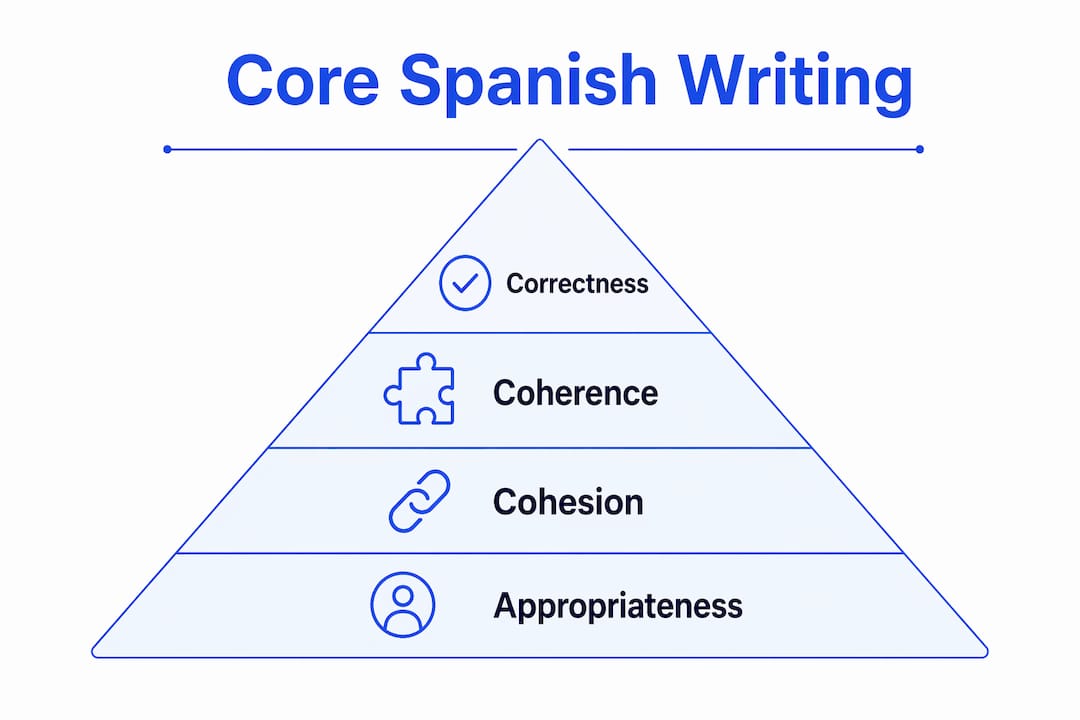
Appropriateness (adecuación) means matching your language to the context and audience. A formal business email to a client in Madrid uses different vocabulary and tone than a casual message to a friend in Buenos Aires. Understanding regional language differences also shapes appropriateness, since vocabulary and conventions vary across Spanish-speaking regions.
The four dimensions work together. Here is a quick reference for what each one demands from you as a writer:
- Correctness: Accurate verb forms, agreement, punctuation, and accent marks
- Coherence: Logical sequencing of ideas with a clear beginning, middle, and end
- Cohesion: Use of discourse connectors and pronoun reference to link sentences
- Appropriateness: Register, tone, and vocabulary matched to the audience and purpose
How do official frameworks like ACTFL evaluate Spanish writing?
The American Council on the Teaching of Foreign Languages (ACTFL) provides one of the most widely referenced frameworks for assessing Spanish writing proficiency. ACTFL’s presentational writing rubrics evaluate learners on five criteria: task fulfillment, lexical resources, grammatical accuracy, coherence, and cohesion. This framework is directly relevant if you are preparing for proficiency assessments or want a benchmark for your current level.
The key insight from ACTFL is that isolated correct sentences are not enough. Higher writing scores correlate with producing organized, cohesive paragraphs that are understandable even to readers who are not familiar with learner language. This shifts the goal from “avoiding mistakes” to “communicating effectively.” The table below summarizes how ACTFL performance levels map to writing expectations:
| ACTFL level | Writing expectation |
|---|---|
| Novice | Isolated words, memorized phrases, minimal sentence formation |
| Intermediate | Simple sentences on familiar topics; some errors in complex structures |
| Advanced | Connected paragraphs with clear organization; handles unexpected topics |
| Superior | Extended discourse; nuanced argument; near-native control of register |
For adult learners in academic or professional contexts, the Intermediate to Advanced transition is the most critical. At this stage, you move from producing correct sentences to producing coherent paragraphs. Understanding Spanish proficiency levels in detail helps you set realistic targets and choose the right practice strategies for your current stage.
What practical approaches improve Spanish writing effectively?
Improving Spanish composition skills requires a combination of deliberate production, exposure to authentic models, and targeted feedback. Effective writing improvement results from coupling reading for models with deliberate text production plus feedback to correct errors. Here is a structured approach that works for adult learners:
- Write daily with a specific goal. Set a 15-minute timer and write on a defined topic: a professional email, a short opinion paragraph, or a summary of an article you read. Focused, short sessions beat occasional long ones.
- Read Spanish texts actively. A 2025 meta-analysis confirms that extensive reading produces gains across all language domains, including writing. Reading exposes you to natural sentence structures, vocabulary in context, and the connectors that make text flow.
- Target your grammar weak spots. The three areas that trip up most intermediate writers are ser versus estar, por versus para, and the subjunctive mood. Isolate one at a time and write sentences that force you to use it correctly.
- Plan before you write. Spend two minutes outlining your main point and two or three supporting ideas before you write a single sentence. This single habit improves coherence more than any grammar drill.
- Revise with a purpose. Read your draft once for grammar, once for cohesion (check your connectors), and once for appropriateness (is the tone right for the audience?). Three focused passes beat one vague read-through.
- Get feedback from a qualified source. Regular feedback identifies recurring errors that self-review misses. A certified instructor or structured language tutor can spot patterns in your mistakes that you cannot see yourself.
Pro Tip: Combine reading and writing in a single session. Read a short Spanish article, note three connectors or phrases you want to use, then write a paragraph responding to the article’s main argument. This forces active vocabulary acquisition rather than passive recognition.
A structured Spanish practice workflow that integrates reading, writing, and feedback cycles produces faster gains than practicing each skill in isolation.
How do cognitive factors shape Spanish writing development?
Writing in Spanish is not purely a linguistic task. Research confirms that executive functions, the cognitive processes governing planning, working memory, and inhibitory control, directly influence writing skill development. A study of 352 Spanish-speaking kindergarteners found that executive functions had a significantly larger effect on spelling (β=0.699) than on handwriting (β=0.361). This means cognitive control matters more for orthographic accuracy than for the physical act of writing. For adult learners, this finding has a direct implication: spelling in Spanish demands more deliberate cognitive effort than it might appear.
The research also reveals that spelling and composition are partly distinct skills that require different types of practice. Transcription skills like spelling rely on executive control and pattern recognition. Higher-order composition skills like argumentation and paragraph organization rely on planning and working memory. You cannot improve one by only drilling the other.
“Orthographic transparency in Spanish influences how executive control shapes writing skill acquisition. Learners benefit from targeted instruction that separates transcription practice from composition practice.” — Springer, 2026
For adult learners, this research supports a two-track practice approach. Dedicate separate sessions to micro-skills like spelling and accent placement, and separate sessions to macro-skills like paragraph planning and argument structure. Mixing both in every session dilutes focus and slows progress. Understanding how expert instructors separate and sequence these skills in structured courses can save you months of unfocused practice.
Key takeaways
Strong Spanish writing skills require correctness, coherence, cohesion, and appropriateness working together, and improving them demands deliberate practice, extensive reading, and consistent feedback.
| Point | Details |
|---|---|
| Four core dimensions | Correctness, coherence, cohesion, and appropriateness define all effective Spanish writing. |
| ACTFL benchmark | Official frameworks reward connected paragraphs and task fulfillment, not just grammatical accuracy. |
| Reading accelerates writing | Extensive reading builds vocabulary and grammar models that transfer directly into writing quality. |
| Feedback is non-negotiable | Targeted feedback from a qualified source identifies error patterns that self-review cannot catch. |
| Cognitive skills matter | Spelling and composition rely on different cognitive processes and need separate, focused practice. |
Why writing in Spanish is harder than most learners expect
Most adult learners underestimate Spanish writing because they assume fluency in speaking transfers automatically to the page. It does not. Writing requires a level of planned organization that speaking rarely demands. When you speak, your listener fills in gaps, tolerates hesitation, and asks for clarification. A written text has none of those safety nets. The reader sees exactly what you produced, and if the logic is unclear or the register is wrong, there is no recovery.
What I have seen consistently, working with adult learners at Spanish Explorer, is that the biggest leap in writing quality comes not from grammar study but from learning to plan. Writers who spend two minutes outlining before they write produce dramatically clearer paragraphs than those who start typing immediately. The grammar improves through reading and feedback. The structure improves through the habit of planning.
The other underrated factor is reading widely in Spanish. Most learners read only their course materials. That is like learning to cook by only reading one recipe. Exposure to Spanish journalism, business writing, and opinion pieces gives you an internalized sense of how good Spanish prose sounds. You start to notice when your own writing feels off, which is the first step toward fixing it. Combine that with honest feedback from a qualified instructor, and the progress is faster than most learners expect.
— Paul
Take your Spanish writing further with Spanish Explorer

Spanish Explorer offers adult Spanish courses in Singapore and online that give your writing skills the structured attention they need. Group classes, private lessons, and corporate training programs all include focused writing practice with feedback from certified, bilingual instructors. Whether you are building professional communication skills or working toward a recognized proficiency level, the curriculum is designed to develop correctness, coherence, and real-world writing confidence. Explore the full range of Spanish courses to find the format that fits your schedule and goals. Private classes are also available for learners who want personalized writing instruction tailored to their specific professional or academic needs.
FAQ
What is Spanish writing skills in simple terms?
Spanish writing skills are the ability to express ideas clearly and accurately in written Spanish, covering grammar, vocabulary, text organization, and appropriate tone for the audience and context.
How is Spanish writing different from Spanish speaking?
Writing requires planned organization and explicit cohesion because the reader cannot ask for clarification. Speaking allows for real-time correction and listener support, making writing the more cognitively demanding skill.
What grammar areas should I focus on to improve my Spanish writing?
The three areas with the highest impact for intermediate writers are ser versus estar, por versus para, and the subjunctive mood. Targeted practice on these structures produces measurable accuracy gains.
How does reading help improve Spanish writing skills?
A 2025 meta-analysis confirms that extensive reading produces gains across all language domains including writing, by exposing learners to natural grammar patterns, vocabulary in context, and discourse connectors.
How do I know my Spanish writing level?
The ACTFL framework provides a clear benchmark from Novice to Superior, evaluating task fulfillment, grammatical accuracy, and the ability to produce coherent, connected paragraphs rather than isolated correct sentences.
Recommended
- Spanish Language Proficiency Levels Explained for Adults
- How to learn Spanish grammar: techniques for adults
- How to Set Spanish Learning Goals That Stick
Start Learning Spanish Today
Book a trial class and see how quickly you can progress with a professionally trained native-speaker teacher guiding the way.
Book a Trial Class