 Spanish
TL;DR:
- Academic Spanish is a genre-based communicative system used in university contexts to perform academic tasks with formal structures. It differs from everyday Spanish through impersonal constructions, formal connectors, and genre-specific organization, crucial for student success. Effective learning and teaching involve analyzing texts, practicing rewriting, and designing prompts that explicitly require genre and register application.
Most people assume academic Spanish is just formal vocabulary stacked on top of regular Spanish. That assumption costs students real academic performance. What is academic Spanish, really? It’s a specialized communicative system built around the genres, tasks, and conventions of university and scholarly life. It includes how you structure an argument, how you signal objectivity, and how you navigate lectures, research papers, and evaluations. Understanding it changes how you learn and how you teach.
Table of Contents
- Key takeaways
- What is academic Spanish and how is it defined?
- Core features of academic Spanish writing and speech
- Why academic Spanish matters for student success
- How to learn and teach academic Spanish effectively
- Academic Spanish versus colloquial and heritage Spanish
- My perspective on teaching academic Spanish
- Build your academic and professional Spanish with Spanish Explorer
- FAQ
Key takeaways
| Point | Details |
|---|---|
| Academic Spanish has a specific definition | It is Spanish used to complete academic tasks through genre-based communication in university settings. |
| It differs from everyday Spanish | Register, syntax, and rhetorical conventions set it apart from conversational or colloquial Spanish. |
| Writing style follows formal conventions | Impersonal constructions and structured connectors replace first-person expressions in academic texts. |
| It matters for academic success | Proficiency in academic Spanish directly affects how students comprehend lectures and produce research writing. |
| Learning it requires structured practice | Genre-based instruction, rewriting exercises, and well-designed prompts outperform grammar drills alone. |
What is academic Spanish and how is it defined?
The formal term for this field in Spanish is español con fines académicos, which translates roughly to “Spanish for academic purposes.” Linguist Graciela Vázquez, one of the leading voices in this area, defines academic language teaching as instruction that helps non-native speakers perform oral and written communication in university contexts by studying academic genres and communicative codes.
That definition carries a lot of weight. Notice it doesn’t say “teach formal vocabulary.” It says “academic genres and communicative codes.” A genre, in this sense, is a recognizable text type with a social purpose. Think of a thesis introduction, a research abstract, a seminar response, or an oral exam. Each of these has its own structure, tone, and expectations.
“Academic Spanish is not a style. It is a set of functional competencies tied to specific communicative situations within educational institutions.” — Adapted from Graciela Vázquez’s framework on Spanish for academic purposes.
Academic Spanish sits between everyday professional Spanish and formal literary Spanish. It covers reading academic texts, writing structured arguments, listening to lectures with technical vocabulary, and speaking in scholarly discussions. It is not just one of these skills. It is all four, applied in contexts where correctness and genre-appropriateness both matter.
Core features of academic Spanish writing and speech
If you have ever read a Spanish-language research paper and felt lost not because of the vocabulary but because of how the ideas were organized, you have encountered the structural gap. Academic Spanish writing follows a disciplined introduction-body-conclusion architecture that mirrors the logical expectations of scholarly discourse.
But the structure is only the beginning. What really marks academic Spanish apart is its use of formal connectors and impersonal constructions. Where a conversational speaker might say “Yo creo que este enfoque es mejor” (I think this approach is better), an academic text would reframe that as “Se puede afirmar que este enfoque resulta más eficaz” (It can be stated that this approach is more effective). The shift removes the speaker’s personal stake and positions the claim as a reasoned observation.
Common academic connectors and their purpose
- Sin embargo (however) signals a counterargument
- Por consiguiente (consequently) introduces a result
- Cabe destacar que (it is worth highlighting that) draws attention to key evidence
- A partir de los datos obtenidos (based on the data obtained) grounds claims in evidence
- En este sentido (in this sense) maintains thematic coherence
These phrases are not decorative. They do rhetorical work, guiding the reader through your logic. Using them correctly signals academic competence. Getting them wrong, or substituting casual connectors, signals that you are not operating within the genre.
Academic Spanish versus conversational Spanish: a direct comparison
| Feature | Conversational Spanish | Academic Spanish |
|---|---|---|
| Sentence structure | Shorter, fragmented | Complex, subordinate clauses |
| First-person use | Frequent and natural | Replaced by impersonal forms |
| Vocabulary range | Common, everyday words | Specialized, discipline-specific terms |
| Connectors | pero, y, también | no obstante, asimismo, por ende |
| Text organization | Informal, flexible | Strict genre-based structure |
Shifting from impersonal constructions to first-person expressions and back is not intuitive. It requires deliberate practice. That is why linguistic features cannot be taught through grammar exercises alone. They need to be practiced inside real academic text tasks.
Why academic Spanish matters for student success
Students who cannot navigate academic Spanish face compounding disadvantages. They struggle to understand lecture content, misread assessment instructions, and produce writing that misses the genre mark. This is not about intelligence. It is about not having been taught the code.
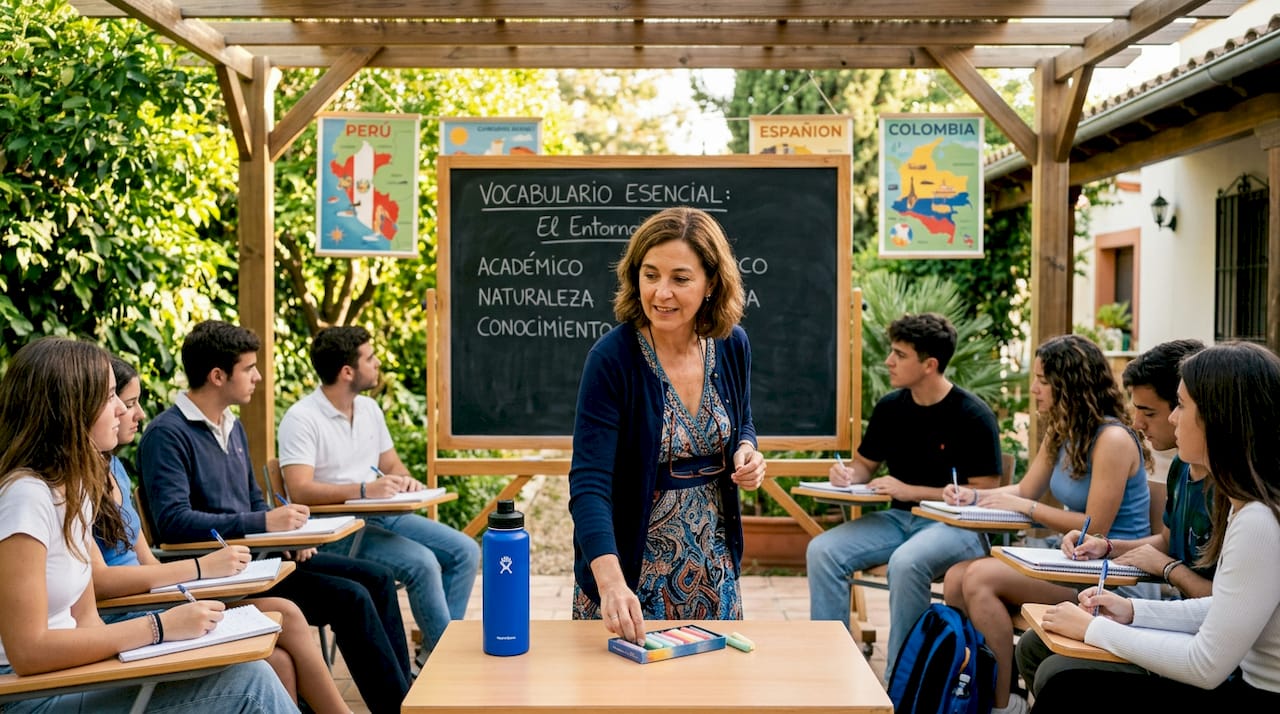
Standardized Spanish educational terminology plays a bigger role than most people realize. When institutions use consistent translations for terms like “formative assessment” or “rubric,” Spanish-speaking students and parents can actually track their own progress. Without standardization, term drift in academic materials creates confusion and erodes trust in official communication.
Research reveals a striking gap in actual practice. Only 2% of assessed writing prompts in one university study met structural criteria for academic literacy, despite most teachers stating they valued academic writing as a priority. The problem is not intention. It is execution. Teachers who value academic literacy but assign poorly structured prompts are inadvertently preventing their students from developing the very skill they say they want.
Pro Tip: If you are an educator, audit three of your current writing assignments. Ask yourself: does this prompt require students to use a recognizable academic genre? If not, the student has no model to work from, and academic register will never develop through that task.
For students preparing to communicate across key Spanish communication skills in both academic and professional settings, mastering this register opens access to conferences, publications, graduate programs, and international academic networks.
How to learn and teach academic Spanish effectively
Learning academic Spanish is not about memorizing more words. It is about learning to operate within genres. Here is how that looks in practice.
-
Start with genre analysis. Before writing an essay, read five examples of academic essays in Spanish. Note how each one opens, how claims are introduced, how evidence is integrated, and how the conclusion avoids repeating the introduction word for word.
-
Practice rewriting exercises. Take a paragraph written in conversational Spanish and rewrite it using impersonal constructions and formal connectors. This builds automatic recall of academic patterns. Explicit rewriting practice is one of the most efficient ways to internalize register shifts.
-
Use structured templates for text types. An introduction template might read: “El presente trabajo tiene como objetivo analizar… A lo largo de este texto, se examinará… Por último, se presentarán las conclusiones.” Templates are scaffolds, not crutches. They train writers to think in genre terms.
-
Engage with discipline-specific vocabulary in context. Reading abstracts and introductions of published Spanish-language research papers exposes learners to vocabulary in its natural habitat, not in isolation. This is more effective than vocabulary lists.
-
Seek feedback on academic output. Having a teacher or peer review writing specifically for register, not just grammar, gives learners the calibration they need.
Pro Tip: Educators should design prompts with explicit genre requirements. Instead of “Write about a social problem,” try “Write a 400-word argumentative essay in which you present a central claim, support it with two pieces of evidence, and address one counterargument using impersonal constructions.” The second prompt teaches academic Spanish through the task itself.
Research on accuracy versus communication orientations in Spanish learning shows that when instruction leans too heavily on grammatical accuracy and test alignment, learners miss the communicative competence they need for real academic tasks. The fix is not to abandon accuracy. It is to embed accuracy practice inside authentic academic tasks.
Working with experienced Spanish teachers who understand both language structure and academic discourse makes a measurable difference, especially for adult learners building Spanish for professional or university purposes.
Academic Spanish versus colloquial and heritage Spanish
Many learners arrive in academic settings already speaking Spanish. Some grew up hearing it at home. Others learned it through travel or conversation classes. This prior knowledge is an asset, but it can also create blind spots.
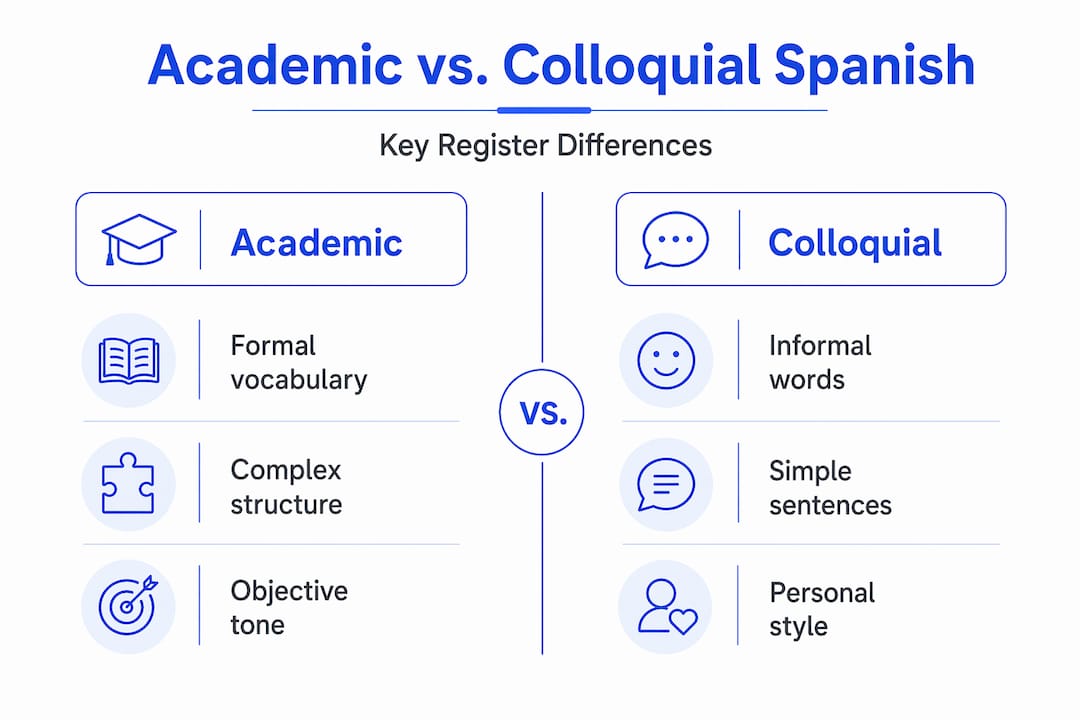
Colloquial Spanish and heritage Spanish both operate in informal or semi-formal registers. They are relationship-driven, context-dependent, and often regionally marked. Academic Spanish, by contrast, demands register-neutrality, standardized vocabulary, and genre-appropriate structure regardless of where the speaker is from.
Key register differences
| Register | Vocabulary type | Structure | Tone |
|---|---|---|---|
| Colloquial Spanish | Informal, regional | Loose, conversational | Personal, expressive |
| Heritage Spanish | Mixed, family-based | Variable | Emotional, familiar |
| Academic Spanish | Formal, standardized | Genre-specific | Objective, precise |
The difference between academic and colloquial Spanish is not just about word choice. It is about the entire communicative stance the writer or speaker takes. Heritage speakers who try to write academically by simply using longer sentences often produce text that sounds overly informal because the underlying structure and connector choices are still conversational.
The transition requires explicit instruction. Students cannot simply absorb academic register from exposure to academic texts. They need guided practice in recognizing and producing it. This is why understanding the types of Spanish curriculum formats matters when building a learning plan. Not every curriculum addresses academic register, and choosing one that does is not obvious.
My perspective on teaching academic Spanish
I’ve worked with enough Spanish learners to say with confidence: the biggest failure in academic Spanish instruction is not the vocabulary gap. It’s the prompt gap.
Teachers assign “write an academic essay” and assume that giving the instruction is the same as teaching the skill. It isn’t. When I’ve looked at actual assignments given to university students, the majority could be answered entirely in conversational Spanish without any penalty. There is no requirement to use impersonal constructions, no expectation of disciplinary connectors, no genre scaffolding. The student learns nothing about academic register from the task itself.
What actually works, in my experience, is explicit substitution practice. Take a sentence a student wrote naturally, like “Creo que la educación pública es fundamental,” and show them how to transform it into “Cabe señalar que la educación pública desempeña un papel central.” That five-minute exercise, done repeatedly, builds more academic register competence than three months of vocabulary drills.
I’ve also noticed that learners who understand the purpose of impersonal constructions, not just the forms, adopt them faster. When you explain that academic Spanish removes the personal “I” to create the appearance of objectivity, the logic clicks. Students stop seeing formal language as arbitrary and start seeing it as a rhetorical choice they are making deliberately.
For educators, the most honest advice I can give is this: before your next writing assignment, read the prompt yourself and ask whether a student who spoke conversational Spanish fluently could complete it without ever learning a single academic structure. If the answer is yes, the assignment is not teaching academic Spanish. It’s testing general fluency and calling it academic literacy.
— Paul
Build your academic and professional Spanish with Spanish Explorer

If this article has made one thing clear, it’s that academic Spanish requires structured, deliberate instruction. Not every Spanish course delivers that. At Spanish Explorer, adult learners in Singapore can access structured Spanish courses designed to build real communicative competence, including the formal register and genre skills that academic and professional contexts demand. Whether you prefer learning in a group setting, through private one-on-one classes, or through online Zoom sessions that fit around your schedule, Spanish Explorer offers a learning path that moves beyond vocabulary drills and into the kind of structured language use that actually transfers to real-world communication.
FAQ
What is the academic Spanish definition?
Academic Spanish, or español con fines académicos, refers to Spanish instruction focused on helping learners complete academic tasks through genre-based communication in university and scholarly settings. It covers reading, writing, listening, and speaking within formal academic contexts.
How is academic Spanish different from regular Spanish?
Academic Spanish uses impersonal constructions, formal connectors, and genre-specific text structures that conversational Spanish does not require. The register, syntax, and rhetorical conventions are distinct from everyday or informal speech.
What should I study in academic Spanish?
Focus on academic text structures, impersonal constructions, formal connectors, discipline-specific vocabulary, and genre-based writing practice. Rewriting exercises that transform colloquial sentences into academic ones are particularly effective for building register competence.
Why is academic Spanish important for university students?
Proficiency in academic Spanish allows students to understand lecture content, interpret assessment instructions accurately, and produce writing that meets scholarly expectations. Without it, students may struggle even when their general Spanish fluency is strong.
How can educators teach academic Spanish more effectively?
Design writing prompts that explicitly require academic genres, impersonal forms, and formal connectors. Review prompt structure before assigning tasks, and use explicit substitution exercises to help students internalize the shift from conversational to academic register.
Recommended
- Spanish Teachers – Spanish Language School
- Understanding Spanish: A practical guide for learners in Singapore
- Latin American Spanish or Spain Spanish: A Learner’s Guide
Start Learning Spanish Today
Book a trial class and see how quickly you can progress with a professionally trained native-speaker teacher guiding the way.
Book a Trial Class