 Spanish
TL;DR:
- Advanced Spanish involves full discourse control, register adaptation, and near-native comprehension at CEFR levels C1 and C2. Certification like DELE objectively measures proficiency and is vital for formal recognition of advanced skills. Progress requires engaging with authentic materials, deliberate practice in register switching, and embracing linguistic challenges beyond vocabulary expansion.
Advanced Spanish is the ability to use the language fluently, accurately, and naturally across complex real-world situations, spanning speaking, listening, reading, and writing. At this level, you move beyond textbook grammar and into the territory where the how of communication matters as much as the what. The Common European Framework of Reference for Languages (CEFR) defines this range as C1 and C2, the two highest proficiency tiers. Official certifications like DELE (Diplomas de Español como Lengua Extranjera), issued by Instituto Cervantes, give these levels a measurable, internationally recognized standard. If you are an adult learner targeting conversational fluency or professional use, understanding what advanced Spanish actually requires will save you years of misdirected effort.
What is advanced Spanish and what skills define it?
Advanced Spanish proficiency is defined by discourse-level control, not vocabulary size. This distinction matters more than most learners realize. A speaker with 10,000 words but poor register awareness will consistently sound unnatural, while a speaker who manages tone, implicit meaning, and contextual nuance will communicate with genuine authority.
The four core skill areas at the advanced level each carry specific demands:
- Speaking: You express complex ideas spontaneously, hold your own in fast-paced native conversations, and adapt your register from formal presentations to casual banter without conscious effort.
- Listening: You follow extended speech, including regional accents, rapid delivery, and implied subtext, without needing repetition or simplification.
- Reading: You interpret literary texts, legal documents, opinion journalism, and technical reports, catching irony, cultural references, and unstated assumptions.
- Writing: You produce structured, well-argued texts across genres, from professional emails to analytical essays, with grammatical precision and stylistic range.
Beyond these four skills, discourse-level control is the defining marker of advanced proficiency. This means managing how ideas connect across sentences and paragraphs, not just whether individual sentences are grammatically correct. Advanced speakers handle sociocultural nuance, including humor, irony, and implied stances, in real time.
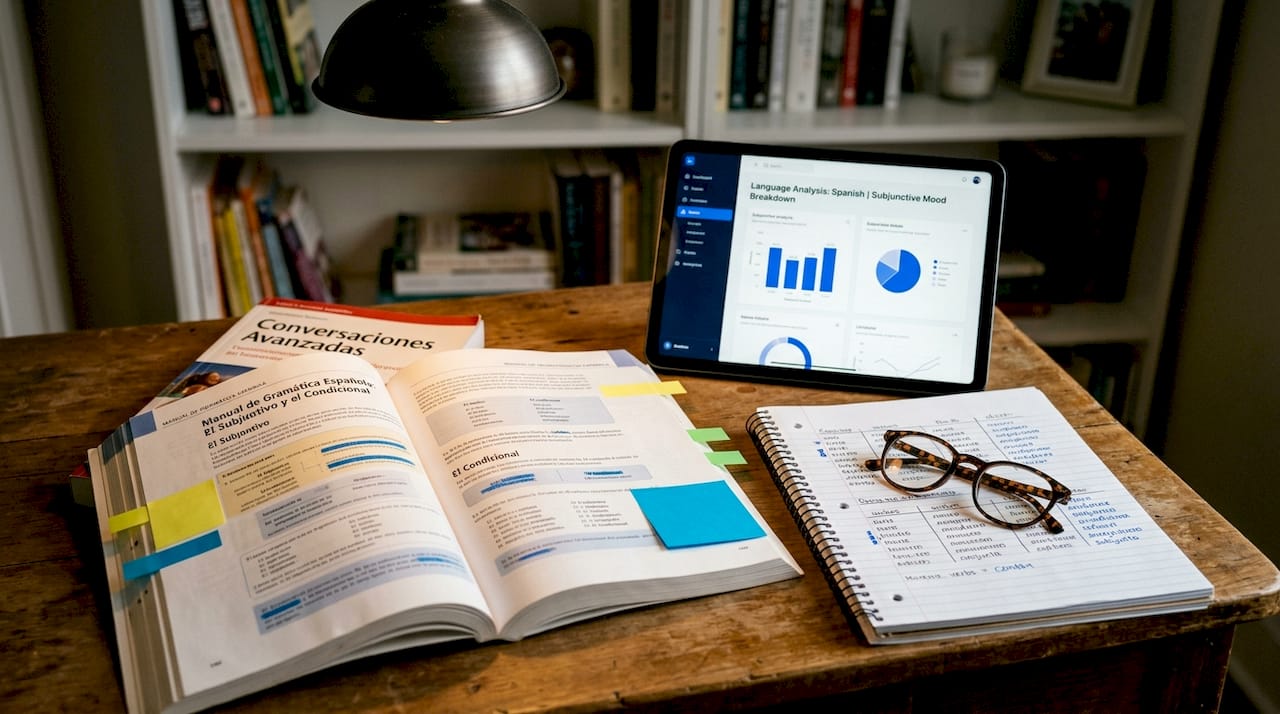
Advanced grammar structures also become second nature at this stage. The subjunctive mood in complex clauses, conditional perfect constructions, and passive voice with nuanced agents are no longer things you calculate. You produce them automatically because you have internalized the patterns through sustained exposure.
Pro Tip: Record yourself speaking on a complex topic for two minutes, then listen back. If you notice frequent pauses to search for words or shifts in register that feel unintentional, those are your clearest signals of where advanced work is still needed.
How do CEFR levels and DELE certification define advanced Spanish?
The CEFR provides the clearest framework for understanding what advanced Spanish means in practice. The framework runs from A1 (complete beginner) through B2 (upper intermediate) and into C1 and C2, the two levels that constitute genuine advanced proficiency. For a full breakdown of how each level maps to real skills, the Spanish proficiency levels guide at Spanish Explorer covers the progression in detail.
The difference between C1 and C2 is meaningful and worth understanding clearly.
| Level | CEFR Label | What you can do |
|---|---|---|
| C1 | Effective Operational Proficiency | Use Spanish flexibly for study, work, and social life; express ideas fluently and spontaneously |
| C2 | Mastery | Understand virtually everything heard or read; express precisely and spontaneously in complex situations |
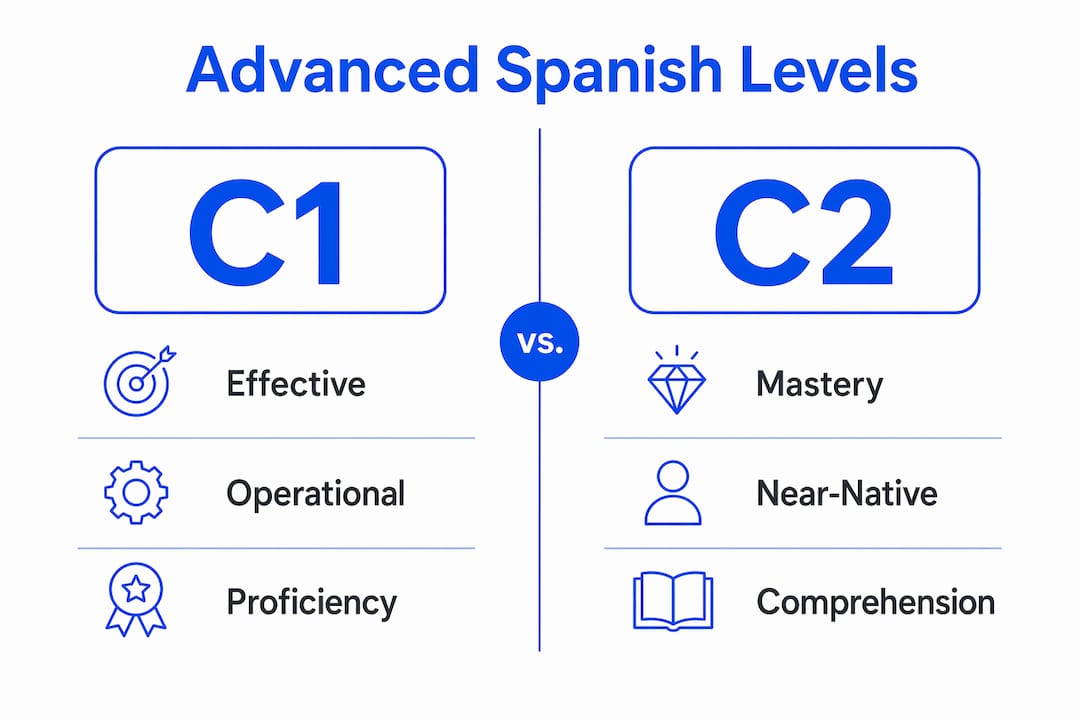
C1 and C2 represent the highest tiers of the CEFR scale, with C2 approaching near-native command of the language. The gap between them is not just vocabulary. C2 requires the ability to reconstruct implicit meaning, handle highly idiomatic speech, and produce nuanced written and spoken output with near-zero errors under pressure.
DELE is the official diploma issued by Instituto Cervantes and is aligned directly to CEFR levels, including C1 and C2. The exam evaluates reading comprehension, listening comprehension, written expression, and oral expression. Candidates must pass all components to receive the certification. This all-or-nothing structure is a key distinction from SIELE, which uses a single composite score without level-specific certification. If you want to compare both options, the DELE vs SIELE comparison at Spanish Explorer breaks down which exam suits different learner goals.
The DELE exam certifies advanced learners and removes the ambiguity around what “advanced” actually means by anchoring it to measurable, skill-based assessments. For professionals seeking roles in Spanish-speaking markets, or academics applying to Spanish-medium institutions, a DELE C1 or C2 certificate carries real weight precisely because it is standardized and internationally recognized.
Pro Tip: If you are preparing for DELE C1 or C2, work with a certified tutor who specializes in exam structure. Research on language exam preparation shows that targeted coaching on exam format and time management significantly improves pass rates compared to self-study alone.
What advanced Spanish techniques actually accelerate fluency?
Most learners plateau at the upper intermediate level because they keep doing what worked earlier: studying grammar rules and expanding vocabulary lists. Advanced fluency requires a different approach entirely. The techniques that move the needle at C1 and C2 all share one characteristic. They force you to process and produce language at full complexity, not simplified versions of it.
Here are the techniques that produce the most measurable gains for advanced learners:
-
Immerse in authentic, high-density input. Long-form content like novels by Gabriel García Márquez or Javier Marías, political speeches, and investigative journalism forces your brain to process complex syntax and register variation at speed. Authentic, higher-density input followed by structured discussion is the recommended method for advanced conversation and literature mastery.
-
Practice register switching deliberately. Take a single topic and discuss it in three registers: formal, professional, and colloquial. This trains the register adaptation that separates advanced speakers from upper-intermediate ones.
-
Engage in structured debate and argumentation. Casual conversation keeps you comfortable. Debate forces you to construct complex arguments, anticipate counterpoints, and express nuanced positions under time pressure. These are exactly the conditions that DELE oral exams replicate.
-
Write structured analytical texts weekly. Choose a complex topic, write 400 words in Spanish, and then revise for precision. Advanced Spanish courses that target real-world communication, such as 24-week programs focused on precision and naturalness, consistently use structured writing as a core component.
-
Study implicit meaning in context. Read opinion columns and identify the writer’s unstated assumptions. Watch Spanish-language films and note how irony and humor are constructed. Managing implicit meaning in real time is the highest-leverage skill at the advanced level.
The common pitfall is treating vocabulary acquisition as the primary goal. A large vocabulary without discourse control produces speakers who sound like walking dictionaries rather than fluent communicators. Expert tips for accelerating language skills consistently point to rich input and structured output as the combination that drives real progress.
Pro Tip: Shadow native speakers by repeating what they say a half-second behind them, matching their rhythm, intonation, and pace. This technique trains prosody and natural delivery faster than any grammar exercise.
How advanced Spanish proficiency applies in real life
Advanced Spanish proficiency opens doors that intermediate skills simply cannot. The practical applications span professional, academic, and personal contexts, and the value compounds the more you use the language in high-stakes situations.
In professional settings, advanced proficiency enables confident engagement in work environments requiring nuanced language use. This includes:
- Leading business negotiations in Spanish without relying on interpreters
- Delivering presentations to Spanish-speaking clients or stakeholders with precision and authority
- Writing structured reports, proposals, and contracts that meet professional standards
- Participating in high-level meetings where subtext, implication, and register all carry meaning
In academic contexts, C1 or C2 proficiency allows you to study at Spanish-medium universities, conduct research using Spanish-language sources, and engage with scholarly literature across disciplines including law, economics, and the humanities.
Socially and culturally, advanced Spanish gives you access to conversations that go beyond surface-level exchange. You can discuss politics, philosophy, and current events with native speakers on equal footing. You catch the humor in a Spanish stand-up routine, understand the cultural weight behind a regional expression, and read between the lines in a way that intermediate learners simply cannot.
For professionals in Singapore working with Latin American or Spanish markets, this level of fluency is increasingly a competitive differentiator. The ability to build genuine rapport in a client’s language, rather than defaulting to English, signals both respect and capability.
Key takeaways
Advanced Spanish is defined by discourse control, register adaptation, and near-native comprehension at CEFR levels C1 and C2, not by vocabulary size alone.
| Point | Details |
|---|---|
| CEFR defines the standard | C1 and C2 are the recognized benchmarks for advanced and mastery-level Spanish proficiency. |
| DELE certifies the level | Instituto Cervantes issues DELE diplomas that assess all four skills and remove ambiguity around “advanced.” |
| Discourse control is the key skill | Managing register, implicit meaning, and complex syntax matters more than vocabulary size. |
| Authentic input drives progress | Engaging with novels, speeches, and journalism produces faster gains than textbook drills at this level. |
| Real-world applications are broad | Advanced Spanish supports business negotiations, academic study, and high-level cross-cultural communication. |
Why most learners misunderstand what advanced Spanish actually demands
I have worked with adult learners at every stage of Spanish acquisition, and the pattern I see most often is this: learners who reach B2 assume they are close to advanced. They are not wrong about their progress, but they consistently underestimate how different the C1 and C2 journey feels compared to everything before it.
At B2, you can hold a conversation. At C1, you can hold a position in a conversation. That shift from communicating information to communicating perspective, with all the register, tone, and implicit meaning that entails, is where most learners stall. They keep doing what worked before: studying more vocabulary, reviewing grammar rules, watching Spanish TV passively. None of that produces the discourse-level control that defines genuine advanced proficiency.
What actually works is discomfort. Reading texts that are slightly too complex. Engaging in conversations where you have to reconstruct meaning from context because you missed a word. Writing arguments and then defending them out loud. The learners I have seen reach C1 fastest are not the ones with the biggest vocabulary. They are the ones who stopped protecting themselves from difficulty.
The other thing worth saying plainly: certification matters. A DELE C1 or C2 is not just a piece of paper. It is a structured external measure that tells you, without ambiguity, where you actually stand. Self-assessment at the advanced level is notoriously unreliable. The exam forces honesty.
— Paul
Take your Spanish to the advanced level with Spanish Explorer
Spanish Explorer offers adult Spanish courses in Singapore designed specifically for learners targeting conversational fluency and professional communication. Whether you prefer group classes, private instruction, or online Spanish classes via Zoom, the curriculum is built around real-world language use at every level.

For learners targeting C1 or C2, Spanish Explorer provides structured preparation through its DELE exam preparation program, guided by certified instructors fluent in both Spanish and English. If you want a personalized learning path, private Spanish classes allow you to focus exactly where your skills need the most development. Explore the full range of adult Spanish courses and find the format that fits your schedule and goals.
FAQ
What is advanced Spanish in CEFR terms?
Advanced Spanish corresponds to CEFR levels C1 and C2. C1 represents effective operational proficiency for work, study, and social life, while C2 represents near-native mastery with the ability to understand virtually everything and express ideas with precision.
How is advanced Spanish different from intermediate?
Intermediate Spanish (B1 to B2) allows you to handle familiar topics and routine communication. Advanced Spanish requires discourse-level control, register adaptation, and the ability to interpret implicit and cultural meanings in complex, unpredictable situations.
What does the DELE exam test at advanced levels?
The DELE exam evaluates reading, listening, written expression, and oral expression at C1 and C2 levels. Candidates must pass all components to receive certification, making it a rigorous and comprehensive measure of advanced proficiency.
How long does it take to reach advanced Spanish?
The timeline varies by starting level and study intensity, but moving from B2 to C1 typically requires 200 to 300 additional hours of focused study and practice. Structured courses with certified instructors accelerate this timeline compared to self-study.
Can I learn advanced Spanish online?
Yes. Online instruction via platforms like Zoom allows advanced learners to access certified teachers, engage in structured conversation practice, and prepare for certification exams without geographic constraints. Spanish Explorer offers online classes specifically designed for adult learners at advanced stages.
Recommended
- Spanish Language Proficiency Levels Explained for Adults
- Spanish fluency explained: Levels, goals, and your path forward
Start Learning Spanish Today
Book a trial class and see how quickly you can progress with a professionally trained native-speaker teacher guiding the way.
Book a Trial Class