 Spanish
TL;DR:
- Bilingual language education employs two languages as instruction media, not just subjects.
- It supports adult professionals in building workplace fluency through content-based practice aligned with CEFR benchmarks.
Bilingual language education uses two languages as the vehicles of instruction, not just as subjects to study. In a bilingual program, content like business communication, negotiation, or presentations gets taught through both languages simultaneously. For adult professionals pursuing Spanish, that distinction matters: you build workplace fluency by using the language in context, not by drilling grammar in isolation. Programs aligned to the Common European Framework of Reference (CEFR) give you a measurable benchmark for every stage of that process.
- Bilingual education integrates content and language learning across two languages.
- It differs from a standard language course, where the second language is the subject, not the medium.
- Research consistently shows net benefits across linguistic, academic, and socio-emotional outcomes.
- CEFR alignment lets you track progress against internationally recognized benchmarks.
- For business Spanish, the goal is additive bilingualism: adding Spanish to your repertoire without losing anything.
Table of Contents
- What is bilingual language education, and what are the main program models?
- What does research say about bilingual education benefits?
- How does bilingual education apply to adult and professional Spanish learners?
- What do high-quality adult bilingual Spanish programs look like?
- How do you choose the right bilingual Spanish program for business?
- How do you get started with a bilingual Spanish learning path?
- Key Takeaways
- A practitioner’s view on what bilingual instruction actually does
- FAQ
What is bilingual language education, and what are the main program models?
Bilingual education formally teaches and develops two languages for academic and professional purposes. It is not the same as an ESL class or a standalone language course. In a bilingual program, both languages carry content; the ratio between them depends on the model.
The core program types
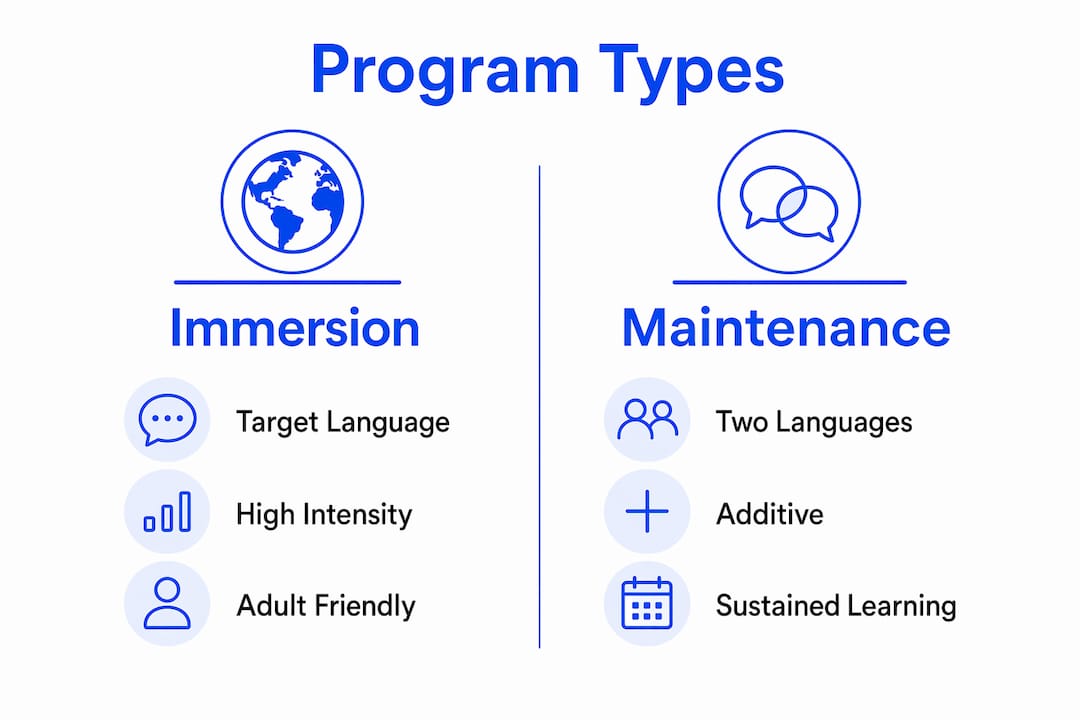
Immersion programs deliver most or all instruction in the target language from the start. Spanish immersion for adults means business topics, case studies, and discussions happen primarily in Spanish, with English used strategically for scaffolding.
Dual-language (two-way) programs split instruction roughly 50/50 between two languages and mix learners from different language backgrounds. Both groups teach each other, which accelerates cultural competence alongside fluency.

Transitional (early-exit) programs use the learner’s first language as a temporary bridge, then shift entirely to the target language. These are common in school settings but less relevant for adult professionals who want sustained bilingual development.
Maintenance and developmental (late-exit) programs keep both languages active throughout. This is the additive bilingualism model: Spanish is added to your existing English without replacing it. UCLA’s Civil Rights Project research shows additive programs produce stronger long-term outcomes than assimilative models that phase out the first language.
For adult learners, immersion-style and maintenance models are the most practical. They mirror how professionals actually use language at work: switching, scaffolding, and applying both languages depending on the audience.
| Model | Language ratio | Best for adults? |
|---|---|---|
| Immersion | Mostly target language | Yes, high-intensity learners |
| Dual-language (two-way) | Balanced use of two languages | Yes, mixed-cohort corporate groups |
| Transitional (early-exit) | Gradual shift from L1 to L2 | Limited, short-term bridge only |
| Maintenance/developmental | Continued use of both L1 and L2 | Yes, professional additive goals |
What does research say about bilingual education benefits?
The evidence is clear and consistent. Systematic reviews find no credible evidence that bilingual instruction harms cognitive or academic development. The net finding across studies is positive: well-designed bilingual programs support linguistic gains, academic performance, and socio-emotional outcomes.
A RAND study of Portland Public Schools’ dual-language immersion program found that students outperformed peers in reading by up to 22% of a standard deviation by Grade 8, with no detriment to math or science. Immersion students also reached intermediate partner-language proficiency by Grade 8, compared to novice levels in non-immersion classes.
Thirty-two years of longitudinal research reviewed by Cambridge shows that sustained bilingual schooling can close achievement gaps after five to six years of consistent instruction. Duration and input quality drive that outcome, not a magic threshold of early childhood exposure.
That last point matters for adults. A 2026 Springer study emphasizes that structured exposure and instructor adaptability are the core success drivers, not age alone. Adults who receive high-quality, consistent bilingual instruction can reach professional-level fluency on a realistic timeline.
Common misconception: bilingual education is remedial or a crutch for weaker learners. Contemporary research frames it as asset-based and additive, leveraging what learners already know to build something more powerful. The advantages of bilingualism extend well beyond the classroom into career mobility and cross-cultural effectiveness.
Pro Tip: When evaluating research claims about bilingual programs, look for longitudinal data (multi-year, not just post-course surveys) and explicit CEFR or standardized assessment alignment. A program that cannot show you how it measures progress is not a bilingual program; it is a conversation class.
How does bilingual education apply to adult and professional Spanish learners?
Adult learners bring something children do not: a clear purpose. That purpose, whether it is leading a client meeting in Madrid, negotiating with a Latin American supplier, or presenting to a bilingual board, shapes everything about how a bilingual program should be designed.
Bilingual instruction integrates business content directly into language learning. Instead of learning vocabulary lists, you practice a supplier negotiation in Spanish, debrief in English, then refine the Spanish version. That loop, content in context, is what cultural immersion in Spanish learning accelerates. Pair it with cultural exchange experiences and the transfer to real-world tasks happens faster.
Realistic CEFR timelines for professionals
- A2 (basic workplace interaction): 3–4 months of consistent bilingual instruction, two to three sessions per week.
- B1 (conversational competency, simple presentations): 6–9 months at the same pace.
- B2 (professional fluency, negotiation, complex presentations): 12–18 months of sustained, content-integrated instruction.
These are estimates. Learners with prior Romance language exposure or higher weekly contact hours move faster. The key variable is not talent; it is consistency and the quality of the instructional design.
- Client meetings and informal networking: target A2–B1 for functional participation.
- Presentations and written proposals: B1–B2 with specific business vocabulary modules.
- Cross-cultural teamwork: pair CEFR milestones with explicit cultural competence training.
- Negotiation: B2 minimum, with role-play and authentic materials from the target market.
CEFR alignment matters to employers because it translates fluency into a credential they recognize. A program that maps its curriculum to CEFR levels gives both the learner and the hiring manager a shared language for progress.
What do high-quality adult bilingual Spanish programs look like?
A well-designed adult bilingual program is not a grammar textbook delivered in two languages. It has specific structural features that separate it from a standard language class.
Core design elements to look for:
- Content-integrated lessons: business topics (negotiations, presentations, emails) taught through Spanish and English, not about Spanish.
- Clear CEFR-aligned outcomes at each module or term.
- Regular formative assessment: short tasks, role-plays, and feedback cycles, not just end-of-term tests.
- Authentic materials: real business documents, news clips, and case studies from Spanish-speaking markets.
- Translanguaging strategies: deliberate use of both languages to build concepts before transferring to Spanish-only delivery.
Instructor qualifications matter more than most learners realize. Multilingual instructors who understand adult learning psychology can scaffold professional content in ways a monolingual teacher cannot. They know when to switch languages to clarify a concept and when to hold the Spanish-only line to build fluency. Spanish Explorer’s instructors are bilingual in Spanish and English, which means they can do both.
Modality comparison:
| Format | Pros | Cons |
|---|---|---|
| Online live (Zoom) | Flexible scheduling, no commute | Requires self-discipline, less spontaneous interaction |
| In-person group | Peer interaction, real-time feedback | Fixed schedule, location-dependent |
| Corporate blended | Tailored content, team cohesion | Requires coordination with L&D |
Pro Tip: Book a trial lesson before committing to a full program. Use it to assess whether the instructor scaffolds in both languages or defaults to English when things get difficult. A trial lesson is also the right moment to request a sample CEFR-aligned lesson plan.
How do you choose the right bilingual Spanish program for business?
Use this checklist when evaluating any program:
- Outcomes: Can the provider state specific CEFR levels you will reach, and by when?
- Curriculum sample: Will they share a sample business-focused lesson plan before you enroll?
- Instructor profile: Are instructors bilingual, and do they have adult professional teaching experience?
- Assessment method: How is progress measured beyond attendance? Look for role-play assessments and written task feedback.
- Class size: Fewer than ten learners per group allows meaningful speaking time per session.
- Modality and scheduling: Does the format fit your work calendar? Online Zoom options matter for busy professionals.
- References or case studies: Has the provider worked with corporate clients in your industry?
Questions to ask providers directly:
- “How do you measure CEFR progress across the program?”
- “Can you share sample business-focused lesson plans?”
- “What is your approach to translanguaging in adult classes?”
- “What reporting do you offer corporate clients?”
Red flags: vague outcome statements (“you’ll feel more confident”), no sample materials, teacher-only monolingual delivery, and no formative assessment beyond a final test.
For corporate language programs, negotiate a pilot cohort of six to eight learners before committing to a full rollout. Set a reporting cadence (monthly progress summaries against CEFR targets) and request content tailored to your industry from day one.
How do you get started with a bilingual Spanish learning path?
- Self-assess your current level. Use a free online CEFR placement tool or request a baseline assessment from your chosen provider.
- Set a concrete CEFR target. “I want to reach B1 for client meetings in nine months” is a goal. “I want to improve my Spanish” is not.
- Book a trial lesson. Most quality providers offer one. Use it to evaluate instructor style and content relevance.
- Choose your modality and frequency. Two to three sessions per week is the minimum for meaningful progress. Online Zoom classes work well for professionals with variable schedules.
- Build a workplace practice routine. Label items in your workspace in Spanish, switch one internal email per week to Spanish, or debrief a meeting in Spanish with a colleague who is also learning.
For corporate pilots: define team goals, select a small cohort, measure baseline CEFR levels, request tailored business content from the provider, and set a monthly reporting frequency.
Pro Tip: Use translanguaging-friendly tasks to accelerate real-world application. Draft a client briefing in English, then rewrite the key points in Spanish with your instructor’s scaffolding. That switch-and-refine loop builds the mental flexibility professionals need faster than any drill.
Key Takeaways
Bilingual language education works for adult professionals because it teaches Spanish through real content, not about it, and CEFR alignment turns that learning into a credential employers recognize.
| Point | Details |
|---|---|
| Definition | Bilingual education uses two languages as instruction media, not just as subjects to study. |
| Research consensus | Systematic reviews find net benefits across linguistic, academic, and socio-emotional outcomes with no evidence of harm. |
| Adult timelines | A2 in 3–4 months, B1 in 6–9 months, B2 in 12–18 months under consistent bilingual instruction, depending on weekly contact hours and prior language background. |
| Program signals | Look for CEFR-aligned outcomes, bilingual instructors, formative assessment, and authentic business materials. |
| First step | Take a baseline CEFR assessment and book a trial adult Spanish class before committing to a full program. |
A practitioner’s view on what bilingual instruction actually does
Most people walk into a Spanish class expecting to be taught Spanish. What bilingual instruction actually does is put you to work in Spanish from the first session, using your English as a scaffold rather than a crutch. The difference in pace is noticeable within weeks.
In adult business classes, translanguaging is the tool that makes this practical. A learner drafts a supplier email in English, identifies the key phrases, switches to Spanish with instructor scaffolding, and then delivers the Spanish version in a role-play. That sequence, English to Spanish to performance, mirrors exactly what happens in a real client call. It is not a shortcut; it is the most direct path to professional application.
The clearest signal of progress is not a test score. It is when a learner stops mentally translating and starts thinking in Spanish during a task. Measuring that through real tasks, presentations, mock negotiations, and written briefs, gives both the learner and the instructor honest data on where the gaps are.
Spanish Explorer offers tailored adult Spanish programs, including online Zoom classes and corporate training, delivered by experienced bilingual instructors. The school is located at 10 Anson Road, Level 22, International Plaza, Singapore 079903, right above Tanjong Pagar MRT. If you are ready to explore adult Spanish courses or want a private class tailored to your business goals, the team can match you to the right format and level.
FAQ
What is bilingual language education in simple terms?
Bilingual language education uses two languages to teach content and build communication skills simultaneously, rather than treating the second language as a subject on its own.
Is bilingual education effective for adult learners?
Yes. A 2026 Springer study confirms that structured exposure and instructor quality drive outcomes more than age, making adult bilingual programs highly effective when well designed.
How long does it take to reach business-level Spanish?
Under consistent bilingual instruction, most adult learners reach conversational B1 in 6–9 months and professional B2 fluency in 12–18 months, depending on weekly contact hours and prior language background.
What should I look for in a bilingual Spanish program?
Prioritize CEFR-aligned outcomes, bilingual instructors with adult teaching experience, formative assessment through real tasks, and authentic business materials rather than textbook-only delivery.
How is bilingual education different from a regular Spanish class?
A regular class teaches Spanish as a subject. A bilingual program uses Spanish as the medium for teaching business content, which builds fluency through application rather than memorization.
Recommended
Start Learning Spanish Today
Book a trial class and see how quickly you can progress with a professionally trained native-speaker teacher guiding the way.
Book a Trial Class