 Spanish
TL;DR:
- Corporate language upskilling involves ongoing, targeted improvement of employees’ communication skills aligned with business goals. It emphasizes proficiency, cultural competence, and interpersonal skills through tailored, practical programs that integrate technology and continuous assessment. Language skills are a strategic asset, enhancing productivity, market access, and career mobility while supporting compliance and diversity efforts.
What corporate language upskilling actually means
Corporate language upskilling is the structured, ongoing process of improving employees’ language abilities to meet real business communication demands. It goes well beyond grammar drills or vocabulary lists. A well-designed program covers language proficiency, cultural competence, and the interpersonal communication skills that global teams depend on every day.
The scope is broad by design. Depending on your workforce and markets, a program might address business writing, client-facing conversation, cross-cultural negotiation, or the specific terminology of your industry. What separates corporate language upskilling from generic language education is its direct alignment with business goals: every lesson, assessment, and milestone connects back to what employees actually need to do their jobs better.
Key components typically include:
- Language proficiency development aligned to internationally recognized frameworks such as the Common European Framework of Reference (CEFR)
- Cultural competence training to help employees communicate effectively across national and organizational boundaries
- Job-relevant content drawn from company materials, workflows, and real business scenarios rather than generic textbooks
- Flexible delivery formats including in-person instruction, live virtual sessions, and blended learning models
- Technology-assisted practice through AI-powered adaptive tools that provide real-time feedback between instructor-led sessions
- Ongoing assessment and reporting to track proficiency gains and demonstrate program value to leadership
Platforms like goFLUENT, Busuu for Business, and Pearson’s corporate language solutions each approach this combination differently, but the best programs share one trait: they treat language as a business capability, not a personal enrichment activity.
Why language skills are a competitive business asset
Language barriers cost companies more than most HR leaders realize. When global teams cannot communicate clearly, decisions slow down, errors multiply, and talented employees get stuck below their potential. Companies investing in language programs report measurable gains in productivity and employee retention, two metrics that directly affect the bottom line.
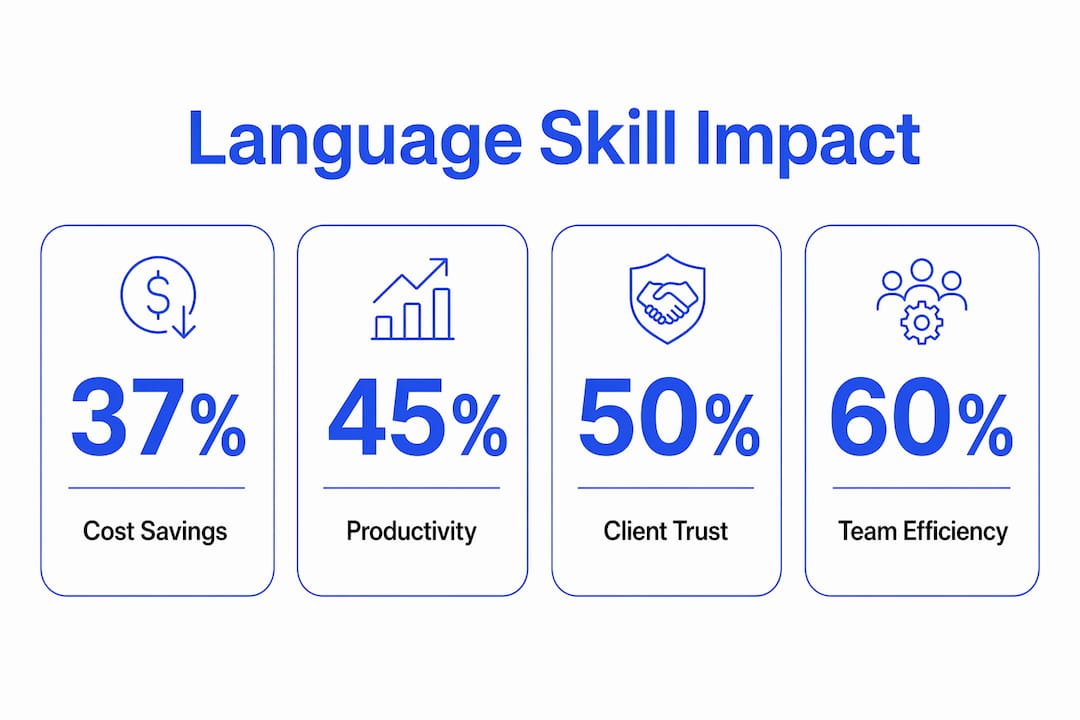
The business case extends beyond internal efficiency. Employees who can communicate in a client’s language build trust faster, close deals more reliably, and represent the company more credibly in new markets. Language proficiency is increasingly a decisive factor in hiring and promotions across industries, particularly for roles with regional or global scope.
Consider the compliance angle, which often gets overlooked. Language ability reduces accidents and costly errors on multilingual job sites and in regulated environments. Employers are regularly cited for health and safety violations because staff cannot understand the relevant regulations in English. A workplace language program addresses that risk directly.
Key drivers pushing organizations to invest in language upskilling right now:
- Global expansion requiring employees to communicate with partners, clients, and regulators in multiple languages
- Workforce diversity in the United States and internationally, creating multilingual teams that need a shared professional language
- Remote and hybrid work increasing reliance on written communication, where language gaps become more visible
- Talent retention as employees increasingly expect employers to invest in their professional development
- Market access in Spanish-speaking, Mandarin-speaking, and other high-growth regions where language competency opens doors that translation tools cannot
How corporate language upskilling benefits employees and organizations
The benefits run in both directions, and the research is clear on this. For employees, language proficiency is a decisive factor in career mobility, with those who receive language support showing more predictable advancement into global and cross-functional roles. That is not just a career perk. It is a retention lever.

Beyond the résumé, language learning builds cognitive skills that transfer across every part of a person’s work. Language switching improves cognitive flexibility, problem-solving, and empathy, skills that are genuinely difficult to develop through any other training format. Employees who go through language programs often become better listeners, more patient collaborators, and more effective in high-stakes conversations.
For organizations, the returns are concrete:
- Reduced recruitment costs by promoting existing bilingual talent rather than hiring externally
- Improved customer relations as multilingual employees connect with a wider range of clients
- Stronger team cohesion across multilingual departments and international offices
- Lower compliance risk through better employee understanding of safety and regulatory requirements
- Expanded market reach into regions where language competency is a prerequisite for doing business
One figure from the U.S. Chamber of Commerce Foundation puts this in perspective: workplace-based English programs can reach the 96% of adult English learners who would benefit from instruction but currently have no access to it. For employers in diverse American cities, that represents an enormous untapped pool of promotable talent.
Pro Tip: Frame language upskilling as a career development benefit during enrollment conversations. Employees who see a direct connection between the program and their own advancement participate more consistently and complete at higher rates.
What makes a corporate language program actually work?
Program design is where most corporate language initiatives succeed or fail. A program built on generic textbooks and one-size-fits-all curricula will lose participants within weeks. The evidence is consistent: replacing generic materials with internal SOPs, emails, and industry-specific scenarios dramatically improves both engagement and practical application.
Start with a proper needs assessment
Before selecting a platform or hiring instructors, map your workforce’s current language levels by role and department. CEFR-aligned placement assessments give you a baseline that makes progress measurable. Without that baseline, you cannot demonstrate ROI, and you cannot place learners in content that is appropriately challenging.

Choose the right delivery model
Three formats dominate corporate language training today, and each fits different organizational contexts:
- In-person instruction works best for teams in the same location who benefit from real-time interaction and group dynamics
- Virtual live sessions via platforms like Zoom suit distributed or remote workforces and allow access to specialized instructors regardless of geography
- Blended learning combines scheduled instructor-led sessions with self-paced digital practice, giving learners flexibility while maintaining accountability
For organizations with employees across multiple time zones or locations, blended learning tends to deliver the most consistent outcomes. The lifecycle approach matters here: initial placement, continuous monitoring, and active engagement management are not optional extras. They are what separate programs that produce results from those that quietly fade after the first quarter.
Assign dedicated program ownership
Language programs without a clear internal owner drift. Someone in your L&D or HR team needs to own participation data, communicate with instructors or platform providers, and escalate when engagement drops. This does not require a full-time role, but it does require a named person with accountability.
Integrate with career pathways
Aligning language skills with promotion pathways increases program value for both the employee and the organization. When reaching a B2 level in Spanish or English is explicitly tied to eligibility for a regional manager role, participation rates climb and completion follows.
Pro Tip: Use company-specific materials in a substantial portion of your lesson content. Pearson’s corporate language research consistently shows that learners who recognize their own workplace context in training exercises retain vocabulary faster and apply it more readily on the job.
How to measure whether your language program is working
Measurement is the part most programs handle poorly. Tracking completion rates is not enough. A learner can complete every module and still show no meaningful improvement in their ability to run a client meeting in a second language.
Effective measurement combines quantitative and qualitative data across four dimensions:
- Proficiency progress: Pre- and post-program CEFR assessments show whether learners are actually advancing through levels, not just logging hours
- Participation and engagement rates: Session attendance, platform login frequency, and assignment completion reveal whether the program is holding attention
- Business impact indicators: Supervisor feedback, performance review data, and internal mobility rates connect language gains to real job outcomes
- Employee feedback: Qualitative surveys capture what the numbers miss, including whether learners feel the content is relevant to their actual work
Ongoing evaluation allows program adjustments and demonstrates ROI to leadership. Build a quarterly review cadence into your program from the start. If participation drops in month three, you need to know why before month six, not at the annual review.
Integrating language program data with your existing talent management system also pays off. When L&D leaders can show that employees who completed a language program were promoted at a higher rate than those who did not, the budget conversation for the next cycle becomes much easier.
AI, human skills, and where corporate language training is heading
The most important shift in corporate language upskilling right now is not technological. It is conceptual. Language programs are moving away from translation-focused training toward developing the human-centered skills that AI genuinely cannot replicate: mindful communication, cultural adaptability, trust-building, and the ability to read a room across cultural boundaries.
AI tools assist with adaptive practice and real-time feedback but cannot replace human empathy and cultural nuance in high-stakes communication. A chatbot can correct your grammar. It cannot teach you how to disagree respectfully with a senior colleague from a high-context culture, or how to read the silence in a negotiation.
Tools like Avant’s Mira Coach+ represent the direction the field is moving: AI handles personalized practice and assessment at scale, while human instructors focus on the interpersonal and cultural dimensions that require genuine expertise. Platforms like goFLUENT and Busuu for Business take a similar approach, combining adaptive digital content with live instructor sessions. The technology is most valuable when it extends the reach of good human teaching, not when it tries to replace it.
Language switching improves cognitive flexibility and problem-solving in ways that matter for leadership, complex negotiations, and cross-functional collaboration. A 2025 study in Construction Management and Economics found that bilingual workers on multilingual job sites function as informal interpreters, connecting teams and reducing safety risks in ways that translation tools simply cannot match.
For HR and L&D leaders, the practical implication is this: language skills are increasingly viewed as a strategic asset, not a bonus. Programs that develop verifiable proficiency alongside human-centered communication skills will deliver more durable value than those focused purely on vocabulary and grammar.
Pro Tip: When evaluating language training platforms, ask vendors how they balance AI-driven practice with live human instruction. The answer tells you whether the program will build real communication skills or just improve test scores. Explore resources like WordByWord for perspectives on how language education develops the soft skills employers value most.
Spanish Explorer offers corporate Spanish courses for adult learners in Singapore, delivered in-person at 10 Anson Road, Level 22, International Plaza (above Tanjong Pagar MRT) and via live online Zoom sessions. Programs are designed for business and conversational use, with certified instructors who teach in both Spanish and English. For teams that need flexibility, online Spanish classes are available for corporate groups and individual professionals.
Key Takeaways
Corporate language upskilling delivers measurable business value when programs combine CEFR-aligned assessment, job-relevant content, and human-centered instruction rather than relying on generic curricula or AI tools alone.
| Point | Details |
|---|---|
| Definition and scope | Corporate language upskilling covers language proficiency, cultural competence, and communication skills aligned to business goals. |
| Career mobility impact | Employees with language training show more predictable advancement into global and cross-functional roles. |
| Job-relevant content | Replacing generic textbooks with company-specific materials improves engagement and practical application. |
| Lifecycle management | Effective programs require CEFR-aligned placement, continuous monitoring, and a named internal program owner. |
| AI has limits | AI tools support adaptive practice but cannot replicate cultural nuance, trust-building, or interpersonal communication. |
FAQ
What is corporate language training?
Corporate language training is a structured program that builds employees’ language proficiency and communication skills to meet specific business needs, covering speaking, writing, cultural competence, and job-relevant vocabulary.
What does “corporate language” mean in a business context?
Corporate language refers to the shared professional language a company uses for internal and external communication, often English in multinational organizations, along with the cultural norms and communication styles that go with it.
What are the top languages prioritized in global business?
English is the dominant language of international business, followed by Spanish, Mandarin Chinese, and Arabic, reflecting the largest global trade relationships and fastest-growing consumer markets.
How do you measure the ROI of a language upskilling program?
Track proficiency progress through pre- and post-program CEFR assessments, monitor participation rates, collect supervisor feedback, and connect language gains to internal mobility and retention data over time.
How is AI changing corporate language training?
AI tools like Avant’s Mira Coach+ provide adaptive practice and real-time feedback at scale, but the most effective programs pair these tools with live human instruction to develop the cultural and interpersonal skills AI cannot teach.
Recommended
Start Learning Spanish Today
Book a trial class and see how quickly you can progress with a professionally trained native-speaker teacher guiding the way.
Book a Trial Class