 Spanish
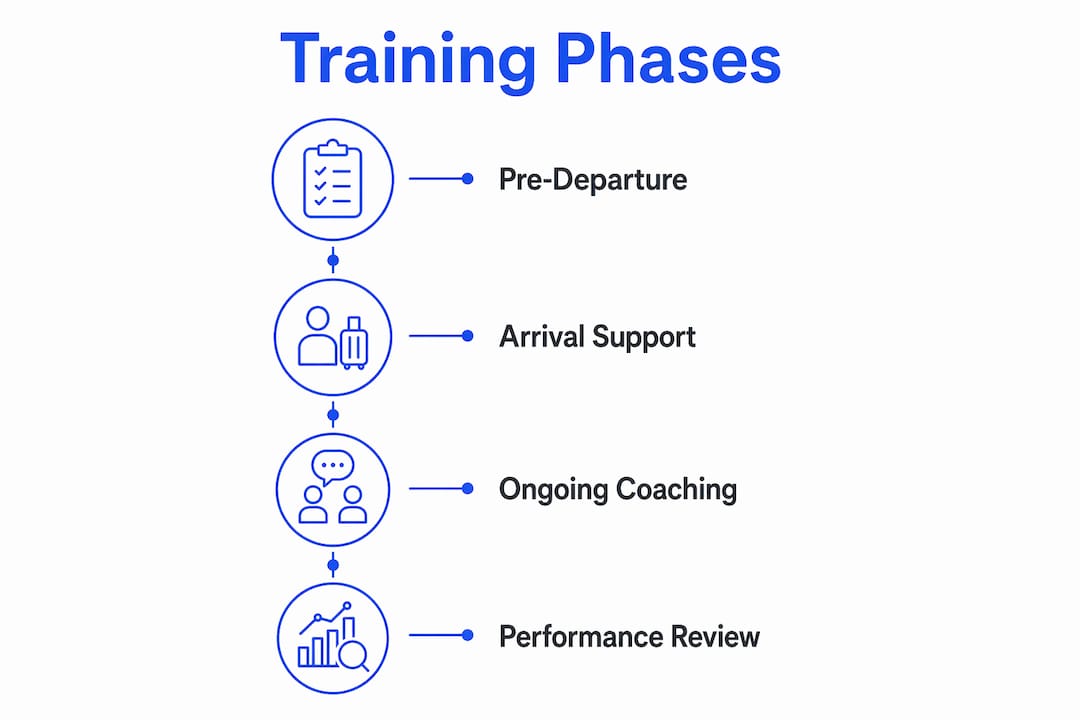
Expatriate language training is structured language and cultural education designed specifically for employees relocating to work in a foreign country. Unlike general language classes, it targets the exact communication demands of a professional role abroad: negotiating contracts, managing local teams, reading workplace dynamics, and navigating daily life outside the office. Programs typically run across three phases: pre-departure preparation, arrival and transition support, and ongoing coaching throughout the assignment. Delivery formats range from private coaching and group sessions to online modules, and the best programs blend all three depending on the learner’s schedule and role.
The core components of effective expatriate language training include:
- Role-specific vocabulary: Business terms, industry jargon, and communication styles relevant to the host country
- Cultural context: Workplace norms, hierarchy expectations, and social customs that affect professional relationships
- Practical fluency: Speaking and listening skills for real meetings, calls, and negotiations, not just textbook exercises
- Phased delivery: Pre-departure basics, arrival immersion, and long-term fluency development
- Progress benchmarks: Fluency targets often aligned to the Common European Framework of Reference for Languages (CEFR), which provides a globally recognized scale from beginner (A1) to mastery (C2)
Why language training determines expatriate success
The business case for investing in language training for expats is direct. 67% of surveyed expats reported that language barriers actively hinder workplace performance. This figure highlights what most HR teams already sense but rarely quantify: when an employee cannot communicate confidently, their output drops, their relationships suffer, and their willingness to stay on assignment shortens.
Language proficiency also reduces the isolation that derails many expatriate assignments. Expats who cannot hold a basic conversation outside work tend to withdraw socially, which compounds stress and accelerates burnout. Training that builds conversational confidence alongside professional vocabulary addresses both problems at once. Companies that treat language training as a retention tool, not just an orientation checkbox, see measurably stronger assignment completion rates.
The benefits of learning languages extend beyond communication. Research from ACTFL shows that multilingual individuals develop stronger memory, better problem-solving ability, and greater capacity to concentrate, all of which translate directly into workplace performance. For an expat managing a cross-cultural team under pressure, those cognitive advantages are not abstract.
How to set up an effective expatriate language training program
A well-built program follows a clear sequence. Skipping steps, especially the needs assessment, is the most common reason training fails to produce measurable results.
- Assess language needs and role requirements. Identify the host country language, the employee’s current proficiency level, and the specific communication demands of the role. A finance director negotiating with local banks needs different training than a project manager coordinating a multilingual team.
- Set CEFR-aligned fluency targets. Define what “good enough” looks like before training starts. A B1 level may suffice for daily workplace interaction; a client-facing leadership role may require B2 or higher.
- Plan the training timeline across assignment phases. Pre-departure training should begin at least three months before relocation. Arrival support should kick in within the first two weeks on the ground. Ongoing coaching should continue for the duration of the assignment.
- Choose delivery formats that fit the employee’s schedule. A busy executive may need flexible online sessions; a team cohort may benefit from group language classes that build shared vocabulary and camaraderie.
- Customize content to the industry and culture. Generic language courses teach survival phrases. Effective expatriate training teaches the language of the employee’s actual work, including sector-specific terms, negotiation styles, and meeting etiquette.
- Embed milestones and recognition into the program. Setting clear objectives with measurable checkpoints keeps motivation high. Recognizing progress, formally or informally, reinforces the behavior.
- Build in repatriation support. The return transition is often overlooked. Employees who have invested in a host-country language benefit from structured support to maintain those skills and apply them in their home-country role.
What delivery formats work best for expat learners
No single format works for every learner or every assignment context. The most effective programs combine methods deliberately.
- Face-to-face instruction remains the gold standard for fluency development. Direct interaction with a qualified instructor accelerates pronunciation, listening comprehension, and conversational confidence in ways that self-study cannot replicate.
- Online platforms and virtual classes give busy professionals the flexibility to train around demanding schedules. Platforms that incorporate interactive exercises and spaced repetition help learners retain vocabulary between sessions. Digital language tools built for professional learners can supplement instructor-led training effectively.
- Blended learning combines virtual and in-person sessions, typically with online modules covering vocabulary and grammar between live coaching calls. This format suits expats who travel frequently or work across time zones.
- Private coaching is the fastest path to fluency for individuals with specific role demands. A one-on-one instructor can focus entirely on the learner’s weak points and simulate real work scenarios, from board presentations to difficult client conversations.
- Group classes work well for teams relocating together or for building shared language skills across a department. The peer dynamic adds accountability and makes practice feel less high-stakes.
Pro Tip: Customize training content to the learner’s actual job, not a generic professional profile. An expat who practices the vocabulary and scenarios they will actually encounter on day one retains far more than someone working through a standard business language curriculum.
The concrete benefits of language training for employees and organizations
The advantages of expatriate language courses show up on both sides of the employment relationship.
- Improved workplace communication: Employees who speak the local language reduce miscommunication, build stronger relationships with local colleagues, and participate more fully in team decisions.
- Higher salary potential: Language skills can add to an employee’s salary, according to research on multilingual professionals.
- Better retention: Expats who feel linguistically and culturally equipped to do their jobs are significantly less likely to abandon an assignment early, which saves companies the substantial cost of a failed relocation.
- Career advancement: Multilingual employees gain access to international roles, cross-border projects, and leadership positions that monolingual peers cannot fill.
- Organizational competitiveness: Companies with language-capable workforces can enter new markets faster, build local partnerships more effectively, and manage global teams with less friction.
Multilingualism also sharpens cognitive skills that benefit the whole organization. Research shows that people who speak more than one language demonstrate improved concentration, stronger memory, and a greater tendency toward creative thinking. Those qualities compound over time in employees who work across cultures regularly.
What the research says about making language training actually work

The evidence on effective expatriate training points consistently toward a few key factors.
| Success Factor | What the Research Shows |
|---|---|
| Phased delivery | Pre-departure, arrival, and ongoing coaching each address distinct learning needs and produce better outcomes than one-time training |
| Role customization | Tailored training shifts learners from survival phrases to professional fluency enabling leadership and negotiation |
| Cultural intelligence | Language learning builds the emotional distance needed for reasoned decision-making in high-pressure foreign environments |
| Embedded goals | Linking language milestones to professional development plans improves both motivation and measurable results |
| Cognitive benefits | Multilingualism enhances memory, creativity, and problem-solving, contributing to overall employee adaptability |
The Middlebury Institute’s custom language services model illustrates what best practice looks like in action: programs blend private lessons, group sessions, and online modules, all customized to the learner’s role and host-country culture. One-size-fits-all approaches consistently underperform because they cannot account for the specific communication demands of different industries and assignment contexts.
Pro Tip: Tie language training progress to the employee’s formal performance review cycle. When fluency goals appear alongside business objectives, employees treat language learning as part of their job, not an optional extra.

How to choose a qualified language training provider
Not every provider delivers what the brochure promises. These criteria separate effective programs from expensive ones.
Instructor qualifications matter most. Look for certified instructors with experience teaching professionals in a business context, not just academic language teachers. The ability to simulate real work scenarios, from client calls to performance reviews, requires a different skill set than classroom instruction.
Industry and role customization is non-negotiable. A provider that offers the same curriculum to a logistics manager and a legal counsel is not doing its job. Ask specifically how content is adapted to the learner’s sector and role before signing any agreement.
Delivery flexibility should match the employee’s reality. Providers that offer only fixed-schedule in-person classes will struggle to serve expats with demanding travel schedules. Look for options that include online sessions, recorded materials, and asynchronous practice tools.
Progress tracking and reporting give employers visibility. A good provider measures fluency at intake, sets CEFR-aligned targets, and reports progress at regular intervals. Without measurement, it is impossible to know whether the investment is working.
Cultural training integration separates good providers from great ones. Language and culture cannot be taught in isolation. Providers that weave cultural context into every lesson produce expats who communicate not just correctly but appropriately.
What expatriate language training actually costs
Budgeting for language training requires understanding what drives cost variation. Per-learner pricing depends on the language, the delivery format, the intensity of the program, and the level of customization required.
Private coaching with a qualified business language instructor typically costs more per hour than group instruction, but it produces faster results for individuals with specific role demands. For companies relocating a team, group programs offer a more cost-effective path to baseline proficiency.
Online programs generally carry lower per-learner costs than in-person instruction, though the best blended programs combine both. Providers that offer structured online learning alongside live coaching sessions tend to deliver better outcomes than purely self-directed platforms.
The real cost benchmark is not the training fee but the cost of a failed assignment. Early returns from expatriate postings cost organizations substantially in recruitment, relocation, and lost productivity. Language training that prevents even one failed assignment typically pays for an entire cohort’s program. Frame the budget conversation around risk reduction, not training spend.
Why cultural training belongs inside every language program
Language and culture are inseparable. An expat who learns vocabulary without cultural context will speak grammatically but communicate poorly. Workplace norms around hierarchy, disagreement, silence, and relationship-building vary enormously across cultures, and misreading them creates friction that no amount of fluency can fix.
Cultural training teaches expats to interpret what they observe, not just what they hear. Understanding why a local colleague avoids direct disagreement in a meeting, or why relationship-building precedes business discussion in certain markets, changes how an expat navigates their entire assignment. The importance of cultural immersion in language learning is well established: learners who engage with cultural context alongside vocabulary develop faster and retain more.
Language learning also builds what researchers describe as emotional and cognitive distance. When working through a challenge in a second language, the cognitive effort involved creates a degree of objectivity that helps expats assess situations more clearly and make better decisions under pressure. That effect is one reason why language and cultural intelligence training together produce stronger assignment outcomes than either alone.
Key Takeaways
Effective expatriate language training combines phased delivery, role-specific customization, and cultural context to produce professionals who communicate with confidence and adapt to foreign work environments.
| Point | Details |
|---|---|
| Language barriers hurt performance | 67% of surveyed expats reported that language barriers actively hinder workplace performance. |
| Phased delivery works best | Pre-departure, arrival, and ongoing coaching each address distinct learning needs and produce better outcomes than one-time training. |
| Customization drives fluency | Tailored training aligned to the employee’s role shifts learning from survival phrases to professional fluency. |
| Salary impact is measurable | Language skills can add to an employee’s salary, making training a direct career investment. |
| Culture and language must go together | Expats who learn language without cultural context communicate correctly but often misread workplace dynamics. |
FAQ
What is expatriate language training?
Expatriate language training is structured language and cultural education designed for employees relocating to work in a foreign country. It covers role-specific vocabulary, cultural norms, and practical communication skills across pre-departure, arrival, and ongoing phases.
What are the three phases of expatriate training?
The three phases are pre-departure orientation, arrival and transition support, and ongoing mentorship throughout the assignment. Each phase addresses different learning needs, from basic preparation to sustained professional fluency.
What qualifies someone as an expat?
An expatriate is typically an employee who relocates from their home country to work in another country, either temporarily or long-term, usually as part of a company assignment or international transfer.
What are the main types of language training delivery?
The four main formats are face-to-face private coaching, group instruction, online self-paced platforms, and blended programs that combine virtual and in-person sessions. Most effective expatriate programs use a combination of at least two formats.
How do you measure whether language training is working?
Progress is best tracked using CEFR-aligned assessments at intake and at regular intervals throughout the program. Linking fluency milestones to professional development goals gives both employees and employers a clear measure of return on the training investment.
Recommended
Start Learning Spanish Today
Book a trial class and see how quickly you can progress with a professionally trained native-speaker teacher guiding the way.
Book a Trial Class