 Spanish
TL;DR:
- A language exchange involves two people taking turns speaking each other’s target language to enhance conversational skills.
- Practicing regularly with structured themes improves fluency and integrates real-world context into language learning.
A language exchange program is a mutual practice arrangement where two people take turns speaking each other’s target language, splitting session time equally so both partners learn. It suits adult learners, working professionals, and corporate trainees who want conversational agility and cultural context alongside their formal Spanish study. Platforms like Tandem and Meetup make it easy to find partners, and the CEFR framework gives both parties a shared vocabulary for setting realistic goals.
Table of Contents
- What formats does a language exchange program take?
- Why language exchange benefits adult learners and professionals
- How language exchange differs from structured courses, and how to use both
- How to run an effective language exchange session
- How to choose a language partner and where to find one
- Safety, professionalism, and etiquette for workplace exchanges
- What progress looks like and how to measure it
- Overcoming communication barriers and language anxiety
- Key Takeaways
- Why structured learning and exchange belong together
- Spanish Explorer makes your exchange time count
- Useful sources and platforms
- FAQ
What formats does a language exchange program take?
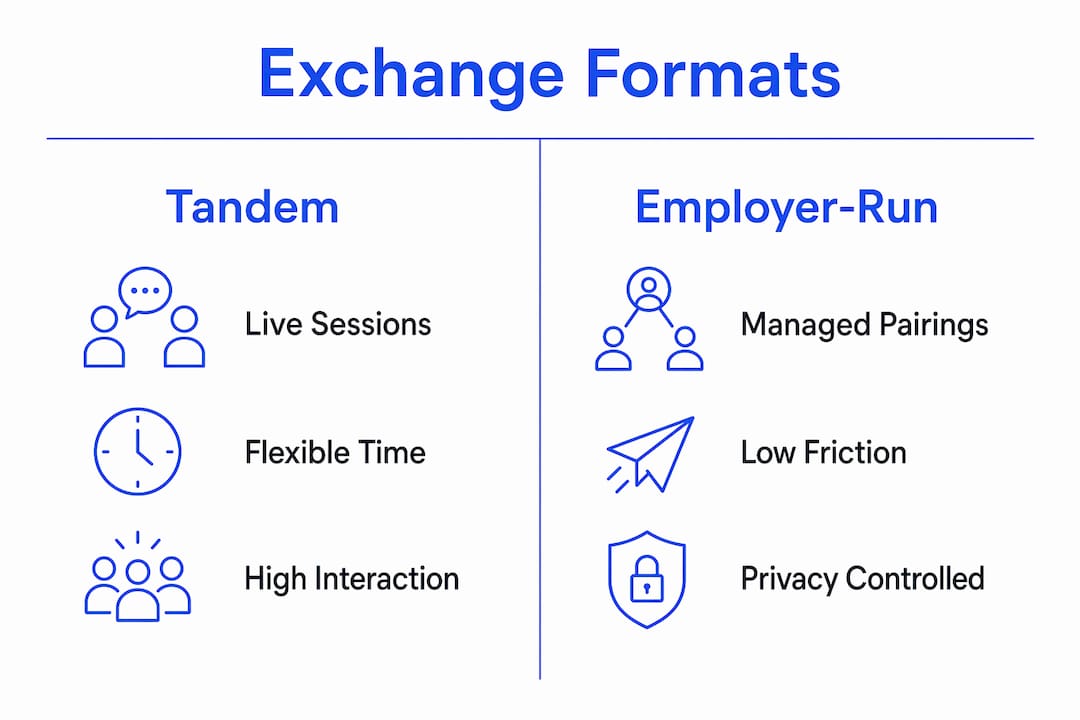
Language exchanges can be organized in several ways, and the format you choose shapes everything from scheduling friction to speaking intensity.
Main formats at a glance:
- Tandem apps (Tandem, HelloTalk): live text, audio, and video chat with matched partners worldwide; high scheduling flexibility, moderate speaking intensity.
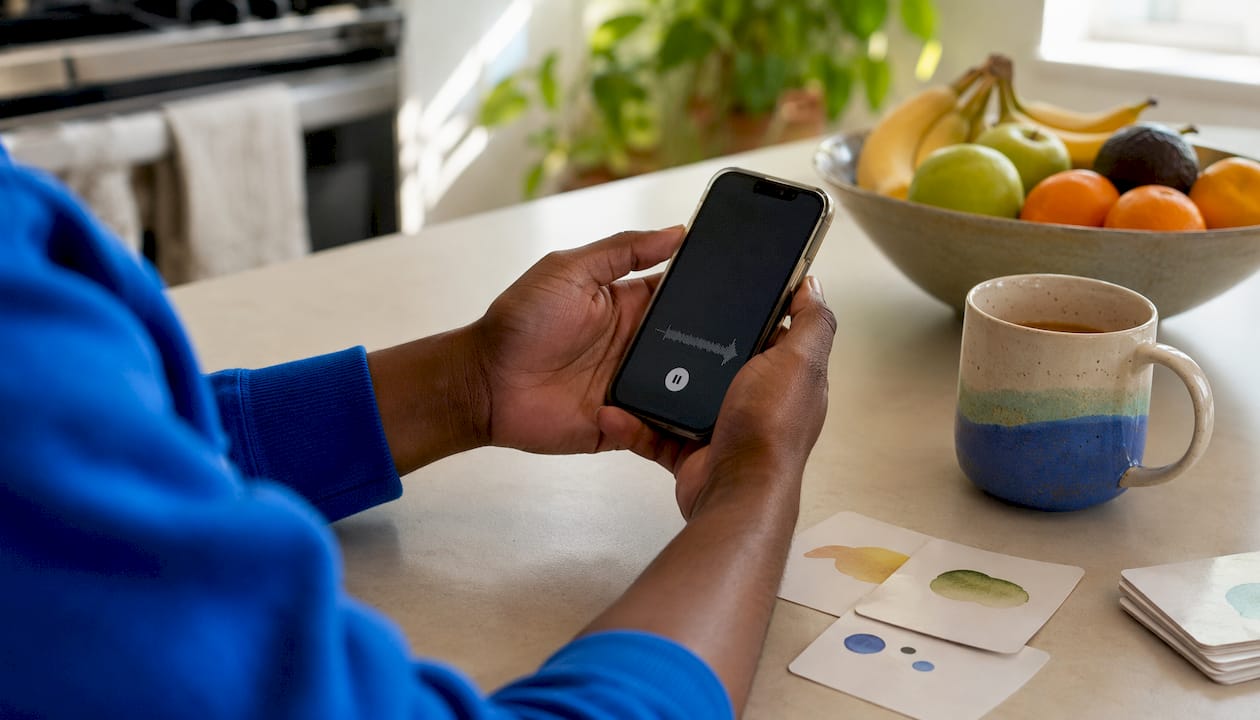
- Asynchronous voice messages: record and send voice notes on your own schedule; low friction, lower spontaneity.
- In-person meetups: organized through Meetup or ConversationExchange; highest speaking intensity, but requires geographic proximity.
- University or structured partner programs: formally paired by an institution; built-in accountability.
- Corporate internal pairings: employer-matched colleagues or clients; controlled confidentiality and scheduling.
| Format | Time commitment | Scheduling friction | Speaking intensity | Best for |
|---|---|---|---|---|
| Tandem / live app | short sessions | Low | High | Flexible professionals |
| Async voice messages | brief daily practice | Very low | Medium | Busy schedules |
| In-person meetups | longer sessions | Medium | Very high | Immersive practice |
| Corporate pairings | Varies | Low (internal) | High | Workplace vocabulary |
| University programs | Fixed schedule | Medium | High | Structured learners |
Employer-run pairings reduce privacy and scheduling friction when managed internally, which makes them a strong option for companies rolling out Spanish training across teams.
Why language exchange benefits adult learners and professionals
The core value is conversational agility: the ability to handle unpredictable, real human speech. Textbooks and apps script the dialogue; a live partner does not.
- Authentic input: natural pacing, regional slang, and filler phrases that scripted lessons never teach.
- Immediate micro-feedback: a patient partner catches errors in real time, which reduces early fossilization of mistakes before they become habits.
- Low cost: most platforms are free or low-cost, making exchanges an accessible supplement to private tutoring.
- Cultural context: you absorb workplace norms, humor, and register shifts that no grammar syllabus covers.
Expert insight: Experts recommend focusing exchanges on weekly themes rather than open-ended small talk. Unfocused sessions plateau quickly. A professional who arrives with a topic — say, negotiating timelines or handling client objections in Spanish — walks away with vocabulary they can use on Monday morning.
For practical ideas on structuring your Spanish speaking practice, a focused theme beats a casual chat every time.
How language exchange differs from structured courses, and how to use both
Exchanges are practice-focused. Structured courses are instruction-focused. That distinction matters because conflating the two is the most common mistake professionals make.
A course supplies grammar progression, systematic error correction, graded materials, and a certified teacher who can diagnose gaps. An exchange supplies reps. Expecting a language partner to teach you the subjunctive is like expecting a gym buddy to replace a personal trainer. They can spot your form, but they cannot design your program.
What exchanges should not be expected to fill:
- Syllabus and graded progression
- Systematic grammar instruction
- Formal assessment and feedback reports
- Structured error correction across multiple sessions
How to pair them effectively:
- Use your CEFR course targets to set exchange themes each week.
- Bring class vocabulary lists or a dialogue from that week’s lesson into your partner session.
- After a grammar lesson on the subjunctive, spend 20 minutes of your exchange using it in real sentences.
Pro Tip: Schedule your exchange session within 24 hours of a class lesson. The material is fresh, your partner gives you live reps, and retention improves significantly compared to practicing days later.
How to run an effective language exchange session
A repeatable 40-minute structure keeps sessions productive without eating into a busy workday.
- Warm-up (5–7 min): Quick check-in in the target language. One or two sentences about your week, no pressure.
- Focused practice — Partner A’s language (20 min): Work a pre-agreed theme (e.g., presenting a project, handling a complaint). One partner speaks; the other listens and notes errors without interrupting.
- Correction and review (8–10 min): Share the error log. Discuss two or three recurring mistakes. Agree on one phrase to practice before the next session.
- Wrap and action items (3–5 min): Set next session’s theme, confirm the date, and each partner commits to one task (e.g., write three sentences using today’s new phrase).
Repeat the structure in the other direction at the next session, or split a longer meeting in half.
Session checklist:
- Agree on the theme before the session, not during it.
- Confirm recording consent if you plan to replay the session.
- Use an error log (a shared doc works well) rather than interrupting mid-sentence.
- Assign one post-session task each.
Pro Tip: Use asynchronous voice messages between live sessions. A 10-minute weekly voice note keeps momentum without requiring calendar coordination, and it forces you to speak without a safety net.
How to choose a language partner and where to find one
Prioritize alignment on correction style, availability, and level over native-speaker status. A patient advanced non-native speaker often outperforms a native speaker who has no interest in giving feedback.
Partner selection checklist:
- Correction style match: Do they prefer delayed correction or in-the-moment notes? Agree before session one.
- Level compatibility: A large gap in either direction creates an unbalanced exchange.
- Scheduling fit: Consistent weekly slots beat irregular marathon sessions.
- Topical fit: For professionals, shared interest in business vocabulary accelerates progress.
- Trial period: Run 2–3 trial sessions before committing long-term.
Where to find partners:
- Tandem: large global community, strong filtering by language level and interests.
- HelloTalk: built-in correction tools and voice-note features.
- Meetup: local in-person groups in most major cities.
- ConversationExchange: straightforward matching by language pair and location.
- Corporate internal pairing: HR or L&D teams can match colleagues across departments or offices.
Safety, professionalism, and etiquette for workplace exchanges
Set expectations before the first session. Ambiguity about confidentiality or correction style creates friction that kills consistency.
- Confidentiality: If you practice workplace scenarios, agree explicitly that business details stay between partners.
- Recording consent: Always confirm before recording any session.
- Correction agreement: Decide in writing (even a one-line message) who corrects, how, and when.
- Punctuality: Treat exchange sessions like client calls. Late arrivals waste both partners’ limited time.
- Agenda sharing: Send a one-line theme note the day before so neither partner arrives unprepared.
- Online safety: Verify identities on platforms before sharing personal contact details. Use official in-app meeting links rather than personal numbers.
Pro Tip: For corporate programs, create a one-paragraph etiquette agreement that covers confidentiality, correction style, and scheduling norms. Distribute it to all pairs at the start of the program. It takes five minutes to write and prevents most common friction points.
What progress looks like and how to measure it
Measurable gains from language exchange concentrate in fluency and listening comprehension. Grammar accuracy improves more slowly without structured instruction alongside it.
- Weeks 1–4: Reduced anxiety, faster word retrieval, more comfort with silence and pauses.
- Months 2–6: Improved vocabulary recall, longer uninterrupted speaking turns, fewer filler words.
- Months 6+: Higher-level pragmatic competence — reading tone, adjusting register, handling interruptions.
Progress metrics to track:
- Speaking minutes per week (aim for at least 60 minutes of active speaking time).
- New phrases used per session (log them in your error doc).
- Error types reduced over time (track recurring mistakes in your shared error log).
- Task completion: can you handle a five-minute client call in Spanish without switching languages?
Pair these metrics with your CEFR course milestones. If your class is targeting B1 conversational fluency, use your exchange sessions to practice the specific can-do descriptors at that level. Your Spanish language practice workflow should connect course goals to exchange themes every week.
Overcoming communication barriers and language anxiety
Language anxiety is the single biggest reason adults plateau or quit. The fix is not more vocabulary; it is lower stakes and higher repetition.
Practical strategies:
- Start with familiar topics. Use your professional domain as the entry point. Talking about your actual job in Spanish is easier than abstract small talk because you already know the content.
- Normalize mistakes explicitly. Open your first session by telling your partner you want to be corrected, not protected. This reframes errors as data, not failure.
- Use preparation to reduce panic. Pre-loading three to five phrases on the session’s theme before you start cuts the cognitive load significantly.
- Address cultural differences directly. Ask your partner how they would phrase a request, decline a meeting, or express disagreement in their culture. These micro-conversations build pragmatic competence faster than grammar drills.
- Shorten sessions when anxiety spikes. A focused 20-minute session beats a painful 60-minute one. Consistency matters more than duration.
For guidance on common communicative functions and how to phrase them in Spanish, the practical guide to communicating in Spanish covers the workplace scenarios most professionals encounter first.
Key Takeaways
A language exchange program works best as a structured practice tool paired with formal instruction, not as a standalone learning method.
| Point | Details |
|---|---|
| Core definition | Two partners take turns practicing each other’s target language, splitting session time equally. |
| Start this week | Book one trial session with a partner from Tandem, HelloTalk, or Meetup. |
| Session frequency | Aim for at least one focused session per week with a pre-agreed theme. |
| Partner trial rule | Run 2–3 trial sessions before committing; prioritize correction style and availability over native-speaker status. |
| Spanish Explorer | Structured group, private, and corporate Spanish courses supply the grammar and materials that make exchange sessions far more productive. |
Why structured learning and exchange belong together
Language exchange is one of the most underrated tools in a professional’s learning kit, but only when it sits on top of solid instruction. The professionals who get the most from exchange sessions are the ones who arrive with a lesson fresh in their mind, a vocabulary list in hand, and a clear correction agreement with their partner. Without that foundation, sessions drift into comfortable small talk and progress stalls.
The piece most guides miss: the exchange does not teach you Spanish. It gives you a place to use what you have already learned under real pressure. That distinction changes how you prepare, how you choose a partner, and how you measure results. Treat it as the application layer, not the instruction layer, and it delivers exactly what it promises.
Spanish Explorer makes your exchange time count
Exchange sessions produce the best results when your course supplies the structure. Spanish Explorer’s group and private Spanish courses are designed for adult learners and professionals who need real conversational and business Spanish, not textbook Spanish. Each lesson gives you grammar, vocabulary, and workplace scenarios you can take directly into your next exchange session.
For companies, Spanish Explorer’s corporate training programs pair structured instruction with practical communication goals, so your team’s exchange time is focused and measurable. Flexible online Zoom classes mean you can fit lessons around your schedule before or after exchange sessions. The training center is at 10 Anson Road, Level 22, International Plaza, Singapore 079903, right above Tanjong Pagar MRT. Book a trial class or request a corporate consultation to get started.
Useful sources and platforms
- Tandem: Best for finding matched partners across 300+ languages with built-in correction tools.
- HelloTalk: Strong for asynchronous voice exchanges and micro-ritual consistency.
- Meetup: Best for in-person language exchange groups in your city.
- ConversationExchange: Straightforward partner matching by language pair and location.
- Wikipedia — Language exchange: Foundational definition and format overview.
- Preply — How to do a language exchange: Step-by-step partner selection and trial-period guidance.
- Talkling — How to find a language exchange partner: Format tradeoffs and partner-matching criteria.
- Spanish Explorer — Spanish courses: Structured adult Spanish courses to pair with exchange practice.
FAQ
What is a language exchange program in one sentence?
A language exchange program is a mutual practice arrangement where two people take turns speaking each other’s target language, typically splitting session time equally between both languages.
What is a language partner and how do you find one?
A language partner is someone who speaks the language you are learning and wants to learn yours in return. You can find partners through apps like Tandem and HelloTalk, local meetups, or ConversationExchange.
How long does it take to see results from language exchange?
Early gains in comfort and word retrieval typically appear within the first few weeks; improved fluency and vocabulary recall usually follow with two to six months of consistent, focused practice.
Can language exchange replace a structured Spanish course?
No. Exchange provides conversational reps but cannot replace systematic grammar instruction, graded progression, or formal error correction. Spanish Explorer’s structured courses supply the instruction layer that makes exchange sessions productive.
How do you do a language exchange session effectively?
Agree on a theme before the session, use a 40-minute structure with defined time blocks for practice and correction, keep an error log, and assign one post-session task to each partner.
Recommended
Start Learning Spanish Today
Book a trial class and see how quickly you can progress with a professionally trained native-speaker teacher guiding the way.
Book a Trial Class