 Spanish
TL;DR:
- Spanish pronunciation is a highly predictable system based on five stable vowels and clear rules for consonants and stress. Mastery of these core patterns allows learners to pronounce most words correctly early in their studies. Focusing on pronunciation from the beginning accelerates overall fluency and enables clearer communication across all Spanish-speaking regions.
Spanish pronunciation is a rule-based phonetic system where each letter corresponds to a predictable sound, making it one of the most learnable pronunciation systems for adult language learners. Unlike English, where spelling and sound often contradict each other, Spanish phonetics follow consistent patterns that reward systematic study. Master the five vowels and the core stress rules, and you can pronounce almost any Spanish word correctly on the first attempt. That is the single most important fact about what is Spanish pronunciation: it is a system, not a guessing game.
What is Spanish pronunciation and why is it so consistent?
Spanish pronunciation is defined as the set of rules governing how letters and letter combinations map to sounds in spoken Spanish. The system is built on five vowel sounds and mostly one-to-one letter-sound patterns, with a small set of well-defined exceptions. This predictability is the feature that separates Spanish phonetics from English phonetics most sharply.

In English, the letter “a” alone can produce at least six distinct sounds depending on the word. In Spanish, “a” always sounds like the “a” in “father.” This consistency means that once you learn the rules, you can read aloud a word you have never seen before and be understood. That is a realistic goal for any adult learner, not just a promise made in a language school brochure.
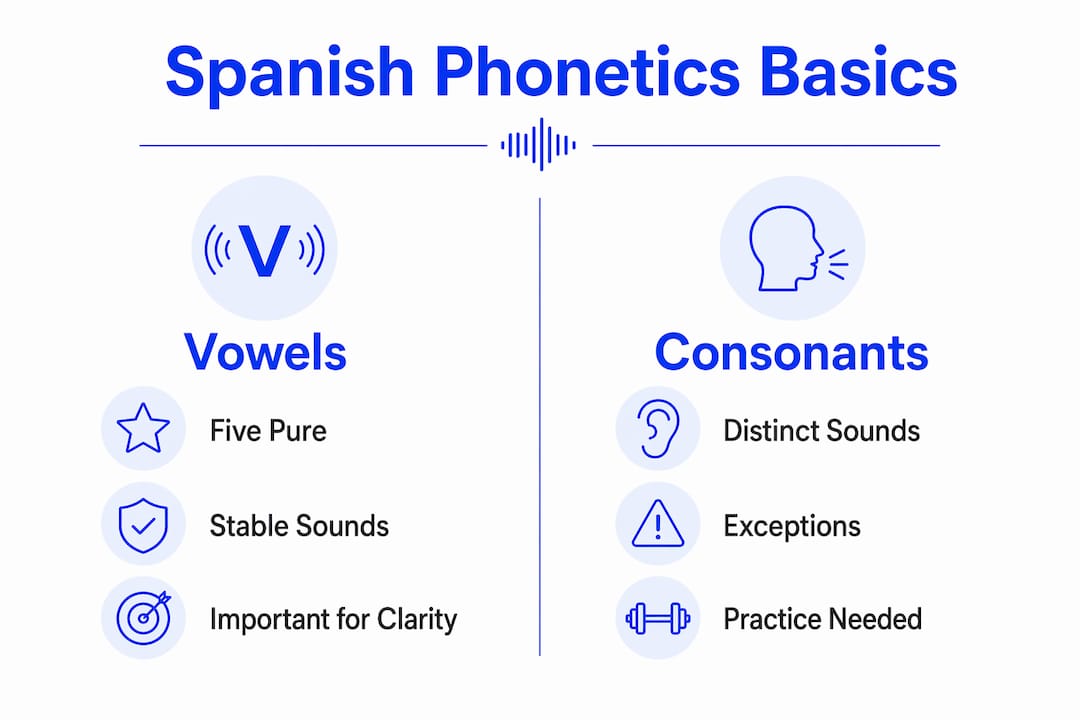
Spanish phonetics explained at the foundational level comes down to two categories: vowels and consonants. Vowels are the anchor of the system. Consonants carry a small number of exceptions that follow their own clear logic. Understanding both categories gives you a complete map of how to pronounce Spanish with accuracy and confidence.
What are the foundational Spanish vowel sounds?
Spanish has five vowel sounds: a, e, i, o, u. Each one is pure and stable, meaning the sound does not shift or glide as you hold it. This is the defining feature of Spanish vowels compared to English vowels.
In English, the vowel in “say” starts as an /e/ sound and glides toward /i/. In Spanish, the /e/ in mesa (table) stays flat and clean throughout. The same principle applies to all five vowels. Here is how each one sounds:
- a sounds like the “a” in father. Example: casa (house)
- e sounds like the “e” in bed, but shorter and crisper. Example: leche (milk)
- i sounds like the “ee” in feet. Example: libro (book)
- o sounds like the “o” in more, held steady. Example: rojo (red)
- u sounds like the “oo” in food. Example: luna (moon)
Because each vowel sound is held steady, Spanish words are easier to decode phonetically than their English equivalents. A learner who drills these five sounds first will find that reading Spanish aloud becomes intuitive within weeks, not months.
Pro Tip: Record yourself saying each vowel in isolation, then inside a simple word. Compare your recording to a native speaker on SpanishDict or Forvo. The gap between your vowel and theirs tells you exactly where to focus your practice.
One practical consequence of pure vowels is that Spanish diphthongs, where two vowels appear together, are pronounced as two distinct sounds in quick succession rather than blended. The word bueno (good) is pronounced “boo-EH-no,” with both vowels fully articulated. English speakers often want to blend them, which is the most common vowel error to correct early.
Which consonant sounds in Spanish differ most from English?
Spanish consonants follow predictable rules with a handful of exceptions that every learner needs to know. The letter h is always silent in Spanish. The word hola (hello) is pronounced “OH-la,” not “HOH-la.” This trips up English speakers consistently because silence from a written letter feels wrong.
Here are the key consonant differences to learn first:
- h is always silent. Hablar (to speak) is pronounced “ah-BLAR.”
- j produces a strong guttural sound made at the back of the throat, similar to the Scottish “loch.” Joven (young) is “HOH-ven” to an English ear, but the Spanish /x/ sound is stronger than an English “h.”
- ll is typically pronounced like the English “y.” Llama is “YAH-ma.”
- ñ is a distinct letter producing the “ny” sound in canyon. Mañana (tomorrow) is “mah-NYAH-na.”
- b and v are pronounced almost identically in Spanish, both producing a soft sound between English “b” and “v.” English speakers often over-distinguish them.
- c before “e” or “i” sounds like “s” in Latin America and like “th” in Spain. Cerveza (beer) is “ser-VEH-sa” in Mexico and “ther-VEH-tha” in Madrid.
Pro Tip: Treat the silent h, the guttural j, and the ñ as three separate mini-drills. Spend five minutes on each one before combining them into full words. Focused repetition on individual sounds builds the muscle memory that general conversation practice cannot.
Consonant exceptions like silent h and the behavior of c, g, and j with the vowels e and i require deliberate practice with vowel context. Saying gato (cat) and gitano (gypsy) back to back trains your ear and mouth to switch automatically between the hard and soft sounds of “g.”
How do stress and intonation rules affect Spanish pronunciation?
Stress in Spanish follows three clear rules that cover the vast majority of words. Stress placement is systematic, with accent marks used only to signal exceptions.
The three rules work as follows:
- Words ending in a vowel, “n,” or “s” are stressed on the second-to-last syllable. Casa is “CA-sa.” Hablan is “HA-blan.”
- Words ending in any other consonant are stressed on the last syllable. Hablar is “ha-BLAR.” Ciudad is “ciu-DAD.”
- Any word with a written accent mark is stressed on the accented syllable, regardless of the first two rules. Café is “ca-FÉ.” Música is “MÚ-si-ca.”
| Stress rule | Example word | Stressed syllable |
|---|---|---|
| Ends in vowel, n, or s | hablan | First syllable: HA-blan |
| Ends in other consonant | hablar | Last syllable: ha-BLAR |
| Written accent mark present | música | Marked syllable: MÚ-sica |
Intonation in Spanish declarative sentences falls at the end, while questions rise and then fall. This is the opposite of the rising intonation English speakers use for yes/no questions, which is why Spanish questions can sound flat to English ears at first.
Spanish is syllable-timed, meaning each syllable receives roughly equal duration. English is stress-timed, where stressed syllables are longer and unstressed syllables are compressed. Applying English rhythm to Spanish speech is one of the most common pronunciation mistakes adult learners make, and it is the one that most affects how natural you sound to a native speaker.
Pro Tip: Clap once per syllable as you say a Spanish sentence. If your claps are uneven, you are applying English rhythm. Even claps mean you are producing syllable-timed Spanish correctly.
What regional variations exist in Spanish pronunciation?
Spanish is spoken by over 500 million people across more than 20 countries, and pronunciation varies significantly by region. Andalusian Spanish is a well-documented example, featuring features like seseo, where /s/ and /θ/ merge into a single /s/ sound, and ceceo, where both sounds merge into /θ/ instead. The final /n/ in Andalusian speech is often realized as a velarized [ŋ], similar to the “ng” in “sing.”
| Feature | Latin American Spanish | Spain Spanish |
|---|---|---|
| c/z before e, i | Pronounced as /s/ (seseo) | Pronounced as /θ/ (like “th”) |
| ll pronunciation | Often merged with /y/ | Varies by region |
| Final consonants | Generally pronounced | Often weakened or dropped in Andalusia |
For learners, the practical question is which accent to target. The answer is that focusing on being widely understood across regions matters more than perfecting any single local accent. A neutral Latin American accent, often associated with Colombian or Mexican Spanish, is widely intelligible and well-represented in media, making it a practical starting point. For learners in Singapore interested in understanding the full picture, the Latin American vs. Spain Spanish guide from Spanish Explorer covers the key differences in detail.
Regional variation is not a problem to solve. It is a feature of the language that becomes easier to navigate as your ear develops through consistent exposure to different speakers.
What practical tips help learners master Spanish pronunciation?
Mastering Spanish pronunciation requires a structured approach rather than passive exposure. The following strategies produce measurable results for adult learners:
- Start with vowel drills. Spend the first week of study on the five pure vowels alone. Use SpanishDict or Forvo to hear native pronunciations and record yourself for comparison.
- Learn the stress rules before vocabulary. Knowing where to stress a word before you memorize it means you never have to unlearn a bad habit later.
- Mimic native speakers from multiple regions. Listening to podcasts like Coffee Break Spanish or watching Spanish-language news from both Mexico and Spain trains your ear for variation.
- Practice consonant exceptions in vowel context. Say gato and gitano in the same breath. Say casa and ciudad together. Context drills build automatic switching between sounds.
- Apply syllable timing consciously. Clap or tap as you speak to enforce equal syllable duration until it becomes natural.
Giving each syllable full value is the single most effective habit for sounding natural in Spanish. Most adult learners underestimate how much their English rhythm undermines their Spanish speech even when their vocabulary and grammar are strong.
Pro Tip: Use the Mimic Method, developed by Idahosa Ness, to train your ear before your mouth. The method focuses on sound recognition as a prerequisite to sound production, which is especially effective for adult learners who have spent decades hearing only English phonetics.
The Spanish pronunciation guide for beginners from Spanish Explorer is a practical resource that covers sounds and stress in a structured sequence, which complements the systematic approach described here.
Key takeaways
Mastering Spanish pronunciation requires learning five pure vowels, three stress rules, and a small set of consonant exceptions, all of which follow consistent, teachable patterns.
| Point | Details |
|---|---|
| Five pure vowels are the foundation | Each vowel holds a single steady sound, making Spanish phonetically predictable from day one. |
| Consonant exceptions follow clear rules | Silent h, guttural j, and the ñ are the highest-priority exceptions to drill early. |
| Stress rules cover most words | Three rules and written accent marks account for stress placement in virtually every Spanish word. |
| Syllable timing changes everything | Spanish gives equal duration to each syllable; applying English rhythm is the most common fluency barrier. |
| Regional variation is manageable | Aim for wide intelligibility rather than a perfect regional accent, and your pronunciation will serve you across all Spanish-speaking contexts. |
Why pronunciation rules are the best investment you can make early
I have seen adult learners spend months building vocabulary and grammar while ignoring pronunciation, and then struggle to be understood in real conversations. The frustration is real, and it is avoidable. The rules governing Spanish pronunciation are genuinely simple compared to English. You can learn the five vowels in a single session. The stress rules take a week to internalize. The consonant exceptions take another week. That is two to three weeks of focused work that pays off for the entire life of your Spanish learning.
What I find most interesting is that learners who master pronunciation early actually acquire vocabulary faster. When you know how a word sounds, you recognize it in speech, which reinforces the written form and the meaning simultaneously. Pronunciation is not a separate skill. It is the foundation that everything else is built on.
My honest advice: do not wait until your grammar is “good enough” to focus on pronunciation. Start on day one. The beginner grammar rules and pronunciation rules reinforce each other when learned together. And do not worry about regional accents until you are at an intermediate level. Focus on being understood clearly, and the accent will develop naturally through exposure.
— Paul
Take your Spanish pronunciation further with Spanish Explorer
Spanish Explorer offers adult-focused Spanish courses in Singapore designed to build real speaking confidence from the ground up. Whether you prefer group classes, private coaching, or online sessions via Zoom, the curriculum is structured to develop accurate pronunciation alongside conversational and business communication skills.

Private classes at Spanish Explorer are particularly effective for pronunciation work, since a certified instructor can give you immediate, personalized feedback on your vowel sounds, stress placement, and rhythm. Courses are available at the school’s location at 10 Anson Road, Level 22, International Plaza, right above Tanjong Pagar MRT, as well as online for flexible scheduling. Explore the full range of adult Spanish courses or book a private Spanish class to get personalized pronunciation coaching from day one.
FAQ
What is Spanish pronunciation in simple terms?
Spanish pronunciation is the system of rules that maps letters to sounds in spoken Spanish. It is highly consistent, with five stable vowel sounds and predictable consonant behavior, making it easier to learn than English pronunciation.
Why are Spanish vowels easier than English vowels?
Spanish vowels are pure and stable, meaning each vowel produces one fixed sound without gliding. English vowels shift and blend, which is why Spanish vowel pronunciation feels more predictable to learners.
What are the most common Spanish pronunciation mistakes?
The most common mistakes include anglicizing vowel sounds, applying English stress-timed rhythm instead of syllable-timed rhythm, and mispronouncing the silent h and guttural j.
Does regional variation in Spanish make pronunciation harder to learn?
Regional differences like seseo in Latin America and ceceo in parts of Spain affect specific consonant sounds, but the core vowel and stress rules remain consistent. Learners who focus on intelligibility rather than a specific accent adapt to regional variation naturally over time.
How long does it take to develop good Spanish pronunciation?
The foundational rules, covering vowels, stress, and key consonant exceptions, can be internalized in two to four weeks of daily focused practice. Sounding natural and fluent takes longer, but the core system is learnable quickly because of its consistency.
Recommended
- Latin American Spanish or Spain Spanish: A Learner’s Guide
- Master Spanish basics: a step-by-step guide for Singapore learners
- Spanish Pronunciation Guide for Beginners (Sounds & Stress)
Start Learning Spanish Today
Book a trial class and see how quickly you can progress with a professionally trained native-speaker teacher guiding the way.
Book a Trial Class