 Spanish
TL;DR:
- True intensive Spanish courses offer high contact hours, daily sessions, and focused speaking practice.
- They enable faster progress compared to standard programs through frequent interaction and immediate feedback.
- When choosing, verify weekly hours, class size, instructor credentials, and emphasis on active speaking.
Signing up for a Spanish course is one thing. Choosing the right kind of course is where most learners stumble. The word “intensive” gets thrown around loosely by language schools, and many people assume it simply means learning faster. But speed is not the point. What actually determines whether a course will transform your Spanish is the structure, the volume of speaking practice, and the quality of feedback you receive. This article breaks down exactly what an intensive Spanish course is, how it compares to standard programs, and how to find one in Singapore that genuinely delivers.
Table of Contents
- Defining an intensive Spanish course
- How intensive courses compare to standard Spanish programs
- Inside an intensive Spanish course: Structure, curriculum, and expectations
- Who should choose an intensive Spanish course?
- How to choose the right intensive Spanish course in Singapore
- Why intensity isn’t always about speed: What most learners overlook
- Ready to experience Spanish fluency? Explore intensive courses in Singapore
- Frequently asked questions
Key Takeaways
| Point | Details |
|---|---|
| Clear course structure | Intensive Spanish courses feature more hours and a higher focus on speaking practice than standard options. |
| Faster skill progress | Learners in intensive programs often notice rapid improvements in conversational fluency. |
| Best for specific goals | Intensive courses suit those who want fast results for travel, academics, or career advancements. |
| Evaluate before enrolling | Check the number of teaching hours, feedback methods, and interaction style before choosing a course. |
Defining an intensive Spanish course
The term “intensive” in language learning has a specific meaning, even if not every school honors it. A true intensive Spanish course is not just a regular class crammed into fewer weeks. It is a program built around significantly higher contact hours, more frequent sessions, and a curriculum that prioritizes active spoken practice over passive study.
Think of it this way. A standard Spanish course might meet twice a week for 90-minute sessions. An intensive course meets daily, often for three to four hours, and dedicates a large portion of that time to real conversation with guided feedback. The total input you receive in one week of intensive study can equal what takes a month in a regular program.
Here is what genuinely defines an intensive Spanish course:
- High weekly teaching hours. Typically 15 to 25 hours per week, sometimes more.
- Daily or near-daily sessions. Frequency reinforces memory and prevents vocabulary decay between lessons.
- Active speaking practice built into the schedule. Not an add-on, but a core component.
- Rapid, structured feedback. Errors are corrected in context, immediately, so bad habits do not have time to form.
- Curriculum aligned with measurable proficiency levels. Such as the DELE (Diplomas de Español como Lengua Extranjera) framework, which tests real-world language competency.
“A practical benchmark when comparing ‘intensive’ offers: ask about the number of teaching hours per day, number of days per week, and what share of time is dedicated to spoken interaction and conversation with feedback.” Theabroadguide.com
Myths about intensive courses: Many learners worry that intensive courses are only for advanced students, or that they are stressful by design. Neither is true. Intensity refers to volume and structure, not to a punishing pace. A well-designed intensive course is challenging but manageable, and it is built to help learners of all starting levels build momentum quickly.
Pro Tip: When evaluating any intensive Spanish course, ask the provider directly: “What percentage of class time is spent on live speaking practice?” If they cannot give you a clear answer, that is a red flag.
The Spanish teaching expertise behind a course matters just as much as the schedule. Certified instructors who are fluent in both Spanish and English can bridge comprehension gaps in real time, which is essential when the pace is high.
How intensive courses compare to standard Spanish programs
Now that you know what defines “intensive,” it helps to see these two formats side by side. The differences are significant, and your choice should depend on your goals, timeline, and how you learn best.
| Factor | Intensive course | Standard course |
|---|---|---|
| Weekly hours | 15 to 25+ hours | 3 to 6 hours |
| Session frequency | Daily or 4 to 5x per week | 1 to 2x per week |
| Class size | Typically smaller (6 to 10 students) | Often larger (10 to 20 students) |
| Speaking time | 40 to 60% of class time | 15 to 30% of class time |
| Progress speed | 1 level in 4 to 8 weeks | 1 level in 3 to 6 months |
| Feedback frequency | Constant, in-lesson | Periodic, often delayed |
| Best for | Fast goals, exams, travel, careers | Long-term casual learning |
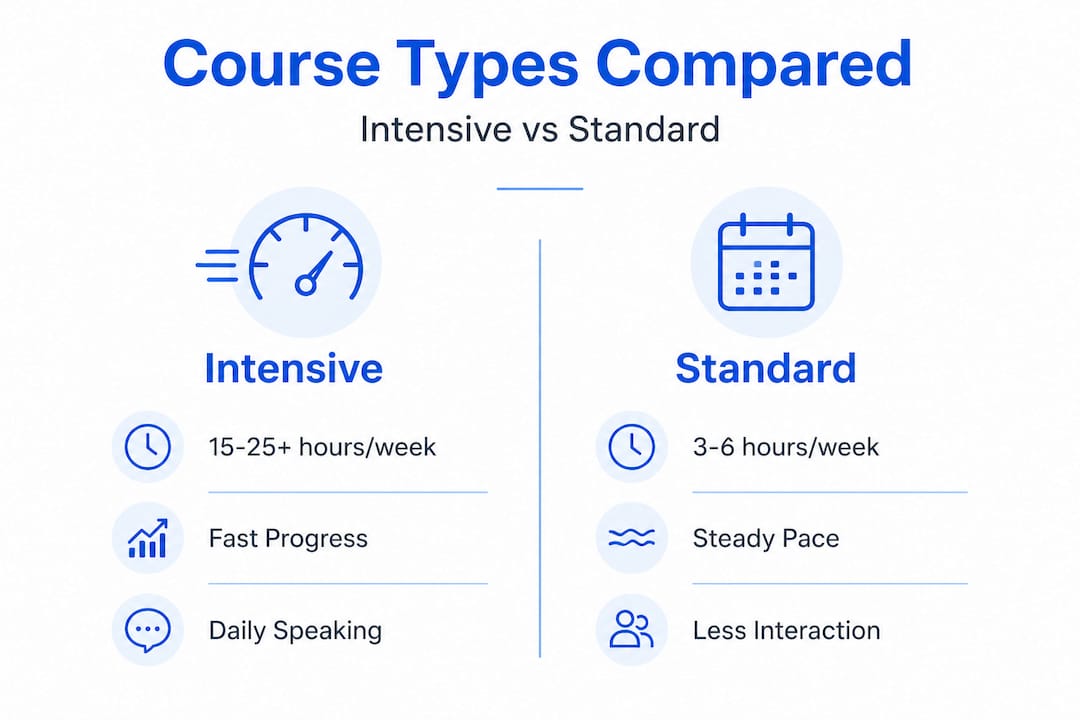
Intensive courses dedicate a significant proportion of time to spoken interaction with real-time feedback, which is the primary reason they produce faster communicative results.
Who benefits most from intensive formats?
- Professionals preparing for roles that require Spanish communication
- Students with an upcoming DELE exam or university language requirement
- Travelers heading to a Spanish-speaking country within weeks or months
- Career changers entering industries where Spanish is an asset
- Anyone with a specific deadline or time-sensitive goal
Who might do better in a standard course?
- Learners with long-term goals and no deadline pressure
- People who prefer slow, reflective study and need time to absorb material between lessons
- Those with very limited weekly availability due to work or family commitments
Understanding the differences in Spanish course types can also influence your decision, because the variety of Spanish you choose to focus on matters for specific professional or travel goals.
Inside an intensive Spanish course: Structure, curriculum, and expectations
Comparisons are useful, but it helps to know what a day or week in an intensive course actually feels like. Here is a practical look at how these courses are typically organized.
Sample weekly structure (25 hours per week):
| Day | Morning focus | Afternoon focus | Duration |
|---|---|---|---|
| Monday | Grammar and vocabulary | Conversational drills | 5 hours |
| Tuesday | Listening comprehension | Role-play scenarios | 5 hours |
| Wednesday | Reading and written response | Oral feedback session | 5 hours |
| Thursday | Grammar review | Group discussion tasks | 5 hours |
| Friday | Mock DELE assessment | Pronunciation and fluency | 5 hours |
A typical benchmark for intensive Spanish is asking about hours per day, days per week, and the share of interactive practice included. This structure is not rigid, but the best programs keep all four skills (speaking, listening, reading, and writing) active throughout the week rather than siloing them.
Common teaching methods in intensive programs:
- Conversational drills. Repeated practice with real sentence patterns that mirror everyday situations, like ordering food, negotiating, or introducing yourself professionally.
- Rapid feedback loops. Instructors correct pronunciation and grammar in the moment, preventing repeated errors from becoming permanent habits.
- Contextual vocabulary building. Words are taught within real scenarios, not as isolated lists, which improves retention dramatically.
- Peer interaction tasks. Group exercises that push learners to communicate under mild time pressure, mimicking natural conversation.
- Short daily assessments. Low-stakes quizzes or spoken tasks that track progress and identify weak areas quickly.
Pro Tip: Supplement your in-class practice with 20 to 30 minutes of Spanish listening each evening, a podcast, a show, or a song. The more your brain hears the language outside of class, the faster your listening comprehension accelerates.
If you want more control over pacing and content, private Spanish classes can deliver the same intensive structure in a one-on-one format. You can also review Spanish course syllabus details to understand how levels progress before committing to a program. The course organization approach used by leading schools in Singapore is built around this structured fluency model, making sure learners are not just memorizing but actively communicating.
Who should choose an intensive Spanish course?
Understanding the format helps, but is an intensive option right for you? Here is how to decide based on common learner profiles.
Fast-track learners are people who want to move from zero to conversational in the shortest possible time. They have a clear goal, a defined deadline, and the commitment to show up daily. Intensive courses were built for this profile.
Exam candidates preparing for DELE certification need concentrated exposure to all four tested skills. Intensive programs that align with DELE standards give candidates the structured practice they need to perform well under exam conditions.
Travelers heading to Spain, Mexico, Colombia, or any other Spanish-speaking destination within a few months benefit enormously from intensive study. The focus on spoken interaction means they leave class ready to have real conversations, not just recite textbook phrases.
Job seekers and professionals in sectors like trade, hospitality, healthcare, or finance increasingly find that Spanish is a differentiator. An intensive course can deliver job-ready communication skills in a matter of weeks.
Intensive Spanish courses accelerate communicative competence especially for learners with personal, academic, or professional goals, because the high frequency of input and output creates the kind of immersive pressure that drives rapid acquisition.
There are also learners for whom intensive formats are not the right fit right now. If you are managing a demanding work schedule with no flexibility, or if you learn better through slow, reflective practice, a standard course may produce better results for you without the burnout risk. Exploring the Spanish learning benefits relevant to your specific goals can help you decide. You can also try speaking practice ideas alongside any course format to accelerate your progress regardless of pace.
How to choose the right intensive Spanish course in Singapore
Once you have decided that an intensive Spanish course fits your needs, the next step is finding the right one. Not all programs labeled “intensive” deliver equal results. Here is a practical process for evaluating your options.
-
Ask for the exact weekly hour count. Any provider should be able to tell you precisely how many teaching hours per week are included. If the number is below 15, the program may not qualify as truly intensive.
-
Confirm the class size. Smaller classes mean more speaking time per student. A group of 6 to 10 learners is ideal. Larger groups dilute the individual attention and reduce your time to speak.
-
Find out how much time is dedicated to conversation. When evaluating a course, ask specifically about hours, weekly schedule, and the proportion of time spent in conversation with feedback. This is the single most important predictor of communicative progress.
-
Check instructor credentials. Look for certified instructors who are native or near-native speakers with formal teaching qualifications. Experience teaching at your current proficiency level matters.
-
Review the curriculum alignment. Courses aligned with DELE or CEFR (Common European Framework of Reference) standards give you a clear, internationally recognized progression path.
-
Look at scheduling flexibility. In Singapore, many learners are working professionals. A course that offers morning, evening, or weekend intensives gives you options without sacrificing your career.
-
Ask about trial classes. A reputable school will let you experience the teaching style before you commit. This gives you a direct feel for the pace, the instructor’s approach, and whether the environment suits you.
Understanding the online Spanish learning workflow can also help you decide whether an online intensive format is a practical alternative if your schedule or location makes in-person attendance difficult.
Why intensity isn’t always about speed: What most learners overlook
Here is a perspective most course marketing does not talk about. The learners who get the most out of intensive Spanish courses are not the ones focused on finishing fast. They are the ones who treat the format as an opportunity for deeper engagement, not just faster completion.
Speed without quality is useless in language learning. You can sit through 20 hours of Spanish instruction per week and still leave unable to hold a conversation, if those hours are passive. Grammar lectures, vocabulary lists, and reading exercises without feedback-rich speaking practice do not build the fluency you need for real-world use.
The real power of a well-built intensive course is the feedback loop. You speak. You make an error. The instructor corrects it immediately. You try again. This cycle, repeated dozens of times per session, creates the kind of neural reinforcement that slow-drip learning simply cannot replicate. The frequency of correction and the speed of adaptation are what produce lasting fluency, not the compressed calendar.
We have also seen learners burn out from intensive programs that pushed volume without building confidence. The best intensive courses balance challenge with encouragement. They push you to produce language under pressure while keeping the environment supportive enough that you are not afraid to make mistakes.
Our teaching approach is built on this principle: structured fluency means you learn grammar and vocabulary in the context of real communication, not in isolation. The goal is never to finish the syllabus. It is to make sure you can actually use what you have learned when it counts.
So when you evaluate an intensive course, look past the schedule. Look at the quality of the feedback, the credibility of the instructors, and whether the curriculum is designed to make you speak, not just study.
Ready to experience Spanish fluency? Explore intensive courses in Singapore
If this article has clarified what you are looking for in a Spanish course, the next step is straightforward.

Spanish Explorer offers intensive Spanish courses in Singapore designed for exactly the kind of learner described throughout this article: someone with clear goals, limited time, and a serious commitment to building real conversational ability. Whether you want group learning or a focused one-on-one experience through private intensive lessons, our programs are structured around active speaking, instructor feedback, and measurable progression aligned with DELE standards. Conveniently located in Singapore’s central business district, our classes fit the schedules of working professionals and students alike. The best way to know if it is right for you is to try it. Book a trial Spanish class and experience the difference firsthand.
Frequently asked questions
How long does it take to improve my Spanish with an intensive course?
Most learners notice significant improvement in conversational skills within 2 to 4 weeks of consistent intensive study, because intensive courses accelerate communicative competence through high-frequency practice and structured feedback.
Are intensive Spanish courses suitable for total beginners?
Yes, many intensive programs start at the absolute beginner level and are structured so that newcomers progress quickly, since courses dedicate substantial class time to spoken interaction with immediate guidance.
Is there homework or self-study in addition to class time?
Most intensive courses include practice assignments and listening tasks to reinforce what was covered in class, extending the learning well beyond the classroom hours.
Can I take an intensive Spanish course online if I live in Singapore?
Yes, many language providers in Singapore now offer online intensive formats with live instruction, making them fully accessible regardless of your location or commute.
What questions should I ask before enrolling in an intensive Spanish course?
Focus on teaching hours, class size, methods for speaking practice, and how feedback is delivered, since a practical benchmark when comparing programs is the number of hours per day, days per week, and the share of interactive conversation included.
Recommended
- Spanish Language Course Private Class | Spanish Explorer
- Spanish Class in Singapore | Spanish Language Centre
- Spanish Class Online: Learn Spanish Language in Singapore
- Spanish Courses in Singapore | Spanish Language Centre
Start Learning Spanish Today
Book a trial class and see how quickly you can progress with a professionally trained native-speaker teacher guiding the way.
Book a Trial Class