 Spanish
TL;DR:
- Building real-world language skills improves communication, enhances career prospects, and sharpens cognitive abilities.
- Practicing in authentic contexts, setting specific goals, and receiving immediate feedback are essential for development.
Building real-world language skills delivers concrete, measurable payoffs: you communicate with non-native colleagues without friction, navigate foreign cities without panic, read primary sources in their original language, and signal to employers that you can adapt where monolinguals cannot.
The short version: practical language proficiency is one of the few skills that compounds across every area of your life simultaneously.
Here is what that looks like in practice:
- You resolve a cross-cultural misunderstanding at work before it becomes a problem.
- You negotiate a deal, ask a local for directions, or read a contract without a translator in the room.
- You access research, media, and relationships that are invisible to English-only speakers.
- You demonstrate adaptability and cultural intelligence, two qualities employers consistently rank above technical credentials.
- Your brain gets sharper: bilinguals switch tasks faster than monolinguals, according to NIH-funded research.
The sections below lay out the evidence, the methods, and a realistic timeline for getting there.
Table of Contents
- Why do real-world language skills pay off across your whole life?
- How do real-world language skills differ from textbook knowledge?
- How do you actually build real-world language skills?
- How long does it take, and what does it cost?
- Key Takeaways
- What practitioners and employers actually see
- Useful sources
- FAQ
Why do real-world language skills pay off across your whole life?
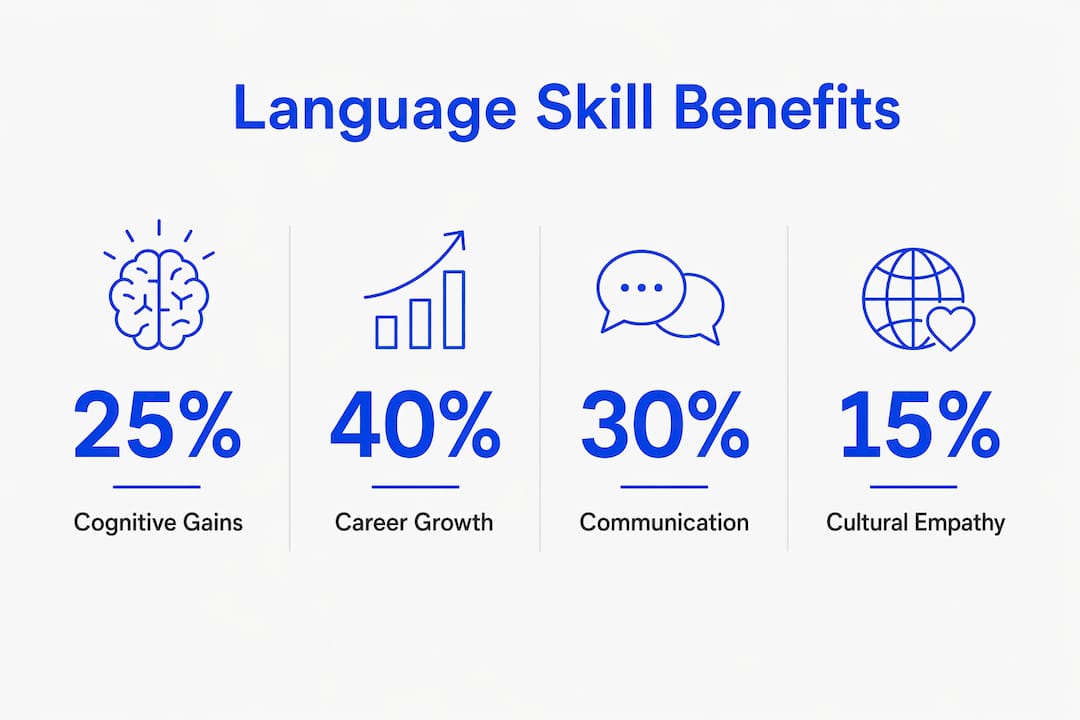
The payoffs fall into four categories, and none of them are abstract.
Cognitive and academic gains
ACTFL reports that knowing more than one language contributes to measurable cognitive and workplace advantages, with many employers actively relying on multilingual staff. Research cited by the British Academy found that bilinguals outperform monolinguals in problem-solving, multitasking, and prioritizing tasks, and even score higher on literacy and mathematical assessments. Those gains are not limited to childhood learners. Adults who build a second language develop stronger working memory and attention control, skills that transfer directly to complex professional tasks.
Career and professional outcomes
The British Academy’s briefing on languages found that many surveyed employers agree future executives will need foreign language skills and international experience, and that multilingual employees have greater chances of promotion than colleagues who speak only English. A considerable number of UK SMEs agreed that graduates who speak only English are at a disadvantage in the jobs market. The language industry in the US alone is worth billions and enables American businesses to reach foreign markets worth trillions.
“Language skills can no longer be regarded as an optional extra to a well-equipped society. Rather, they are a key indicator of how willing and prepared we are to operate in an increasingly multilingual and multicultural world.” — The British Academy
Beyond raw translation, language learning builds workforce skills that employers prize: adaptability, empathy, resilience, and improved task-switching. These are the skills that show up in hiring decisions and promotion reviews, not just on a resume line.
Communication, travel, and daily problem-solving
Practical language proficiency changes what you can actually do. You read a menu, negotiate a price, ask a pharmacist a question, or follow a local news story without waiting for someone to translate it for you. That independence compounds over time. Travelers with even conversational fluency report richer experiences and fewer logistical failures than those relying entirely on apps.

Cultural empathy and inclusion
UNESCO’s analysis explains that language shapes thought itself, which is why multilingual education improves inclusion and access to knowledge across disciplines. When you learn a language, you gain a lens on how its speakers organize the world: what they find polite, what they find offensive, what they consider a compliment. That understanding is not something a translation app can give you.
How do real-world language skills differ from textbook knowledge?
Textbook knowledge gets you to the exam. Real-world skills get you through the conversation.
The difference is not vocabulary size or grammar accuracy. It is whether you can function when the other person speaks fast, uses slang, drops words, or follows a cultural protocol you were never taught. UNESCO’s Courier piece makes the case directly: human-centered communication, including nuance, nonverbal cues, and cultural protocol, is a learner skill that AI tools cannot fully model.
Consider two learners at the same textbook level. One has drilled grammar exercises for six months. The other has spent that time listening to podcasts, role-playing workplace scenarios, and asking native speakers to correct their phrasing. In a real meeting, the second learner follows the conversation, catches the joke, and knows when to stay quiet. The first learner understands the grammar but misses the meaning.
“Deep language learning builds cultural understanding, idiomatic competence, and empathy that machines cannot reproduce.” — Time
Real-world skills include repair strategies (what to say when you do not understand), pragmatic awareness (how to make a request politely in that culture), and listening comprehension under noise and speed. None of those appear on a vocabulary quiz.
Pro Tip: Ask your instructor to run at least one role-play per session using a scenario from your actual life: a work meeting, a client call, a social dinner. That single habit closes the gap between classroom knowledge and real-world use faster than any drill.
Understanding cultural sensitivity in language learning is part of what separates a competent communicator from someone who merely knows the words.
How do you actually build real-world language skills?
The most effective methods are contextual learning, deliberate practice at the edge of your current ability, agentic goal-setting, and immediate feedback. Here is a weekly template that puts all four together.
-
Set a personal domain goal (Day 1, 15 minutes). ACTFL’s research brief recommends agentic learning: choose a domain that matters to you (business negotiation, travel, social conversation) and let that domain drive your practice choices. Intrinsic motivation is the single strongest predictor of reaching advanced proficiency.
-
Listen to authentic input daily (20 minutes). Podcasts, news clips, or short videos in your target language. BBC Future’s research reporting shows that immersion-like exposure and statistical learning under ambiguity accelerate real-world comprehension faster than structured drills alone. You do not need to understand everything; the pattern recognition is the point.
-
Shadow a native speaker (10 minutes). Play a short audio clip, pause it, and repeat the phrase at the same speed and rhythm. This trains your mouth and ear simultaneously, which is how you stop sounding like you are reading aloud.
-
Run a role-play in your target domain (20 minutes, 3x per week). Use a conversation partner, a tutor, or an AI chatbot to simulate a real scenario. Time’s reporting and eSchoolNews both point to contextual, scenario-based practice as superior for long-term retention and transfer.
-
Get corrective feedback immediately. A tutor, a language exchange partner, or a structured class with a certified instructor gives you the error correction that self-study cannot. Multilingual instructors who understand both your native language and the target language can pinpoint exactly where your interference errors come from.
-
Review and adjust weekly (10 minutes). Note which scenarios felt smooth and which felt stuck. Shift next week’s practice toward the stuck ones. This is deliberate practice: working at the edge of your ability, not in your comfort zone.
Pro Tip: Use an AI chatbot (ChatGPT, Claude) as a 24/7 practice partner for low-stakes role-plays, then bring the same scenario to a human instructor for real feedback. The AI builds fluency; the human builds accuracy and cultural judgment. Neither replaces the other.
New contextual teaching methods show that story-based and scenario-driven practice consistently outperforms isolated grammar drills for retention. The same principle applies whether you are learning Spanish, Mandarin, or any other language.
How long does it take, and what does it cost?
Timelines depend on three variables: your starting point, your practice intensity, and the quality of feedback you receive. Here are realistic ranges for adult learners starting from zero.
| Goal | Estimated Time on Task | Sample Weekly Schedule | Approximate Cost Range |
|---|---|---|---|
| Survival phrases (travel, basics) | 40–80 hours | 3 hrs/week for 3–6 months | Self-study: low cost; apps only |
| Conversational fluency | 200–400 hours | 5 hours/week for several months | Group classes + self-study |
| Professional / business use | 400–600 hours | 6 hours/week for several months | Private lessons or corporate program |
| Near-native fluency | 600+ hours | Intensive immersion or sustained study | Private + immersion program |
These ranges assume deliberate practice with feedback, not passive exposure. Structured adult courses that combine deliberate practice, immediate feedback, and task-based outcomes compress these timelines noticeably compared to self-study alone.
How do you know when you have reached a given level? Use can-do statements: “I can introduce myself and my role in a business meeting,” “I can follow a phone call without asking for repetition,” “I can read a contract and flag the key clauses.” When you can do those tasks under real conditions, not just in a classroom, you have the skill.
Prior language experience matters too. A native Spanish speaker learning Portuguese moves faster than an English speaker learning Mandarin. Intensity and feedback quality are the two levers you control most directly.
Key Takeaways
Building real-world language skills is the difference between knowing a language and being able to use it when it counts, in a meeting, on a trip, or in a negotiation.
| Point | Details |
|---|---|
| Real-world skills beat textbook knowledge | Pragmatics, listening under speed, and cultural protocols matter more than grammar accuracy in live situations. |
| Cognitive and career gains are documented | Bilinguals switch tasks faster, and many employers say future executives will need foreign language skills. |
| Agentic, contextual practice works best | Choose a personal domain, practice in real scenarios, and get corrective feedback every week. |
| Timelines are realistic for adults | Conversational fluency takes roughly 200–400 hours; professional use takes 400–600 hours; near-native proficiency requires sustained effort beyond 600 hours, all with deliberate practice. |
| Structured programs compress the timeline | Courses combining feedback, role-play, and task-based outcomes move faster than self-study alone. |
Ready to move from classroom knowledge to real-world fluency? Spanish Explorer’s adult Spanish courses and online Zoom classes are built around exactly the methods described above. Start with a trial class and see how fast the gap closes.
What practitioners and employers actually see
The gap between textbook Spanish and boardroom Spanish is something I have watched play out repeatedly. A learner who spent a year on grammar exercises freezes when a native speaker speeds up or drops a subject pronoun. A learner who spent the same year in scenario-based practice, getting corrected in real time, handles the conversation and then moves on.
The research maps directly to what good instruction looks like in practice. Agentic goal-setting, contextual role-plays, immediate corrective feedback, and deliberate practice at the edge of ability are not just academic recommendations. They are what separates a course that produces communicators from one that produces test-takers.
Spanish Explorer’s adult programs, including group conversational classes, private lessons, and corporate training delivered via Zoom or in person, are structured around these principles. The instructors are certified, bilingual in Spanish and English, and trained to run the kind of scenario-based sessions that transfer to real situations. For teams and companies, the corporate language programs are designed to produce measurable workplace outcomes, not just completion certificates.
If you are an adult learner or an HR professional weighing language training, the question is not whether language skills matter. The evidence on that is settled. The question is whether your practice method will actually get you to the point where you can use them.
Useful sources
- The Benefits of Learning Languages — ACTFL: Research summary on cognitive and employer-valued outcomes of multilingualism.
- How to Reach Advanced Language Proficiency — ACTFL Research Brief: Evidence for agentic, domain-focused learning as the path to advanced proficiency.
- Language Matters: The Role and the Power of Multilingualism — UNESCO: Analysis of how language shapes thought and why multilingual education matters.
- Why Studying Languages Still Matters — UNESCO Courier: The case for human-centered language learning in an era of AI translation.
- Why Learning a Language Still Matters — Time: Journalism piece on idiomatic competence and cultural empathy that AI cannot replicate.
- What’s the Best Way to Learn a New Language? — BBC Future: Research on immersion, statistical learning, and the role of technology in language acquisition.
- A Second Language Is More Than an Elective — eSchoolNews: Contextual learning and deliberate practice as superior methods for retention and transfer.
- Beyond Translation: How Language Learning Builds Workforce Skills — AMISA: Employer demand for adaptability, empathy, and resilience linked to language learning.
- Briefing on Languages — The British Academy: Comprehensive policy brief on language skills, employability, trade, and cognitive benefits.
- The Importance of Structured Language Courses for Adults — Spanish Explorer: How structured adult programs map to research-backed methods and measurable outcomes.
- Bilinguals Switch Tasks Faster Than Monolinguals — NIH: NIH-funded study on cognitive task-switching advantages in bilingual adults.
Pick one method from the how-to section above and run it for a single week. That is enough to feel the difference.
FAQ
What are the main benefits of learning a world language?
Language learning delivers cognitive gains (faster task-switching, stronger memory), career advantages (higher promotion rates, employer preference for multilingual candidates), and cultural empathy that no translation app can replicate. The British Academy and ACTFL both document these outcomes across professional and personal contexts.
Why are languages considered a skill for life?
Unlike many technical skills, language proficiency compounds over time and transfers across roles, industries, and life stages. The cognitive benefits, including problem-solving and multitasking, persist and even protect against cognitive decline in later life, according to research cited by the British Academy.
What advantages come from developing strong language skills?
Strong language skills give you access to relationships, markets, and information that are closed to monolingual speakers. Professionally, multilingual employees are more likely to be promoted and are increasingly preferred by employers who operate across borders.
How long does it realistically take to reach useful proficiency?
For survival-level conversation, expect 40–80 hours of deliberate practice. Conversational fluency typically requires 200–400 hours; professional or business-ready use takes 400–600 hours. Near-native proficiency requires sustained practice beyond 600 hours. Structured courses with regular feedback compress these timelines compared to self-study.
Recommended
Start Learning Spanish Today
Book a trial class and see how quickly you can progress with a professionally trained native-speaker teacher guiding the way.
Book a Trial Class