 Spanish
TL;DR:
- Many learners struggle with speaking Spanish fluently due to overthinking grammar rules during conversations. Focusing on practical language use and exposure helps internalize grammar naturally, improving confidence and retention. Balancing speaking practice with targeted grammar study accelerates progress and maintains motivation over time.
Most learners hit the same wall: they study Spanish grammar rules for weeks, sit down with a native speaker, and freeze. The words scatter. The rules dissolve. If that sounds familiar, you are not alone, and you are not failing. The real question is not whether to focus on Spanish grammar, but how to use it so it builds confidence rather than creates paralysis. Grammar is not the enemy of fluency. Misusing it is.
Table of Contents
- Key Takeaways
- Why focus on Spanish grammar at all
- When grammar focus becomes a problem
- How to integrate grammar with speaking practice
- How natural exposure accelerates grammar absorption
- My honest take on grammar and adult learners
- Learn Spanish the smart way with Spanish Explorer
- FAQ
Key Takeaways
| Point | Details |
|---|---|
| Grammar as a framework | Spanish grammar gives you the structure to form clear, meaningful sentences from day one. |
| The 20/80 rule applies | Mastering a core set of grammar rules covers the vast majority of everyday communication needs. |
| Isolation backfires | Studying grammar without speaking practice creates hesitation and slows real-world fluency. |
| Context beats drills | Learning grammar through stories and real conversations improves retention and motivation significantly. |
| Feedback accelerates progress | Active correction cycles build grammar intuition faster than passive memorization ever will. |
Why focus on Spanish grammar at all
Think of Spanish grammar as the skeleton of the language. Without it, your words pile up without shape. With it, even a short sentence carries precise meaning.
The importance of Spanish grammar is not about passing tests or sounding academic. It is about making yourself understood. When you place an adjective after the noun correctly, say “un coche rojo” instead of “un rojo coche,” a native speaker processes your meaning instantly. When you confuse ser and estar, the sentence can shift from describing a personality trait to reporting a temporary mood, two very different messages.
Here is where things get interesting. You do not need to master every grammar rule to speak well. Mastering just 20% of core grammar covers roughly 80% of daily communicative fluency. That 20% includes present tense conjugations, basic past and future structures, gendered nouns, and the ser/estar distinction. These rules are not trivial, but they are learnable in weeks, not years.
The role of grammar in Spanish also becomes clearer when you compare it to building with Lego. You can snap pieces together randomly and create something, but the structure will not hold under pressure. Grammar gives you the instructions. You do not follow every instruction perfectly on your first build, but knowing they exist means you can self-correct as you go.
A persistent myth among adult learners is that grammar belongs in classrooms and not in conversation. That misconception stalls progress. Professional communicators, whether in business meetings or casual travel situations, rely on grammar constantly, even when they no longer think about it consciously. The goal is to internalize the rules so they run in the background.
What grammar actually covers for Spanish beginners
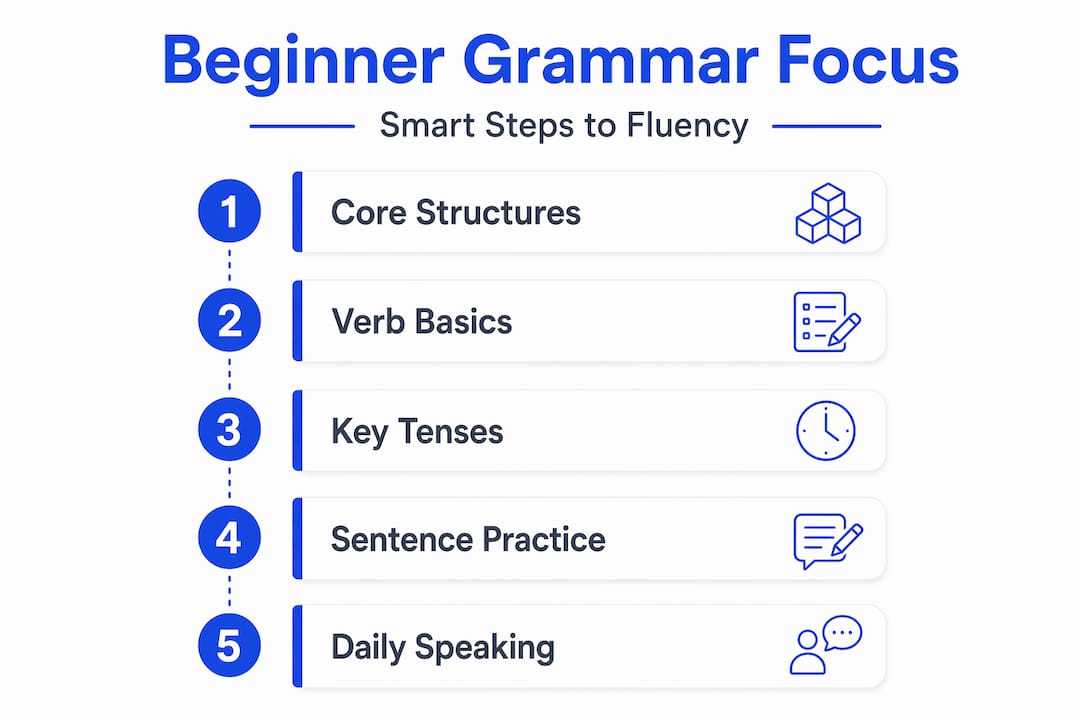
For anyone starting out, Spanish grammar for beginners covers more ground than verb endings alone. It includes:
- Noun gender: Every Spanish noun is masculine or feminine, which affects articles, adjectives, and pronouns
- Verb conjugation: Spanish verbs change form depending on who is performing the action
- Sentence word order: Subject, verb, object patterns differ from English in key ways
- Ser vs. estar: Two separate verbs both translate as “to be,” but they serve entirely different purposes
- Agreement rules: Adjectives must match nouns in both gender and number
Understanding these categories gives you a map. You may not know every street, but you can orient yourself without getting completely lost.
When grammar focus becomes a problem
Here is the uncomfortable truth. Many learners study grammar diligently and still cannot hold a basic conversation. That is not a character flaw. It is a predictable outcome of treating Spanish like a math equation to solve before speaking.
Excessive grammar focus leads to overthinking that impairs real-time conversation. When your brain is scanning for the correct subjunctive conjugation mid-sentence, you lose the thread of what you were actually trying to say. The person across from you senses the hesitation. You feel embarrassed, and you speak less. The less you speak, the worse the hesitation becomes.
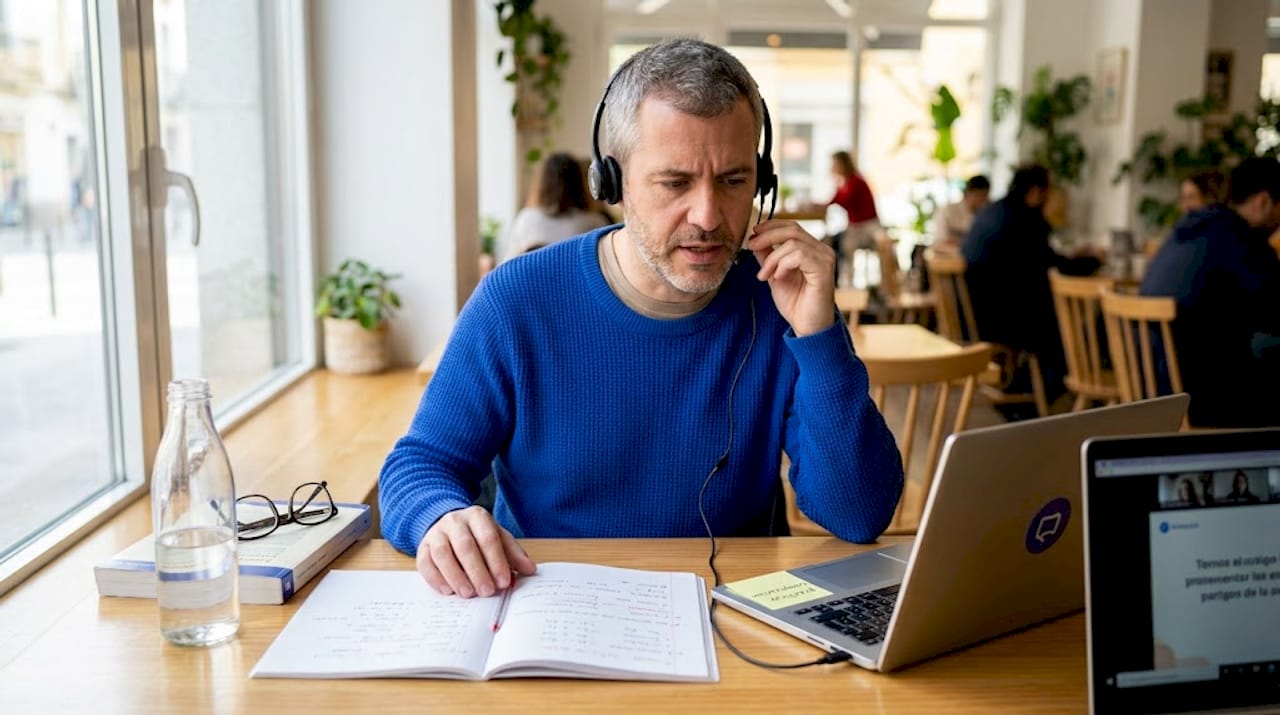
Grammar knowledge that does not translate to speaking has limited practical value. Communication skills require active use, not just passive understanding of rules on a page. Knowing that the preterite and imperfect serve different functions in Spanish storytelling does not help you if you cannot produce either one quickly under normal conversation pressure.
There is also a motivation issue. Teaching grammar too early overloads working memory and damages motivation. When a beginner is buried in agreement rules before they can say a full sentence with confidence, the learning experience feels punishing. Many people quit at this stage, convinced they simply “lack the talent” for languages.
Think of grammar as a useful tool that works best when it supports communication rather than replacing it. One widely shared framing describes grammar as the “snack in the back seat” of language learning. It is there, and it matters, but it is not driving the vehicle.
Pro Tip: If you notice yourself mentally conjugating verbs mid-conversation, that is a signal to speak more and analyze less. Let the errors happen. You will correct them faster through use than through additional study.
How to integrate grammar with speaking practice
The most effective approach treats grammar as something you discover through use and then clarify through instruction. Here is how that actually works in practice.
-
Start with functional language chunks. Rather than memorizing paradigms, start with phrases that work immediately. “¿Puedo tener…?” (Can I have…?) uses the subjunctive without requiring you to know what the subjunctive is yet. Functional language chunks let you communicate while grammar patterns absorb naturally in the background.
-
Use grammar explanations to clarify what you have already heard. If you notice that Spanish speakers keep saying “me gusta” instead of “yo gusto,” a quick grammar explanation about indirect object pronouns suddenly makes sense. You have a real-world hook for the rule. This timing dramatically improves retention compared to learning the rule in isolation. Adults benefit from grammar as an intellectual framework that clarifies patterns they have already encountered through meaningful input.
-
Get real feedback through correction cycles. Passive practice, such as reading without interaction, builds familiarity but not precision. Correction cycles with immediate feedback build grammar confidence faster than memorization alone. Find a teacher or practice partner who will gently correct you in real time. The correction sticks because it is tied to a specific communicative moment you remember.
-
Speak more than you study. A rough ratio many experienced learners recommend is 70% speaking and listening, 30% grammar study. This is not arbitrary. Learners who practice frequently and embrace corrections progress significantly faster than those who focus exclusively on rule memorization.
-
Revisit grammar after speaking sessions. After a real conversation, note the patterns where you stumbled. Then study those specific grammar points. You are now solving a problem you personally experienced, which is far more motivating than working through a grammar workbook chapter by chapter.
A practical resource for adult grammar techniques can help you structure this kind of focused self-study without turning it into a full-time project.
Pro Tip: Start every new grammar topic by finding three real sentences you have actually heard or read that use it. Context first, rule second. Your brain files it differently and retrieves it more easily under conversation pressure.
How natural exposure accelerates grammar absorption
There is a reason children acquire their native language without a grammar textbook. The mechanism is exposure to meaningful, comprehensible language over time. Adults can replicate this process deliberately.
Children learn grammar subconsciously through stories and meaningful language before any formal instruction begins. Spanish learners at every level can borrow this principle. Listening to Spanish podcasts, watching Spanish TV series, or even using audiobooks for language input creates repeated exposure to grammar patterns in natural, emotional contexts. Your brain starts to notice patterns without being forced to analyze them explicitly.
Here is how natural acquisition compares to isolated grammar drills:
| Method | Grammar retention | Speaking confidence | Motivation over time |
|---|---|---|---|
| Grammar drills only | Moderate | Low | Tends to decline |
| Natural exposure only | High (slower start) | High | Tends to increase |
| Combined approach | High | High | Sustained |
The combined approach wins consistently, but the proportion matters. Too many learners front-load the grammar study and never get enough natural exposure to let the patterns settle. The fix is not to abandon understanding Spanish grammar rules. It is to let real input do the heavy lifting while grammar study supports and clarifies.
Stories work particularly well because emotional engagement lowers the stress response. When you are genuinely curious about what happens next in a show or podcast, you are absorbing grammar without treating it as a task. Learning grammar through meaningful context improves both retention and engagement far beyond isolated drills. That is not a minor advantage. It is the difference between quitting at month three and still going strong at month twelve.
Improving Spanish through grammar works best when the grammar is anchored to something real: a conversation you had, a scene you watched, a sentence that surprised you.
My honest take on grammar and adult learners
I have watched many highly motivated adults get completely stuck not because they lacked discipline, but because they treated Spanish grammar as a prerequisite to speaking. They wanted to get the rules right before opening their mouths.
What I have found, consistently, is that the learners who speak early and correct often end up with far stronger grammar instincts than those who memorize rules first. Grammar becomes felt rather than calculated. That shift, from rule to intuition, is the whole game.
What changed things for me was treating every mistake as information rather than evidence of failure. If I said “yo soy cansado” instead of “yo estoy cansado,” a good teacher would flag it gently and keep the conversation going. Within a few sessions, the correction was absorbed not because I had memorized a rule but because I had experienced the right form in a real communicative moment.
My advice is specific: do not wait until your grammar feels “good enough” to start speaking. It never will feel good enough if you are waiting. Start speaking in week one. Let grammar study be the thing that sharpens what you are already doing, not the gate you must pass through first. Balancing grammar with speaking practice is not a compromise. It is the actual method that works.
— Paul
Learn Spanish the smart way with Spanish Explorer
If you are ready to stop memorizing rules in isolation and start building real communication skills, Spanish Explorer offers adult Spanish courses in Singapore that integrate grammar instruction with live speaking practice from the very first lesson.

Whether you prefer group classes, one-on-one private Spanish lessons tailored to your pace, or flexible online Zoom classes that fit around a busy schedule, Spanish Explorer’s certified instructors make grammar feel useful rather than overwhelming. Classes focus on conversational and business Spanish for adults, with teachers who correct, encourage, and adapt to how you actually learn. Explore the full range of adult Spanish courses and find the format that fits your goals.
FAQ
Why is grammar important for learning Spanish?
Grammar gives you the structural framework to form clear, meaningful sentences. Without it, even a large vocabulary cannot produce reliable communication in Spanish.
Can you learn Spanish without studying grammar?
You can absorb some grammar through exposure, but deliberate grammar study clarifies patterns faster and prevents fossilized errors that become very hard to unlearn later.
How much grammar should a beginner focus on?
Beginners benefit most from focusing on a core set of high-frequency grammar rules. Mastering roughly 20% of grammar covers about 80% of everyday communication, which is a realistic and motivating starting point.
What are the most common Spanish grammar mistakes adult learners make?
The most frequent errors include confusing ser and estar, misusing preterite and imperfect tenses, and forgetting noun-adjective agreement. These are all correctable quickly through regular speaking practice and feedback.
How do I improve Spanish fluency through grammar without losing confidence?
Speak early, accept corrections, and study grammar points that come up in your own conversations. Active correction cycles build intuition faster than passive rule memorization and keep your confidence intact.
Recommended
- Spanish fluency explained: Levels, goals, and your path forward
- How to learn Spanish grammar: techniques for adults
Start Learning Spanish Today
Book a trial class and see how quickly you can progress with a professionally trained native-speaker teacher guiding the way.
Book a Trial Class