 Spanish

“Why?” in Spanish is ¿Por qué? Write it as two words, with an accent on qué. To reply with “because,” use porque, one word without an accent.
Question: ¿Por qué estudias español? (Why do you study Spanish?)
Answer: Porque quiero hablar con mis vecinos. (Because I want to speak with my neighbours.)
Por qué, porque, porqué and por que
- Por qué asks for a reason. Use it in a direct question or inside another sentence. No sé por qué cerraron la tienda. (I don’t know why they closed the shop.)
- Porque introduces a reason. Cerraron la tienda porque era tarde. (They closed the shop because it was late.)
- El porqué is a noun meaning “the reason.” Me explicó el porqué del cambio. (She explained the reason for the change.)
- Por que can appear where a verb takes por and the next clause starts with que. Optaron por que el grupo empezara el lunes. (They chose for the group to start on Monday.)
The Real Academia Española’s style guide explains the spelling and grammar of these forms.
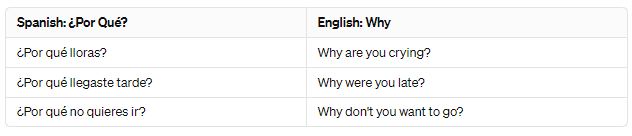
Ask for a reason or a purpose
¿Por qué vas a Madrid? asks for the reason you are going. ¿Para qué vas a Madrid? asks what you plan to do there. Para visitar a mi hermana. (To visit my sister.)

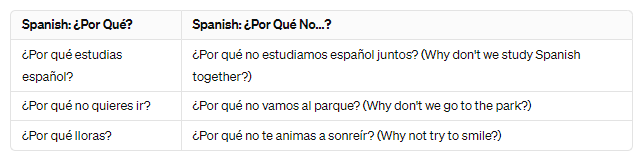
How to say “why not” in Spanish
Use ¿Por qué no…? to ask why something is not happening or to make a suggestion. Compare ¿Por qué no vienes hoy? (Why aren’t you coming today?) with ¿Por qué no quedamos mañana? (Why don’t we meet tomorrow?) Context tells you which meaning fits.
How to say “that’s why” in Spanish
Use por eso to introduce the consequence. Perdí el autobús. Por eso llegué tarde. (I missed the bus. That’s why I arrived late.) To give the reason instead, say Llegué tarde porque perdí el autobús. (I arrived late because I missed the bus.)

Check your answers
- ¿___ quieres cambiar de clase?
- Quiero cambiar de clase ___ trabajo los martes.
- Me explicó el ___ del cambio.
Answers: 1. Por qué. 2. porque. 3. porqué.

To practise asking questions aloud, see the Beginner 1 Spanish trial or check the Spanish group timetable.
Back to all articlesStart Learning Spanish Today
Book a trial class and see how quickly you can progress with a professionally trained native-speaker teacher guiding the way.
Book a Trial Class