 Spanish
TL;DR:
- Learning a third language offers cognitive, cultural, and career benefits beyond bilingualism.
- It boosts brain function, enhances cultural empathy, and provides a competitive edge in the job market.
Learning a third language is defined as acquiring a new linguistic system after already having developed proficiency in two others, and the cognitive, cultural, and career rewards it delivers go well beyond what bilingualism alone provides. The reasons to study a third language are backed by hard science: a 2026 experimental study using the “Language Transfer as a Key to Efficiency” program found that structured L3 training boosts cognitive performance by 18% in university learners. A separate analysis of 86,149 adults across 27 European countries, published in Nature Aging, found that multilingual adults age better than their monolingual peers. For adult learners considering Spanish as a third language, these findings carry real weight.
Why learn a third language for your brain?
The cognitive case for adding a third language is stronger than most people expect. Language learning increases gray matter in brain regions tied to memory, attention, and problem-solving, and this effect compounds with each additional language. The brain does not simply repeat the same process it used for the second language. It recruits more neural networks, engages deeper executive function, and builds what researchers call metalinguistic awareness, which is the ability to think analytically about how language itself works.
That metalinguistic awareness is the hidden advantage of the third language learner. When you already speak two languages, you have already trained your brain to switch between rule systems, notice patterns, and manage competing grammatical structures. Applying that skill to a third language accelerates acquisition in ways that monolinguals simply cannot replicate. Research confirms that multilinguals acquire L3 faster than monolinguals learn L2, precisely because of this built-in cognitive scaffolding.
The benefits extend beyond speed. Multilingualism acts as a cognitive resilience factor, helping people navigate adversity, manage complexity, and maintain mental sharpness under pressure. That is not a soft claim. It is the conclusion of peer-reviewed research on how multilingual experience shapes the brain’s capacity to handle difficult environments.
Key cognitive gains from third language learning include:
- Enhanced executive function: Switching between three language systems trains the brain’s control mechanisms more intensely than two.
- Stronger working memory: Holding vocabulary, grammar rules, and cultural context across three languages expands memory capacity.
- Faster pattern recognition: Prior language experience makes it easier to spot structural similarities in new languages.
- Reduced cognitive decline: The Nature Aging analysis found multilingual adults are 50% less likely to show signs of accelerated biological aging.
Pro Tip: When starting your third language, actively compare its grammar to both your first and second languages. This deliberate noticing strategy is the same technique that produced the 18% cognitive performance gain in the 2026 experimental study.
How does a third language change your identity and cultural understanding?
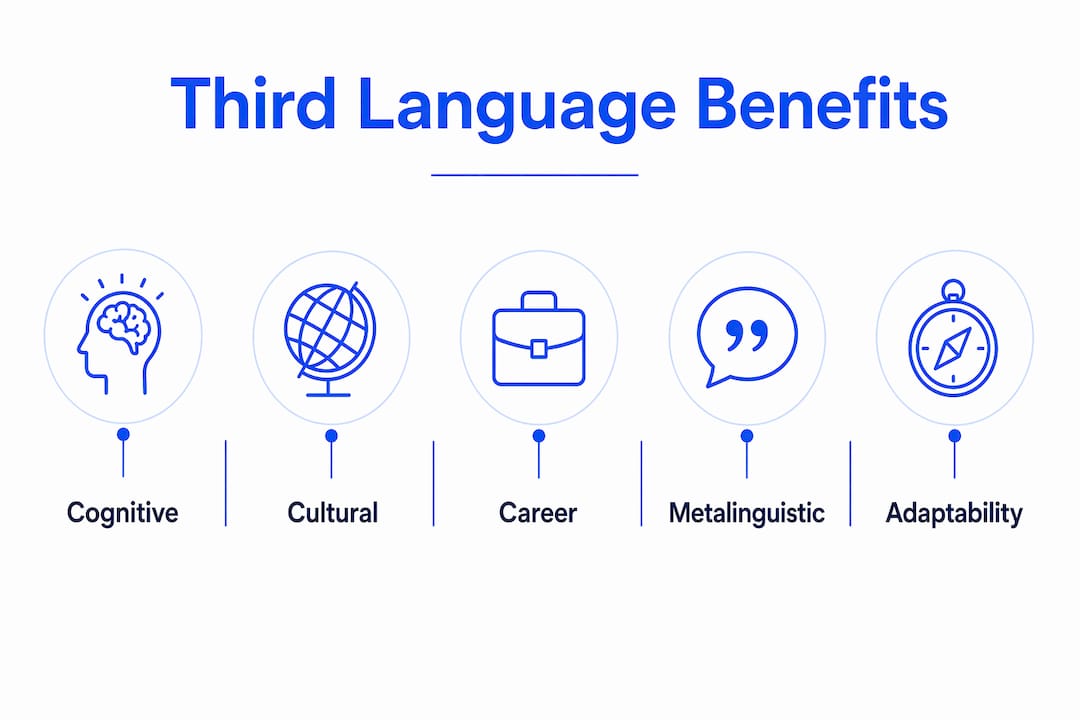
The cultural transformation that comes with a third language goes deeper than vocabulary or grammar. Professor Monzur and Dr. Roy Hamilton both describe a process of analytical detachment that occurs when a learner steps into a third linguistic world. You stop seeing your own cultural assumptions as defaults. You start seeing them as choices, which is a genuinely different way of moving through the world.
This shift matters because it builds empathy in a way that travel or reading alone cannot. When you learn to express grief, humor, or negotiation in a language that structures those concepts differently from your own, you internalize a new perspective. That is not a metaphor. It is a cognitive and emotional rewiring that changes how you interpret other people’s behavior and intentions.
“Human communication has intercultural requirements that AI alone cannot meet. Learning languages builds empathy and relational skills that no translation tool can replicate.” — UNESCO
UNESCO’s position is direct: language learning remains vital precisely because human intercultural dialogue requires slow, relational skill-building that technology cannot shortcut. An AI translator can convert words. It cannot teach you why a Spanish-speaking colleague pauses before disagreeing, or what a particular phrase signals about trust in a Latin American business context.
The identity expansion that comes with a third language also has practical dimensions:
- You become more comfortable with ambiguity, because you have already learned to function in two linguistic systems where you were not fully fluent.
- You develop a stronger sense of your own cultural identity by contrast, because you have seen it from the outside through two other lenses.
- You build genuine cross-cultural relationships that go beyond surface-level politeness, which matters enormously in international business and personal life.
The importance of cultural immersion in language learning is not decorative. It is the mechanism through which a third language delivers its deepest value.
What career advantages does a third language give you?
The impact of a third language on career outcomes is specific and measurable. Multilingual professionals are not simply more hireable in a general sense. They bring distinct cognitive tools to the workplace that monolingual colleagues cannot easily replicate. The analytical detachment that comes with third language acquisition directly reduces cognitive bias in decision-making, which is a documented advantage in negotiation, risk assessment, and cross-cultural management.

Industries where this advantage is most pronounced include international trade, financial services, technology, hospitality, and healthcare. In Singapore’s business environment, Spanish opens doors to Latin American markets, which represent some of the fastest-growing trade relationships in the Asia-Pacific region. Professionals who can conduct meetings, read contracts, and build relationships in Spanish hold a genuine edge over those relying on interpreters. The career value of Spanish training is not theoretical for Singapore-based professionals. It is a concrete differentiator.
Multilingualism also builds workplace resilience. Research identifies multilingual experience as a resilience factor in complex environments, meaning multilingual professionals adapt faster to organizational change, manage ambiguity better, and perform more consistently under pressure. Those are qualities that show up in performance reviews and promotion decisions.
Specific career advantages of third language proficiency include:
- Stronger negotiation skills: Multilingual speakers make fewer emotionally reactive decisions because they process situations through multiple cultural frameworks.
- Wider candidate pool access: Roles requiring Spanish proficiency attract fewer qualified applicants, reducing competition for multilingual candidates.
- Better client relationships: Speaking a client’s language, even partially, signals respect and builds trust faster than any other professional gesture.
- Higher adaptability scores: Multilingual employees consistently score higher on adaptability assessments used in leadership development programs.
- Access to global roles: Multinational companies actively seek professionals who can operate across language zones without requiring translation support.
Pro Tip: If you already speak English and Mandarin, Spanish is a particularly high-leverage third language choice. It shares Latin roots with English, which accelerates vocabulary acquisition, while opening an entirely different cultural and commercial world from your existing language pair.
How do you learn a third language more efficiently?
Third language acquisition, known in linguistics as L3 acquisition, works differently from learning a second language. The key mechanism is cross-linguistic transfer, where your brain draws on whichever of your existing languages is structurally closest to the new one. For English speakers learning Spanish as a third language, English’s Latin-derived vocabulary provides a powerful scaffold. Words like “communication,” “education,” and “information” translate almost directly.
The practical implication is that you should not try to keep your languages in separate mental compartments. Actively comparing Spanish grammar to both your first and second languages speeds up acquisition rather than causing confusion. This is the opposite of what many learners instinctively do.
Effective strategies for third language learning, compared by approach:
| Strategy | What it involves | Why it works |
|---|---|---|
| Metalinguistic noticing | Consciously comparing grammar rules across all three languages | Activates prior knowledge and accelerates pattern recognition |
| Cross-linguistic scaffolding | Using your structurally closest language as a bridge to L3 | Reduces cognitive load by building on existing frameworks |
| Structured program learning | Following a curriculum designed for adult L3 acquisition | Provides systematic exposure and measurable progress milestones |
| Deliberate vocabulary mapping | Linking new words to cognates in L1 or L2 | Builds vocabulary faster by connecting to existing memory networks |
| Spaced repetition practice | Reviewing material at increasing intervals | Strengthens long-term retention without overloading working memory |
Pitfalls to avoid are equally important. Treating your three languages as completely separate systems wastes the cognitive advantage you have already built. Neglecting maintenance of your first two languages while focusing on the third causes skill erosion across all three. And skipping structured instruction in favor of purely informal exposure slows progress significantly, particularly for adult learners who benefit from explicit grammar instruction.
Building Spanish vocabulary fast is achievable when you apply cross-linguistic transfer deliberately, especially if English is already one of your languages.
The third language is worth more than you think
Learning a third language changed how I see the world in ways I did not anticipate when I started. The cognitive benefits are real and they compound over time. But what surprised me most was the identity shift. Speaking three languages does not just give you more words. It gives you more ways of being a person.
The cultural empathy that comes with a third language is not something you can get from a podcast or a translation app. It comes from the slow, sometimes frustrating process of sitting with ambiguity, making mistakes in front of native speakers, and gradually earning the ability to make someone laugh in their own language. That experience changes you at a level that is hard to articulate but easy to feel.
I have seen adult learners in Singapore dismiss the idea of a third language as too ambitious or too time-consuming. That is the wrong frame. The question is not whether you have time to learn a third language. The question is whether you can afford to keep thinking in only two. The world’s most interesting professional and personal opportunities increasingly live at the intersection of cultures, and the people who thrive there are the ones who can move between linguistic worlds with confidence.
The advantages of multilingualism are not reserved for people who grew up in multilingual households. They are available to any adult willing to commit to structured, consistent learning.
— Paul
Spanish Explorer: structured courses for adult language learners
Spanish Explorer offers adult Spanish courses in Singapore designed for learners pursuing conversational fluency and business proficiency. Whether you prefer group classes, private lessons, or online learning via Zoom, the school provides structured programs taught by certified, bilingual instructors.

Located at 10 Anson Road, Level 22, International Plaza, Singapore 079903, right above Tanjong Pagar MRT, Spanish Explorer is accessible for working professionals. Corporate training options are also available for teams seeking to build Spanish communication skills for international business. Every course is designed to apply the cross-linguistic and metalinguistic strategies that research confirms accelerate third language acquisition for adult learners.
FAQ
Why learn a third language if you already speak two?
A third language delivers cognitive, cultural, and career benefits that bilingualism alone does not provide. The 2026 “Language Transfer as a Key to Efficiency” study found structured L3 training boosts cognitive performance by 18%, a gain that goes beyond what second language acquisition produces.
Does a third language improve cognitive skills more than a second?
Yes. Learning a third language engages more neural networks and builds deeper metalinguistic awareness than learning a second language. Research shows multilinguals acquire additional languages faster than monolinguals learn their second, because prior language experience creates cognitive scaffolding.
What are the career benefits of knowing a third language?
Multilingual professionals make better decisions under pressure, adapt faster to change, and access roles that monolingual candidates cannot fill. Analytical detachment from third language acquisition directly reduces cognitive bias in negotiation and cross-cultural management.
Is Spanish a good choice as a third language for Singapore professionals?
Spanish is an excellent third language choice for English speakers in Singapore. Its Latin-derived vocabulary overlaps significantly with English, accelerating acquisition, while opening access to Latin American markets and a global community of over 500 million speakers.
Can adults learn a third language effectively without prior language study experience?
Adults with two existing languages learn a third more efficiently than those starting from scratch. Cross-linguistic transfer from both prior languages provides structural scaffolding, and metalinguistic awareness built through bilingualism directly accelerates L3 acquisition.
Key takeaways
Learning a third language delivers cognitive, cultural, and career advantages that compound with each additional language, making it the highest-return investment for adult learners who already speak two.
| Point | Details |
|---|---|
| Cognitive performance gain | Structured L3 training produces an 18% boost in cognitive performance, confirmed by a 2026 experimental study. |
| Healthy aging connection | Multilingual adults are 50% less likely to show signs of accelerated biological aging, per a Nature Aging analysis of 86,149 adults. |
| Identity and cultural empathy | A third language builds analytical detachment and cross-cultural empathy that no translation tool can replicate. |
| Career differentiation | Multilingual professionals reduce cognitive bias in decision-making and access roles that monolingual candidates cannot fill. |
| Faster acquisition through transfer | Cross-linguistic transfer from L1 and L2 scaffolds L3 learning, making structured adult programs the most efficient path forward. |
Recommended
- Why You Should Learn Spanish: 4 Reasons and Benefits
- Why Study Spanish in 2026: Benefits Worth Knowing
- Unlock the Benefits of Learning Spanish in Singapore
- The Role of Multilingual Instructors in Language Learning
Start Learning Spanish Today
Book a trial class and see how quickly you can progress with a professionally trained native-speaker teacher guiding the way.
Book a Trial Class