 Spanish
TL;DR:
- Native teachers excel in pronunciation, cultural context, and authentic language exposure.
- Well-trained non-native teachers can be equally effective, especially in grammar and structured instruction.
- A balanced approach combining native input with formal pedagogy maximizes Spanish learning outcomes.
Choosing the right Spanish teacher feels straightforward until you start asking questions. Is a native speaker automatically the best option? Research actually shows a more nuanced picture. Native Spanish teachers bring real advantages in pronunciation, cultural authenticity, and natural communication style. But they are not always the only path to fluency, especially in a multilingual learning environment like Singapore. This guide breaks down exactly when native teachers give you an edge, where non-native instructors can be just as effective, and how you can make the smartest choice for your goals.
Table of Contents
- Why native Spanish teachers are valued in language education
- Limitations and misconceptions about native teachers
- Native vs non-native: What matters most for Singapore learners?
- Maximizing results: Practical strategies for parents and professionals
- Our take: Native teachers are not a silver bullet—here’s what actually works
- Discover qualified native Spanish teachers in Singapore
- Frequently asked questions
Key Takeaways
| Point | Details |
|---|---|
| Native teachers boost speaking | Native Spanish teachers help learners develop real-world listening and accurate pronunciation. |
| Non-natives excel at grammar | Qualified non-native teachers are especially strong in explaining grammar and guiding beginners. |
| Best results require balance | Combining native input with sound pedagogy offers the most effective learning path for Singapore learners. |
| Use strategic resources | Pair lessons with practice tools and activities to reinforce native exposure beyond the classroom. |
Why native Spanish teachers are valued in language education
When you sign up for a Spanish class in Singapore, one of the first things you notice is how much teacher background matters to most learners. And for good reason. Native Spanish teachers grew up using the language naturally, which means they carry something no textbook can fully replicate: authentic instinct.
Native speakers do not think about grammar rules before they talk. They just talk. That spontaneity shows up in the way they model pronunciation, choose idioms, and respond to questions. For learners in Singapore who do not have daily exposure to Spanish outside the classroom, this kind of authentic input is genuinely hard to find elsewhere.
“Native teachers lead to better oral performance in language studies, especially in non-immersive settings where classroom exposure is the primary source of language input.”
Here is what native Spanish teachers consistently do better than most other sources of language input:
- Pronunciation modeling: They demonstrate sounds, intonation, and rhythm that learners can absorb organically, without drilling isolated phonemes.
- Idiomatic expression: Real Spanish includes expressions, shortcuts, and filler phrases that textbooks rarely cover. Natives use these naturally.
- Cultural context: Language and culture are inseparable. Native teachers bring references to food, humor, regional customs, and social norms that add depth to every lesson.
- Authentic listening practice: Learners hear real pacing, not the slow, deliberate speech of scripted audio tracks.
For parents enrolling young children, native teachers set the right pronunciation foundation early. Children are remarkably good at picking up accents, and exposure to a native speaker during formative years can shape how they sound in Spanish for the rest of their lives. For professionals who want to learn Spanish in Singapore for work in Spain or Latin America, accent credibility and cultural fluency can directly affect how they are received in business meetings.
This does not mean native teachers are perfect for every situation. But their core contribution, authentic language exposure, is a genuine advantage that structured classroom settings alone struggle to provide.
Limitations and misconceptions about native teachers
Does being a native speaker automatically make someone a great teacher? Not quite. This is one of the most common misconceptions among learners, and it can actually slow down your progress if you let it guide every decision.
Native speakers acquired their language unconsciously. That is a strength in many ways, but it can also be a blind spot. When a student asks why a certain verb conjugation works the way it does, a native teacher may struggle to explain the rule clearly because they never had to learn it as a rule. They just know it feels right.
Qualified non-native teachers who are well trained may be equally or even more effective, offering strong empathy and explicit grammar explanations that native speakers sometimes cannot articulate. Non-native instructors have been through the learning process themselves. They know where students get confused, which grammar points feel impossible at first, and how to explain abstract concepts in plain language.
There is also a bias problem worth naming. Research shows that hiring bias toward natives can lead to employment discrimination and overlooks valuable teaching skills in experienced non-native educators. This means learners who insist on native-only instruction may accidentally filter out some of the best teachers available.
Here are the most common misconceptions to unlearn:
- “Only a native can teach real Spanish.” Highly trained non-native teachers use proven pedagogy and understand learner difficulties intimately.
- “Natives are better at all skill areas.” Non-natives typically outperform in grammar instruction and explicit error correction.
- “A native accent means better teaching.” Accent authenticity is one skill. Lesson design, pacing, and feedback are entirely separate.
- “Non-native teachers use ‘incorrect’ Spanish.” Certified non-native instructors meet the same language standards as their native counterparts.
Pro Tip: When evaluating any teacher, check their credentials and ask about their teaching methodology. A DELE-certified instructor with five years of experience will likely serve you better than a native speaker with no formal training.
For Singapore learners, the most effective approach blends native input with the kind of structured, explicit instruction that helps you understand the why behind the language. Explore the range of types of Spanish teachers available and look beyond nativeness as the only criteria. Pairing that with speaking activities for Singapore learners accelerates practical progress even further.
Native vs non-native: What matters most for Singapore learners?
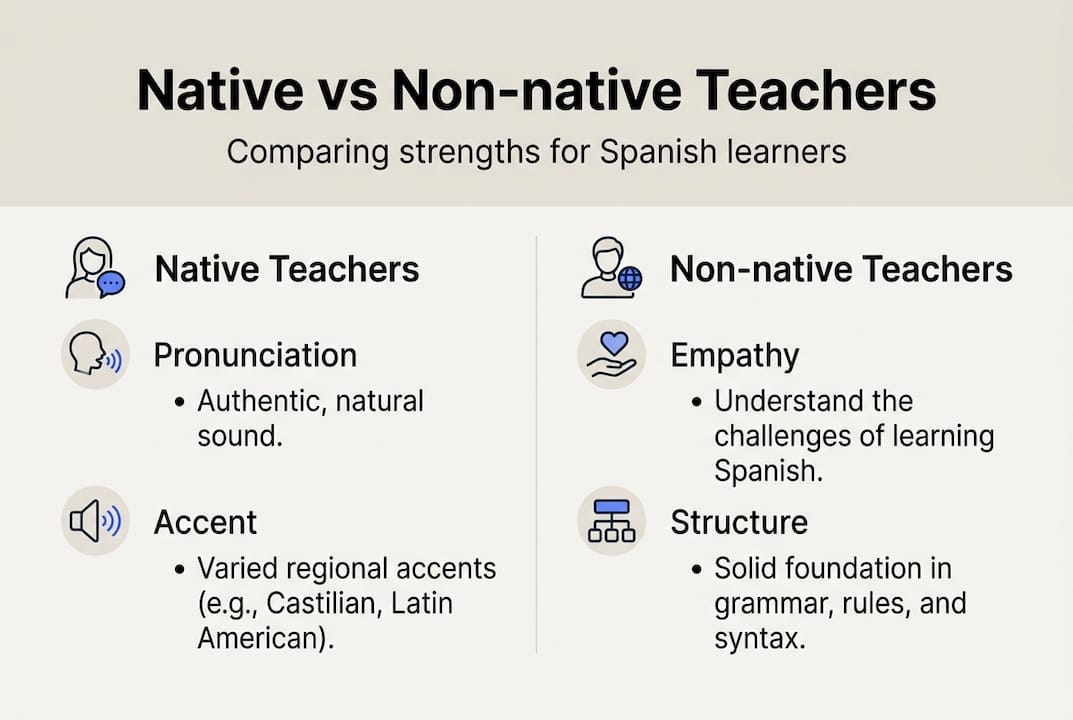
To make an informed choice, it helps to compare native and non-native teacher strengths side by side with Singapore learning outcomes in mind.
| Skill area | Native teacher strength | Non-native teacher strength |
|---|---|---|
| Pronunciation and accent | High: natural modeling | Moderate: aware of learner errors |
| Grammar explanation | Moderate: intuitive, less explicit | High: trained in rules and structure |
| Idiomatic language | High: authentic usage | Moderate: learned through study |
| Cultural context | High: lived experience | Variable: depends on exposure |
| Empathy for learner struggles | Moderate | High: personal learning experience |
| Structured lesson design | Variable | Generally strong |
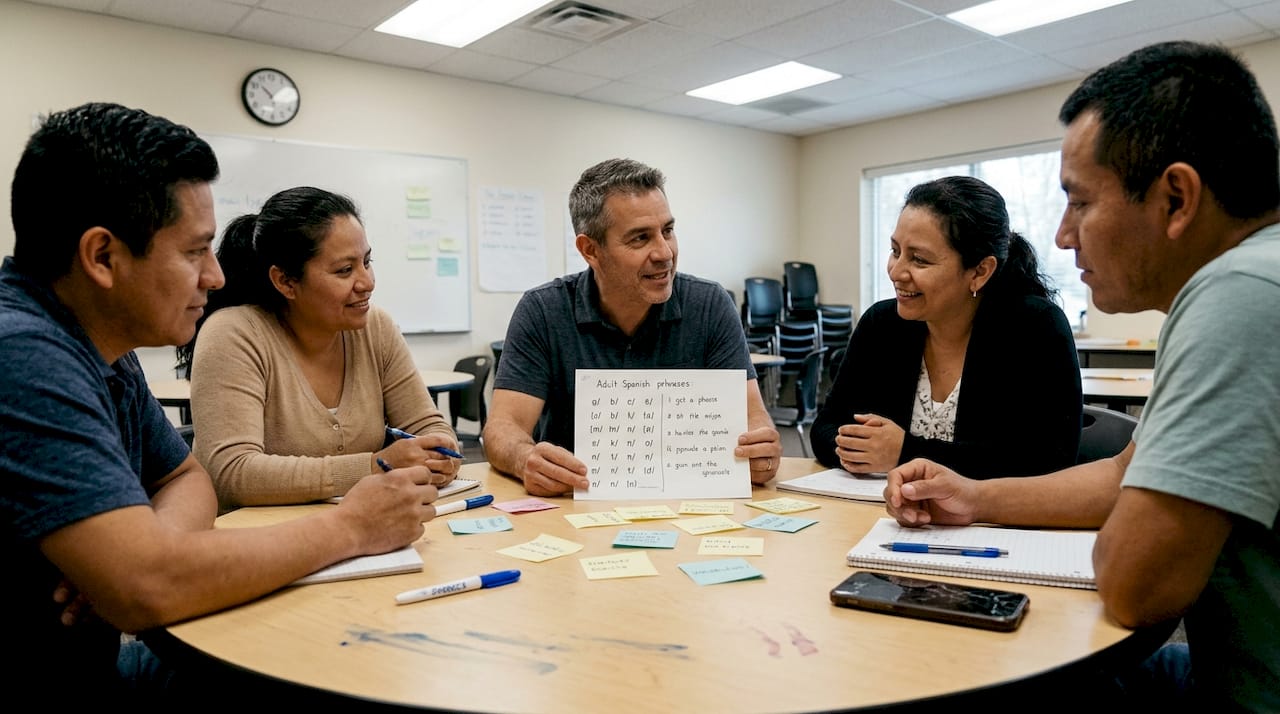
Research on Singaporean Spanish learners found that speaking skill scores improved significantly with high-quality input and modern teaching methods, not just teacher nativeness. In one local study, DELE oral scores moved from 2.4 to 3.6 with focused methodology, showing that pedagogy matters just as much as who is in front of the class.
What this means in practice:
- Beginners benefit most from native input early on, when accent patterns are still forming and authentic listening exposure has the highest impact.
- Intermediate and advanced learners often need sharper grammar instruction and structured feedback, areas where trained non-native teachers frequently excel.
- Exam-focused students need teachers who understand DELE requirements and can design lessons around specific test skills.
Other criteria worth prioritizing: teaching credentials, direct experience with Singaporean learners, flexibility in lesson format, and the ability to adapt to your specific goals. Whether you prefer online Spanish classes or face-to-face sessions, the format matters less than the quality of instruction inside it. And if you want to plan ahead, check out what a realistic timeline to fluency actually looks like so you can set expectations before you begin.
Maximizing results: Practical strategies for parents and professionals
Armed with an understanding of teacher strengths, here is how Singapore learners, especially parents and professionals, can get the best of both worlds.
The research is clear: native input matters most for pronunciation, and active speaking strategies improve outcomes regardless of teacher background. That means your learning environment should combine both authentic exposure and structured practice.
| Learner profile | Recommended approach | Key focus |
|---|---|---|
| Young children (ages 4 to 10) | Native teacher plus playful speaking games | Accent, listening, confidence |
| Teenagers | Group class with native input plus grammar support | Fluency, exam prep |
| Working professionals | Private or corporate class with business focus | Communication, cultural context |
| Adult beginners | Group class blending native and trained instructors | Foundation, pronunciation |
Here is a practical action plan you can follow:
- Start with native exposure. Even one lesson per week with a native teacher builds strong pronunciation habits from day one.
- Supplement with structured grammar work. Use a trained teacher or online resources to fill in the rule-based knowledge gaps.
- Practice speaking outside class. Look for speaking practice ideas in Singapore to keep your conversational skills active between lessons.
- Use a flipped learning approach. Watch native content or listen to podcasts before class, then use lesson time for active discussion and correction.
- Explore funding options. If you are a working adult, a SkillsFuture Spanish course can help offset tuition costs while you access quality instruction.
Pro Tip: For young children, even 20 minutes of native Spanish audio or video daily, like cartoons in Spanish, builds listening comprehension faster than many parents expect. Combine this with a native teacher and results come quickly.
Professionals targeting markets in Spain or Latin America should specifically request teachers with regional expertise. The vocabulary and social norms in Mexico differ from Argentina, which differ again from Spain. Knowing which variety fits your work context is a real career advantage.
Our take: Native teachers are not a silver bullet—here’s what actually works
After years of working with Singapore learners across age groups and goals, we have seen one pattern repeat: students who fixate on finding a native teacher sometimes wait months for the “perfect” match and lose valuable learning time in the process.
Native teachers provide something genuinely useful, authentic language exposure and real pronunciation modeling. We are not dismissing that. But the biggest predictor of success we consistently observe is not teacher nativeness. It is methodology combined with consistent practice.
The learners who make the fastest progress are the ones who show up regularly, speak without fear of mistakes, and work with teachers who give structured, actionable feedback. Whether that teacher grew up in Madrid or Manila matters less than whether they can push you past your comfort zone with a well-designed lesson.
What we recommend: choose a school that blends native input with certified, trained instruction. Look for small group environments where speaking time is built in, not optional. The benefits of a group Spanish class include peer interaction and varied input, which compensate for any single teacher’s limitations. Native or not, the quality of instruction and the volume of your speaking practice are what move the needle.
Discover qualified native Spanish teachers in Singapore
Ready to experience the benefits of native instruction alongside pedagogical expertise? Spanish Explorer brings together native and highly qualified Spanish teachers for learners of all ages and goals across Singapore.
Whether you are a parent looking for the right accent model for your child, a professional building communication skills for a regional role, or an adult beginner starting from zero, we have options built around your schedule and ambitions. Meet our Spanish teachers to see the backgrounds and specializations on offer. Browse our Spanish courses in Singapore to find the right format, or jump straight into flexible online Spanish classes if in-person does not fit your schedule. Book a trial and start building real Spanish communication skills today.
Frequently asked questions
Do I need a native Spanish teacher to become fluent?
No, fluency depends on quality teaching and practice, though native input genuinely helps with accent and authentic communication habits.
Are native Spanish teachers always better than non-natives?
Not always. Non-native teachers trained in pedagogy often excel at grammar and can empathize with the struggles learners face at each stage.
What’s the main advantage of learning from a native Spanish teacher?
Native teachers model accurate pronunciation and introduce cultural nuances that are essential for real-world conversation and authentic communication.
How can I supplement learning if I don’t have a native teacher?
Use active speaking strategies such as speaking clubs, native-content podcasts, or practice apps to build exposure to authentic Spanish outside the classroom.
Recommended
- Spanish Teachers – Spanish Language School
- Spanish Class in Singapore | Spanish Language Centre
- Spanish Class Online: Learn Spanish Language in Singapore
- Is Spanish Hard To Learn: A Comprehensive Guide | Spanish Explorer
- Leer Spaans Online: Complete Gids voor 2026 – Bogaers Taleninstituut Tilburg
Start Learning Spanish Today
Book a trial class and see how quickly you can progress with a professionally trained native-speaker teacher guiding the way.
Book a Trial Class