 Spanish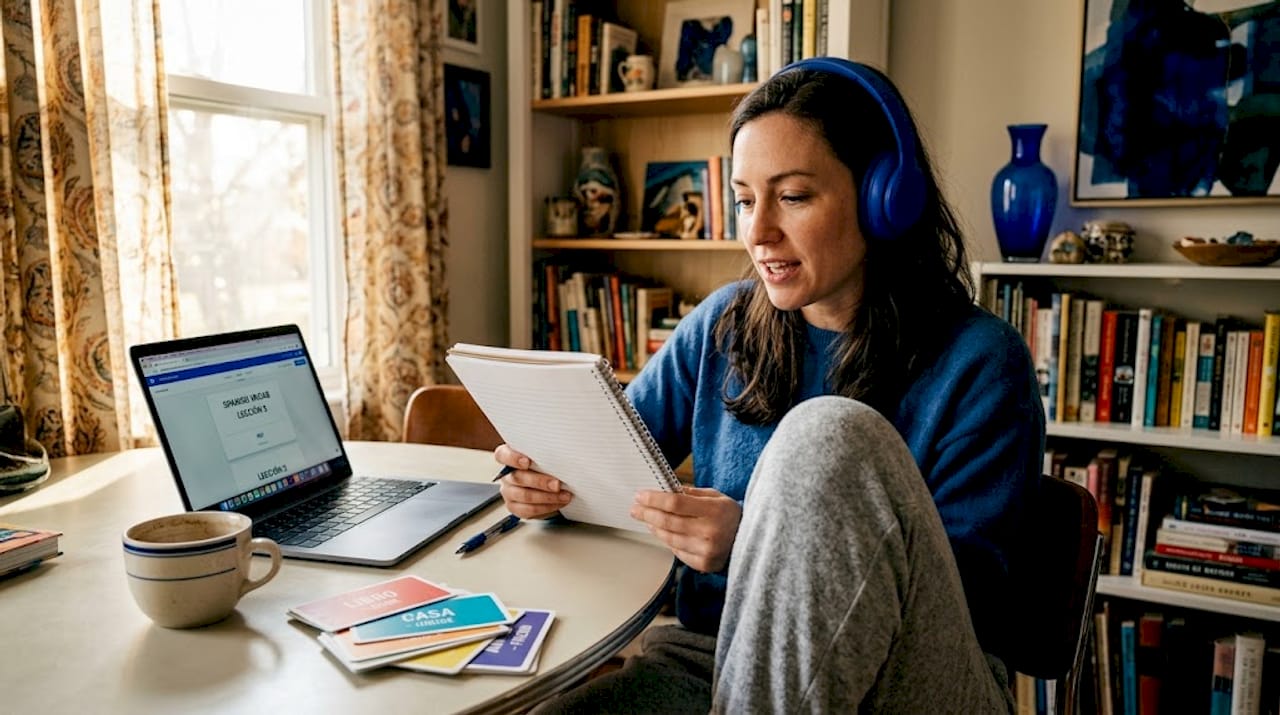
TL;DR:
- Consistent, focused daily practice accentuates progress in Spanish, combining warm-up, core exercises, and review. Using a few targeted tools and habit stacking builds sustainable routines aligned with realistic goals. Engaging actively in conversation and applying spaced repetition optimizes fluency development and long-term retention.
You already know that studying Spanish once a week won’t get you far. What most learners don’t realize is that the structure of their daily practice matters just as much as the time they put in. A scattered daily spanish practice routine built around flashcard apps and half-hearted grammar drills creates the illusion of progress while your speaking ability stalls. This guide cuts through that frustration with a research-backed framework covering everything from warm-up sequences and spaced repetition workflows to how you adapt the routine when life gets busy.
Table of Contents
- Key takeaways
- Building your daily Spanish practice routine
- A 30-minute daily session that actually works
- Making spaced repetition work for vocabulary
- Adapting the routine for your schedule and level
- My honest take on why most people plateau
- Take your practice further with Spanish Explorer
- FAQ
Key takeaways
| Point | Details |
|---|---|
| 30 minutes is enough | A focused daily session split into warm-up, core practice, and review can drive real fluency gains in about three months. |
| Spaced repetition beats cramming | SRS outperforms massed study by 10 to 30%, but only when you keep new card volume controlled and reviews consistent. |
| Output accelerates progress | Practicing conversation with real feedback moves you faster than memorizing vocabulary lists alone. |
| Habit stacking beats motivation | Attaching Spanish practice to an existing daily habit builds longer-lasting consistency than relying on willpower. |
| Flexibility preserves streaks | A 10 to 15 minute fallback session on busy days keeps momentum alive without resetting your progress. |
Building your daily Spanish practice routine
Before you open a single app or textbook, you need the right setup. Skipping this step is one of the most common reasons learners hit a wall after a few weeks.
Choose tools that match your goals
The market is flooded with Spanish learning apps, but most of them only cover one skill. A well-rounded effective Spanish routine pulls from a small set of focused tools. Here is a quick reference to build your toolkit:
| Tool type | Example | Best for |
|---|---|---|
| Spaced repetition (SRS) | Anki | Vocabulary retention |
| Conversation practice | HelloTalk, iTalki | Speaking and listening |
| Grammar reference | A short dedicated grammar guide | Fixing structural gaps |
| Passive listening | Spanish podcasts, YouTube | Ear training and exposure |
Keep it simple. Three to four tools used consistently beat ten apps used occasionally.
Set goals that are actually realistic
Vague goals like “get better at Spanish” produce vague results. Before your routine starts, set Spanish learning goals tied to a specific outcome: holding a five-minute conversation, understanding a podcast at normal speed, or conducting a basic work call. Align your goal to your current level so the daily workload feels challenging without being crushing.
Use habit stacking to lock in the routine
Daily language study maintained through habit stacking outperforms infrequent long sessions for both retention and fluency. The method is simple: attach your Spanish session to something you already do automatically. Morning coffee becomes your Anki review time. A commute becomes a podcast session. The habit you attach to does the heavy lifting of getting you started, so motivation stays out of the equation.
Pro Tip: Set a specific trigger: “After I pour my morning coffee, I open Anki.” Vague intentions like “I’ll practice in the morning” rarely survive contact with a real day.
A 30-minute daily session that actually works
The most effective 30-minute routine breaks into three distinct phases: warm-up, core practice, and consolidation. Each phase has a clear purpose, and skipping any one of them weakens the whole session.
Phase 1: Warm-up (5 minutes)
Start by speaking out loud, not reading. Read a short paragraph from yesterday’s conversation notes, repeat five to ten vocabulary words from your last session, or narrate what you did that morning in Spanish. The goal is to switch your brain into Spanish mode. This removes the mental friction that causes people to stall in the first few minutes of practice.
Phase 2: Core practice (15 minutes)
This is where real progress happens. Real interaction and feedback accelerate fluency significantly more than rote memorization. Use this time for one of the following, depending on your level:
- Live conversation with a language partner or tutor who gives corrections in real time.
- Structured speaking exercises where you describe images, respond to prompts, or retell a story in Spanish.
- Active listening with a Spanish podcast followed by immediately summarizing what you heard in spoken Spanish.
The key word is active. Active listening builds speaking skills faster than background listening. You must be engaged, not just exposed.
Pro Tip: If finding a daily conversation partner feels difficult, try a journaling swap on HelloTalk: write three sentences about your day in Spanish and request written corrections. It only takes five minutes and delivers real feedback.
Phase 3: Consolidation (10 minutes)
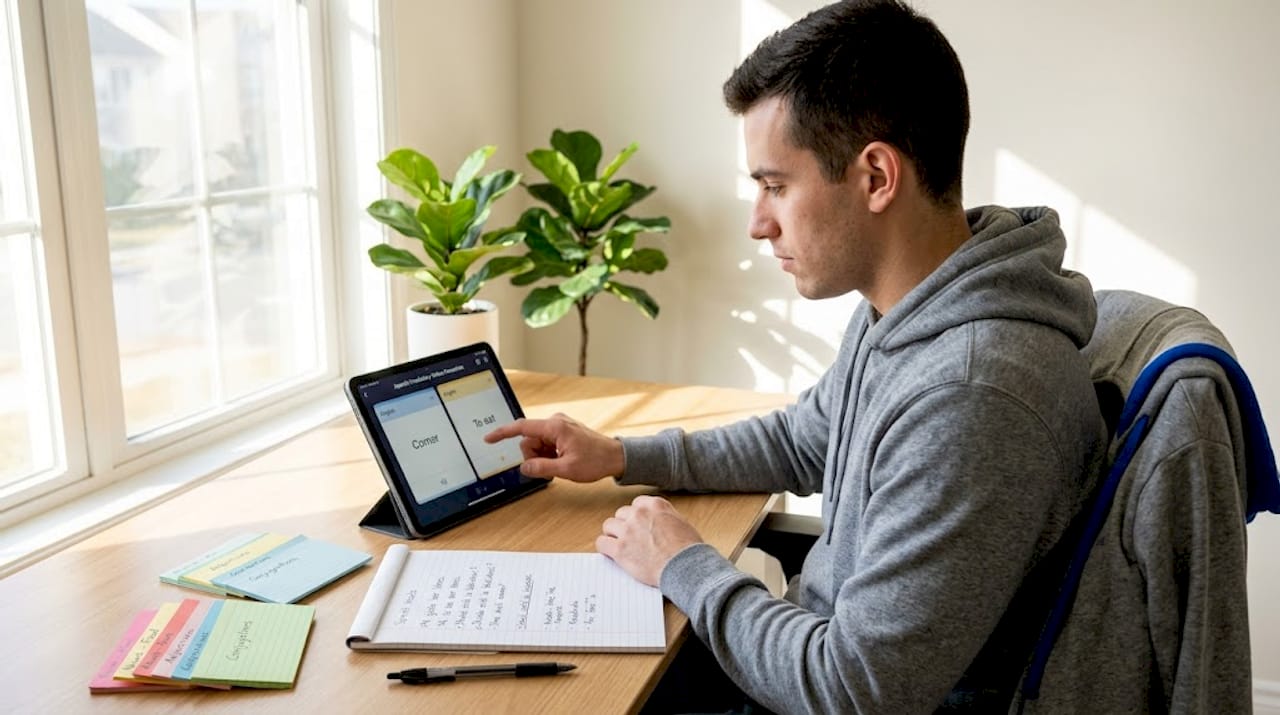
Use this block for review. Go through your Anki cards due for the day, but prioritize reviewing words in context rather than in isolation. Reviewing vocabulary in context improves long-term retention significantly compared to reviewing single words against translations. Close by writing two to three sentences using new words you encountered during the core session.
Here is how the routine adapts across skill levels:
| Level | Warm-up focus | Core activity | Consolidation |
|---|---|---|---|
| Beginner | Pronunciation drills | Structured speaking prompts | Anki + sentence writing |
| Intermediate | Free speaking for 5 minutes | Conversation partner or tutor | Review + journaling |
| Advanced | Debate or opinion sharing | Native content discussion | Grammar gap analysis |
Making spaced repetition work for vocabulary
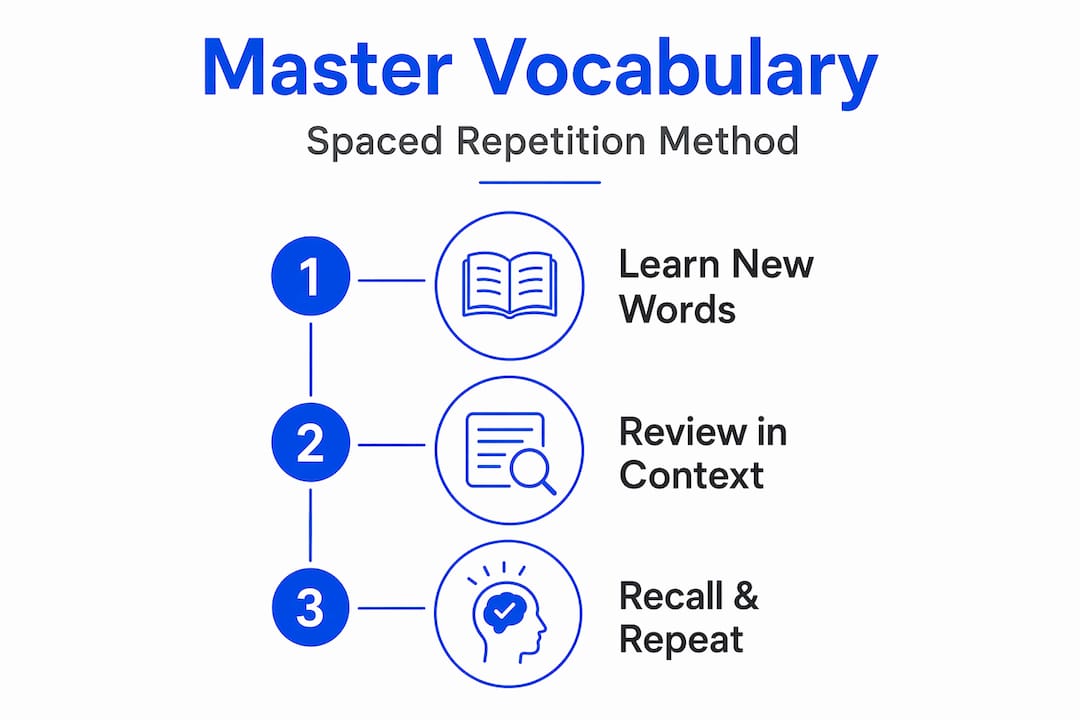
Spaced repetition is not magic. Used wrong, it becomes one of the most demoralizing parts of daily language study. A meta-analysis of 317 experiments found that spaced practice outperforms massed study by 10 to 30% across different ages and study types. But that advantage disappears fast when learners misuse the system.
The daily SRS workflow that prevents burnout
Follow this sequence every time you open Anki or any SRS tool:
- Complete all due reviews before adding or studying new cards.
- Cap new cards at 10 to 20 per day to prevent review backlogs from spiraling out of control.
- Trust the scheduler. Do not manually skip cards or override intervals because a word feels easy.
- Create cards using full sentences, not single words. A card that shows “Estoy harto” in a sentence teaches faster than the word “harto” alone.
- Review daily. Missing multiple consecutive days makes restarting harder and the review pile grows into something genuinely discouraging.
Common SRS mistakes to avoid
- Adding hundreds of cards from pre-made decks without filtering for relevance to your actual goals.
- Studying new cards when you have overdue reviews waiting.
- Treating a low daily card count as a sign you are not working hard enough. Ten focused cards learned well beats fifty cards reviewed carelessly.
- Never connecting SRS vocabulary to real conversation. Words you never use disappear from memory regardless of your review scores.
Pro Tip: When you hear or read a new word in a real conversation or podcast, create a card from that exact sentence. The personal context makes recall dramatically faster than generic example sentences.
Adapting the routine for your schedule and level
The 30-minute session is your target. But real life does not always cooperate. A minimum viable session of 10 to 15 minutes with a fallback micro-session mode keeps learners consistent over the long term. Having a shorter backup routine is not a compromise. It is a design feature.
Minimum viable practice on busy days
On days when 30 minutes is impossible, protect these three things:
- Your Anki reviews (even 5 minutes clears most backlogs).
- One spoken sentence in Spanish, said out loud to yourself.
- One piece of passive Spanish input, even if it is just a three-minute podcast clip during your commute.
That is it. Ten minutes of intentional practice preserves your habit and your memory far better than skipping entirely.
Micro-moments for passive and active practice
Your day already contains pockets of time that most learners ignore. Grocery shopping, washing dishes, walking between meetings: all of these become Spanish speaking exercises when you narrate your actions silently or listen to Spanish audio. Passive exposure is not a replacement for active output, but it keeps your ear sharp between full sessions.
Here is how to customize based on your current level:
- Beginner: Focus almost entirely on input (listening and reading) and short structured speaking prompts. Limit free conversation until you have a base of 500 to 700 words.
- Intermediate: Shift the balance toward speaking. Make conversation practice the centerpiece of every session, and use SRS to target the vocabulary gaps your conversations reveal.
- Advanced: Prioritize Spanish communication skills that are relevant to your goals, whether that is professional fluency, idiomatic expression, or accent refinement. Use native content, not learner-designed material.
Building in a streak system with a simple paper calendar or a habit-tracking app adds a small but real psychological reward. The goal is not a perfect streak. The goal is never missing two days in a row.
My honest take on why most people plateau
I’ve watched learners spend months adding vocabulary cards and dutifully completing grammar exercises, then feel genuinely confused when they still can’t hold a conversation. The frustration is real, but the cause is almost always the same: they are practicing being a student of Spanish rather than practicing being a speaker of Spanish.
What I’ve found, consistently, is that slow progress in most learners comes from a near-total absence of output. They read Spanish. They listen to Spanish. They never produce Spanish under any real pressure. The moment you force yourself to speak, even badly, your brain starts solving the right problems.
The psychological shift matters too. Small daily wins, like successfully explaining something you couldn’t say last week, do more for long-term motivation than any app gamification feature. Perfectionism is the enemy here. Getting corrected is not failure. It is the fastest feedback loop available to you.
My advice: cut one passive activity from your current routine and replace it with ten minutes of real speaking practice. You will feel the difference within two weeks.
— Paul
Take your practice further with Spanish Explorer

A strong daily routine gets you far, but structured guidance accelerates the results. Spanish Explorer offers adult group classes, private sessions, and corporate training designed around real conversational and professional Spanish use. Lessons are delivered by experienced, certified instructors who are fluent in both Spanish and English, so you get genuine feedback in every session, not just exposure.
Whether you prefer online Spanish classes via Zoom or in-person sessions at International Plaza, above Tanjong Pagar MRT, the curriculum is built to complement exactly the kind of daily practice habits this article describes. If you want a private class tailored to your pace and goals, Spanish Explorer can match you with an instructor who focuses on your specific gaps. Browse the full range of adult Spanish courses and reach out to book a trial session.
FAQ
How long should a daily Spanish practice session be?
A 30-minute daily session split into warm-up, core practice, and review is enough to build real fluency in about three months. On tight days, a 10 to 15 minute fallback session preserves your progress.
What is the best way to practice Spanish speaking daily?
Conversation with a real person who gives corrections is the most effective method. Even short exchanges on language exchange apps count as productive Spanish speaking exercises when you engage actively rather than passively.
How do I practice Spanish without burning out?
Cap your new Anki cards at 10 to 20 per day, always complete due reviews before studying new material, and build a minimum viable routine so a busy day never means a skipped day.
Does spaced repetition really work for Spanish vocabulary?
Yes. A 317-experiment meta-analysis confirmed that spaced repetition outperforms traditional massed study by 10 to 30%. The key is reviewing words in sentence context, not in isolation.
How do I identify and fix my Spanish grammar weaknesses?
Pay attention to the corrections you receive during conversation practice, and use a focused resource to identify grammar gaps systematically. Targeted grammar work between speaking sessions closes holes faster than general study.
Recommended
Back to all articlesStart Learning Spanish Today
Book a trial class and see how quickly you can progress with a professionally trained native-speaker teacher guiding the way.
Book a Trial Class